
How to Deploy AI in Procurement at Enterprise Scale


AI in procurement is the use of generative and agentic AI to run high-volume procurement workflows like contract review, vendor onboarding, sanctions screening, sourcing, and invoice processing, with humans supervising the exceptions and overseeing the agents instead of doing the case-by-case work.
Many companies have already deployed successful implementations across procurement workflows. What commonly separates the programs that produce results are the class of AI being used and the workflow the team chooses to automate first.
For many teams, these are not obvious choices. Getting them right means first looking at peers and competitors to understand:
- What’s possible to automate with AI today
- What AI in procurement looks like at Fortune 500 scale
- How to tell a truly autonomous agent from a demo that looks good on paper but struggles with real-world complexity
- How to choose a partner that survives a security review and produces a result the CFO can see within a quarter.
Use these examples as inspiration for starting the process of developing your own AI strategy.
The state of AI in procurement
Ardent Partners' AI Rising 2026 survey of 311 CPOs and senior procurement leaders puts adoption at 58% either actively using or piloting AI, with 32% exploring, 35% piloting, and 22% deploying across multiple areas.
The ROI from those investments is less consistent, though. Deloitte's annual Global CPO Survey of more than 250 CPOs across 40 countries splits respondents by digital maturity, and the gap between the groups is wide. The organizations Deloitte calls Digital Masters, the most digitally mature procurement teams in the survey, earn an average 3.2x return on their generative AI investment. The Followers, the majority still earlier in that work, sit just above 1x.
The surveys also point to where the difference comes from, and it’s usually not technical capability. Deloitte's top four barriers to procurement value delivery are all organizational:
- Siloed working (57%)
- Competing priorities diluting focus (46%)
- Capability to execute (40%)
- Talent gap (34%)
Fareen Mehrzai, senior director analyst in Gartner's supply chain practice, explains:
"Procurement teams are seeing productivity gains from GenAI, but without intentional redesign of roles and processes, those gains remain confined to the individual level."
In other words, at many organizations, individual people are getting faster or more efficient but the function as a whole is not, until someone redesigns the work around the technology.
Why procurement work is ripe for AI automation
Most procurement work includes reviewing documents in mixed formats and languages to process cases that touch things like a contract-management tool, an ERP, or a supplier database. Those workflows have tons of exceptions and likely run on institutional knowledge held by your team..
Work like that (high volume, messy inputs, and lots of human judgment calls) is where enterprise AI has produced its measured production results over the last eighteen months. Few functions have more of this work than the procurement department.
MIT Project NANDA's The GenAI Divide report documents that the biggest ROI in enterprise AI comes from back-office automation, where procurement's operating costs sit.
6 AI in procurement use cases
These six workflows are examples of what can be accomplished with AI in the first year. They are not the only procurement workflows AI can run, but they are among the most common ones running in production today.
1. Contract review first-pass
Contract review AI adoption has doubled year over year and nearly quadrupled since 2024, per LegalOn Technologies' 2026 legal AI report, a survey of 452 in-house legal professionals. Fifty-two percent of in-house legal teams are using or evaluating AI for contract review and just 5% report no interest.
Procurement's contract intake often follows the same pattern. At most companies, a supplier redlines an NDA or an MSA, someone reads it against a playbook of standard terms, flags the deviations, and routes anything unusual to legal.
An autonomous AI agent can do that first-pass read and escalate only the deviations that fall outside the playbook. This can free up time across the board, expedite the process when routine redlines aren’t stuck waiting in a queue, and let the legal team focus their attention on exception cases and negotiations that actually need a lawyer's judgment.
2.Vendor onboarding and due diligence
New supplier onboarding generally involves a flurry of paperwork and processing like a W-9 or its non-U.S. equivalent, insurance certificates, security questionnaires, banking details, and sometimes a sanctions certification. Each document might arrive in a different format. Some might be photographed on a phone, for example, and a fraction of them will carry small internal inconsistencies.
An autonomous AI agent can handle that whole stack. It reads each document regardless of format, extracts the details, cross-checks them against each other and against the vendor record, and escalates only the real inconsistencies for a person to resolve.
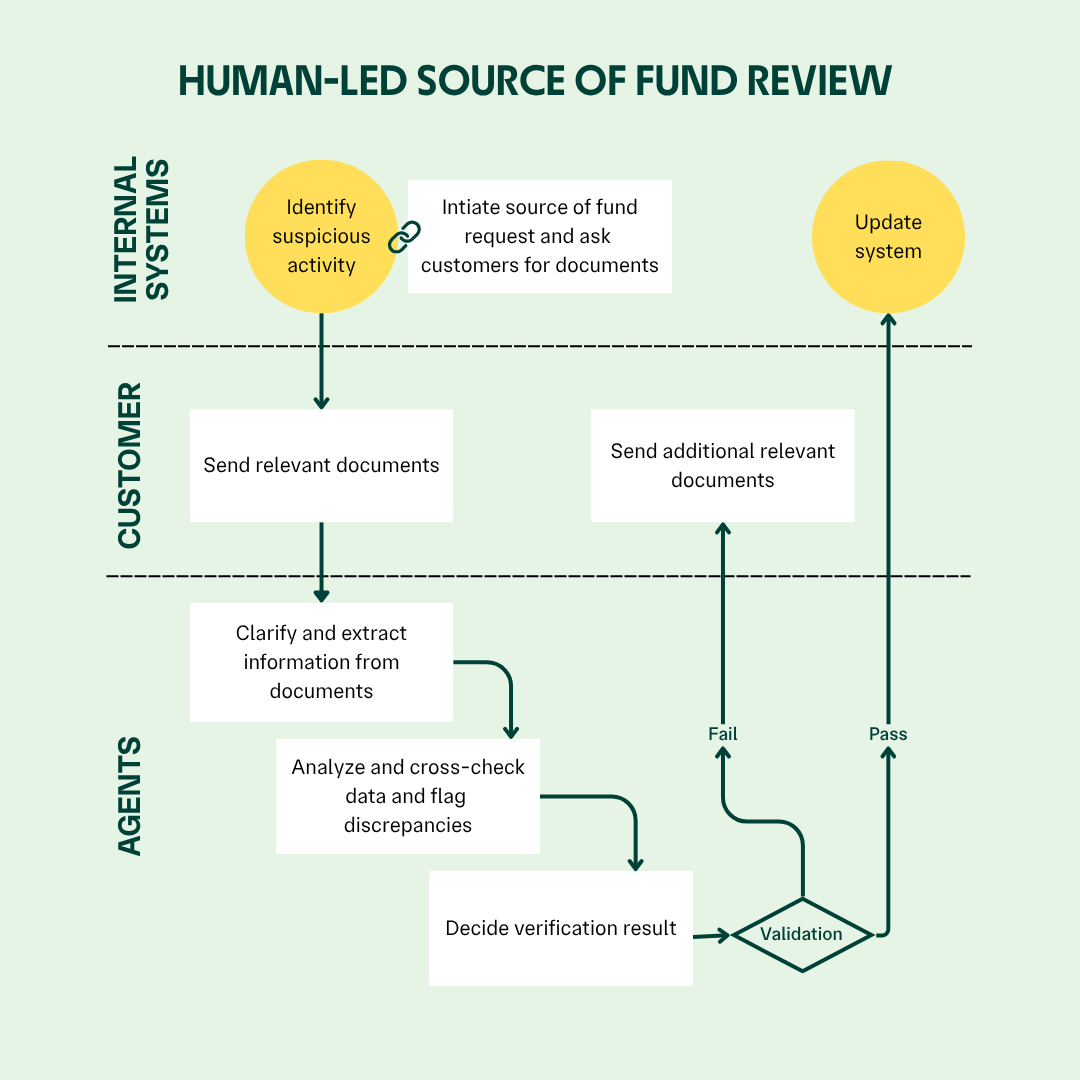
In one such case, a global trading platform runs this kind of document verification on Reindeer, checking the paperwork customers submit to prove where their money comes from. The agent extracts the details at 95% accuracy, better than the human reviewers it works alongside, and runs verification 10x faster. It reached production in two weeks, trained on fewer than 50 sample documents. Similar workflows can handle vendor onboarding or any number of other processes that take up your team’s time today.
3. Sanctions and third-party risk screening
At most large companies, every new vendor gets checked against the U.S. Treasury's OFAC list, the EU consolidated list, and the UK sanctions list, while the existing supply base gets reviewed on a rolling schedule. Screening tools have existed for years, but the one common problem is the number of false positives. Rules-based screening flags far more names than are true matches, and someone on the compliance team often has to clear each one by hand.
An autonomous agent can clear most of those false positives by comparing the rest of the vendor record against the flagged list entry. It should still escalate what it can’t resolve for human review, but AI-enabled automations are generally able to handle a broader set of cases than rules-based automation alone. Instead of a raw alert, the compliance officer gets the case, the reason it was flagged, and a specific question to answer.
4. Spend analytics
Systems like Coupa and SAP Ariba already produce spend cubes, but most procurement teams still spend their time on last-mile classification and the questions the cube can’t always answer.
Coupling generative AI with those tools might speed up the process by answering those questions in plain language ("show me tail spend by division where we have a preferred vendor but a category manager keeps buying outside contract"), but autonomous AI agents can be set up to run analytics reviews like this on a regular basis, identify anomalies, and even draft follow-up emails to raise any issues with a division's finance business partner.
Instead of humans doing manual analysis, AI would produce the weekly spend reports, and the analyst becomes the person answering questions and providing strategic guidance for leadership.
5. Sourcing and RFP handling
When the Icertis and WCC study on AI in contracting asked professionals to rank their AI priorities, risk mitigation came out on top at 76%, followed by contract benchmarking at 74% and supplier evaluation and selection at 73%.
Organizational enthusiasm around AI in contracting moved from 36% in 2025 to 56% in 2026.
On the sourcing side, AI workflows can now power a wide range of specific processes. For example, generative AI can draft the first RFP from the requirements, and AI agents can pull supplier responses into one comparable format. The category manager still makes the award decision, but the tedious and time-consuming work to compile and standardize information is often being handled by agentic systems.
6. Invoice and payables workflows
Three-way matching, exception coding, and payment approval are usually some of the highest-volume lanes in back-office procurement, and the ones most likely to already have some automation in place.
That existing automation is usually rules-based. It clears the clean cases and returns everything else to a person's queue, which is why accounts payable (AP) teams still spend their days working through exceptions and handling a lot of the routine filing work. An autonomous AI agent is often capable of handling a much broader slice of the paperwork, including more of the exceptions, escalating only the ones that genuinely need a person's judgment.
For example, Reindeer’s platform runs this exact class of work for Papaya Global, whose invoice-coding coverage moved from 80% to 97% and whose manual payslip review dropped from 50% to under 10% after deploying an autonomous agent on 10,000+ payslips per month. Originally, Papaya trained the initial agent on one short document and the invoice-coding agent reached about 80% of volume from fewer than 50 sample invoices.
Choosing the right class of AI for automating procurement workflows
This is where vendor conversations get hard. Almost every vendor calls its product an "agent," but only some of what is on the market can automate complete workflows at the level required for enterprise-scale deployments.
You should think about the AI market as three tiers of products, each capable of handling different types of work across the department:
- AI assistants: Think ChatGPT or Gemini. People use them for help with day-to-day tasks. A category manager might use one to draft supplier communications, contract clauses, or first-pass RFP responses, but they’re generally co-pilots working alongside humans, not systems completing work autonomously.
- AI agents: Specialized AI tools that are generally designed to handle a set of defined steps in a larger workflow while being overseen and managed by a human. Left unsupervised, they can also hallucinate and get a case wrong without flagging it, or drift as the work changes.
- Autonomous AI agents: AI platforms often capable of automating entire workflows and processes, handling most cases on their own and escalating only what they cannot resolve. An escalated case goes to a subject-matter expert with the specific question that needs answering, and there are feedback loops built in to improve the agent’s capabilities over time.
Menlo Ventures' State of Generative AI report finds only 16% of enterprise AI deployments qualify as true agents, meaning systems where the model plans, executes, observes the outcome, and adapts its behavior. The remaining 84% are assistants and workflow automations dressed in agentic vocabulary.
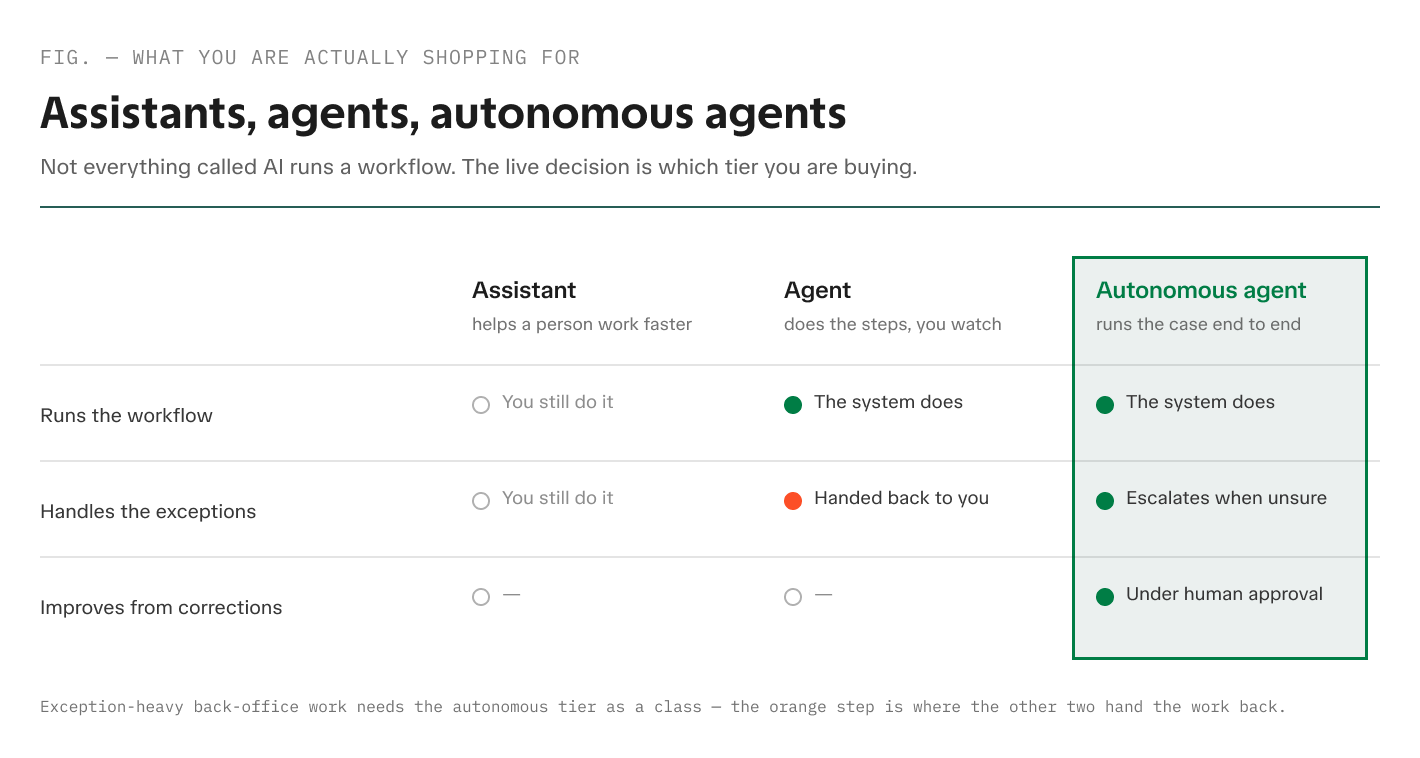
A CPO comparing three demos is often comparing an assistant to an agent to an autonomous agent without knowing it, because demos show what we call “the happy path,” or the easiest cases to automate that can often be handled by even basic AI tools. In reality, though, you’ll likely need a system that can handle the messy cases and the exceptions just as well. Generally speaking, only autonomous agents are capable of handling these types of complex scenarios.
That is why exception-heavy back-office procurement work generally requires autonomous AI agents to automate it effectively.
Here’s one example of a messy case: say an invoice arrives with a PO number that only partially matches, a VAT number in a country format the ERP has not seen, and a vendor name that differs from the PO by a corporate suffix.
- An AI assistant might be used to draft the exception-note email, but the AP analyst would still open the invoice, weigh the vendor-name variant, check the VAT rule, and decide whether to post.
- A basic AI agent might try the match, note the exception regarding vendor name and the VAT anomaly, and return the invoice to the analyst's queue if there are specific guardrails in place to do so. Otherwise, it will likely hallucinate to complete the task. It’s helpful in automating some cases, but the limitations of the technology mean many exceptions and edge cases like vendor-name conventions, VAT variants across regions, partial deliveries, and tax-code discrepancies will often turn right back into work that needs to be done by a human.
- An autonomous AI agent would be capable of matching the routine invoices, posting them into the ERP, and escalating only specific cases for human review, like when a vendor-name question crosses its confidence threshold. The AP specialist might get a specific question, like "Treat this vendor variant as the same vendor?", along with the candidate suppliers and past decisions on similar cases. The specialist answers, and the answer is fed back into the system and can become part of how the agent handles the next case like it.
In procurement work, the volume is almost always high, the processes are often full of exceptions, specific rules frequently live in the heads of a few senior people, and human judgment is practically always the scarce resource that limits the ability to automate work using legacy tools. Autonomous AI agents are now unlocking new opportunities for procurement teams to automate even their most complex workflows and redeploy their team for more strategic work.
Procurement AI security and compliance requirements
At most enterprises, the security and compliance review starts weeks before the first workflow ships, and for procurement the stakes are concrete: supplier records might hold banking details a fraud team worries about, contracts often carry confidentiality obligations, and sanctions-screening decisions have to hold up in a regulatory audit. There are generally four key areas a review will focus on, and it’s important to explore and understand these considerations early in any conversation about a specific vendor, platform, or AI tool.
Technical infrastructure
The physical systems where your platforms run are an important consideration for any AI deployment because they often determine:
- Who can access specific data
- Whether the platform aligns with existing regulatory or legal obligations
- What vulnerabilities may exist within the infrastructure
For example, vendor onboarding files often carry bank accounts and tax IDs, the records payment-fraud schemes target, and cross-border suppliers can bring data-residency rules that bar a vendor's records from leaving the region. The easiest program to defend is generally one that runs on the enterprise's own cloud, in the region compliance requires, without vendor infrastructure sitting between the enterprise and its data.
In our case, Reindeer’s security posture is designed specifically to meet enterprise security and compliance requirements. That includes single-tenant infrastructure, meaning each customer runs on its own dedicated setup rather than a shared one, on AWS, Google, or Azure in the customer's region of choice. Data stays in the customer's environment, and there are zero-data-retention agreements with every large language model (LLM) vendor used. Certifications include SOC 2 Type 2 (audited by EY), ISO 27001, GDPR, and CCPA.
Access runs through the customer's own single sign-on with role-based controls and segregated workspaces, every access is logged and tied to a verified identity.
Model independence
Foundation models, the general-purpose AI these systems are built on, are one of the fastest-moving pieces of the enterprise stack. Today's best model for a document-heavy procurement workflow probably won’t be the best in eighteen months. That matters because procurement workflows generally run for years, and a program built against a single model with no path to swap it is betting a core piece of your operation on one vendor's roadmap.
Model independence (the ability to run whichever model fits each task without rebuilding the workflow around it) helps teams keep workflows and processes running reliably as AI continues to change and evolve.
Governance of logic changes
Procurement processes naturally evolve. Your agent's logic has to change with the work, and one big question is whether those changes are governed by human review or applied silently inside the system.
The Stanford Digital Economy Lab's Enterprise AI Playbook finds that 77% of the hardest challenges in enterprise AI adoption are "invisible costs" like change management, data quality, and process redesign. The same study finds escalation-based operating models, where the agent handles most cases and people see only the exceptions, delivered a 71% median productivity gain against 30% for approval-based models, where a person signs off on every output.
This is another consideration we’ve spent time addressing. Reindeer treats each logic change as a reviewable event: the change is regression-tested against past cases, and the agent manager approves it before it goes live, using a two-loop learning system in which a subject-matter expert corrects the agent on a live case and the agent manager decides whether that correction becomes a standing rule.
Speed to production
How fast a vendor can reach production often tells you how much of this work they have done before. A vendor that has shipped this class of work before can often put a first workflow into production in weeks, because the connectors, the security answers, and the training approach already exist. A vendor that has to figure out those pieces for the first time on your program will often take quarters, and long timelines are a common way programs lose budget before they show a result.
Another variable here is how much pre-work is needed based on how the system works. Since Reindeer uses the two learning loops to progressively expand the scope and capabilities of each AI workflow, there is almost never the need for a large-scale upfront data project before an agent can be deployed.
For example, in our engagement with Hellmann Worldwide Logistics, the agent trained on roughly 20 sample requests and reached production within weeks. Before the agent, Hellmann's pricing team collected shipment details by hand and went back and forth with customers over missing information, and a quote could lose the business to a faster competitor while it was still being built. Quotes now go out complete and fast enough to win more business.
Picking the right workflow: automating volume and complexity
In our experience, many procurement AI programs stall because they begin by focusing on the wrong workflows. Either they start too simply by applying AI to automate work that a simple script could handle, which makes it hard to justify the additional costs and further investment. Or they focus on trying to automate low-volume, complex workflows that may not ultimately be worth the effort.
Programs that produce the best results usually start with workflows where there’s both a high volume of cases and enough complexity inside each case that humans are making judgment calls on each one.
Sit down with all of the workflows and processes across your procurement department. Look for:
- High transaction volume
- Distributed knowledge across large teams
- Exception-heavy cases
- Data that moves across systems
- Existing logic or policy the work depends on
- Speed and accuracy that affects the customer
These are processes where human judgment is the constraint, supplied in small amounts by many different people, and they’re prime candidates for automation with autonomous AI agents.
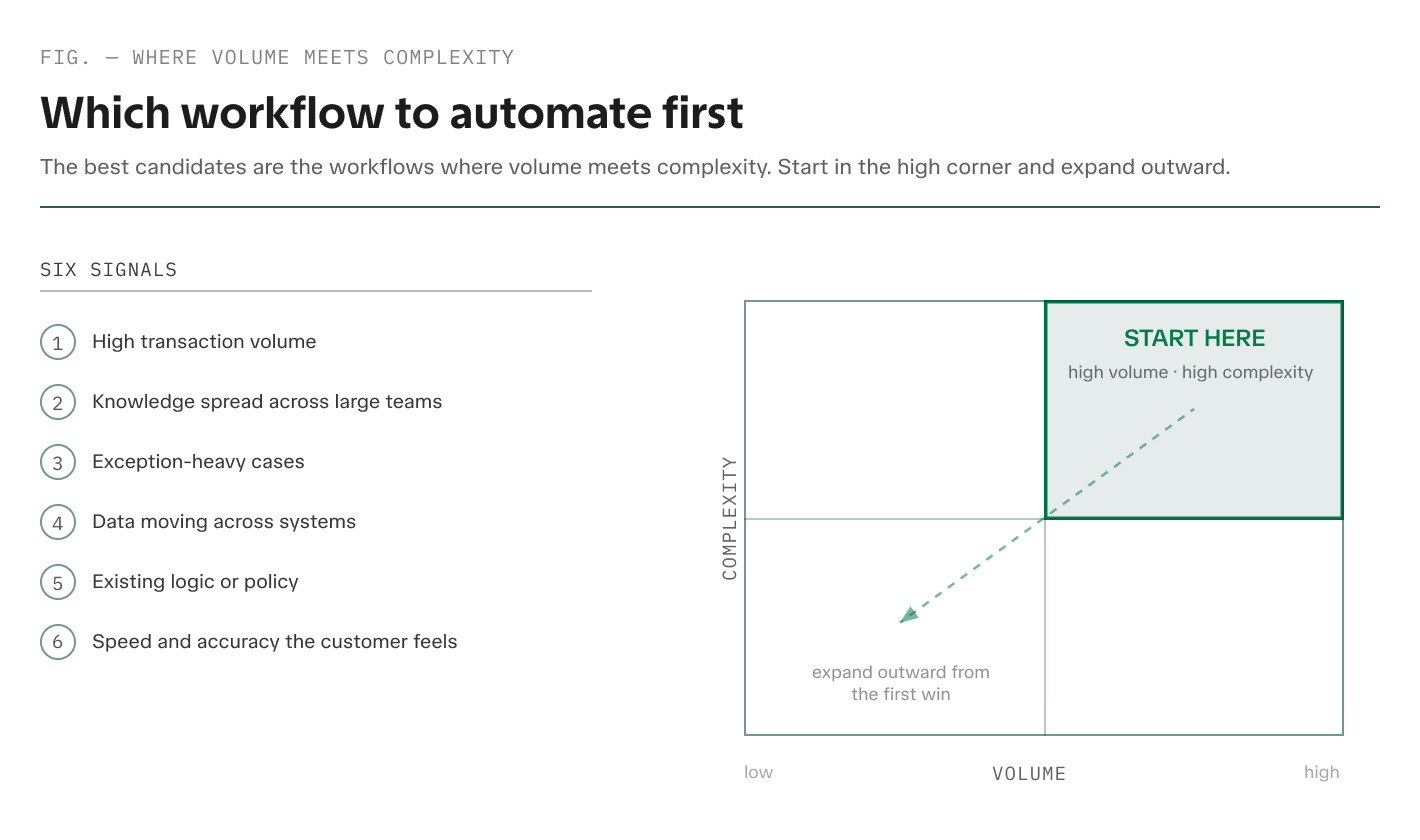
For most procurement teams, contract intake, vendor onboarding, sanctions screening, tail-spend classification, and exception-heavy invoice coding meet all of these criteria, and they’re automations likely to produce first-year results the CFO can see.
The workflows a procurement team probably should not start with are the ones a savvy assistant already covers. Things like templated supplier communications, standard clause insertion in familiar NDAs, and routine RFI drafting are generally better suited for simpler automation solutions.
AI point solutions vs horizontal platforms
Procurement organizations getting serious about AI tend to get pitched a separate AI for every category of work. They might talk to four or five vendors, each one selling a point solution like invoice AI, contract AI, supplier risk AI, or sourcing AI.
The right answer, of course, depends on your specific use case. But there are some significant drawbacks to building a collection of point solutions, whereas a single horizontal platform can uusally unlock more efficiency gains across the department or potentially across the entire organization.
Gartner projects that Fortune 500 companies will run 150,000 AI agents apiece by 2028, up from fewer than 15 in 2025, and finds only 13% of organizations believe they have the right AI agent governance in place. Deploying an army of point solutions means each tool accumulates its own logic the enterprise now depends on, and the cost of replacing any one keeps growing as that logic builds up.
A horizontal platform running procurement, finance, and supply-chain workflows produces a different cost curve. The second workflow can be launched faster and more efficiently than the first because most of the integration, security review, model access, and change-management work is already in place. A correction one team makes can carry into the next workflow.
Institutional knowledge that a single-workflow product would rebuild is often already in the platform's memory. Reindeer co-CEO Yair Weinberger put the tradeoff plainly in his post arguing that companies should buy the platform while keeping ownership.
“When every agent change requires engineering, whether yours or a vendor's, the cost of change is what kills the return, not the license fee," he explained.
Nobody has this fully figured out yet. Regardless, it’s clear that a stitched-together stack of vertical AI products is procurement AI sprawl, and that’s probably not the right move for most organizations.
How to scope a first procurement AI workflow
Most of the successful deployments begin by selecting a single workflow where volume meets complexity, running it in full on production case samples from your own operation, deploying it in weeks, and then scoping the second workflow on the same architecture.
You’ll start by answering these questions:
- Which workflow is being built?
- What do the sample cases look like that can be built against?
- Which people on your procurement team will correct the agent as it learns?
- What is the deployment target date?
Reindeer is built to automate enterprise back-office work across procurement, legal, and compliance.
The same platform architecture running the Hellmann quoting workflow and the Papaya invoice-coding workflow applies to the procurement workflows above, connects to your existing stack including systems like Coupa, Ariba, SAP, Workday, Ironclad, ServiceNow, and SharePoint, and more, and deploys on your infrastructure.
We can help you scope one production workflow, identify training cases from your own operation, and put together a roadmap to get to production in weeks.
Frequently asked questions about AI in procurement
How is AI being used in procurement?
AI is being used in procurement to automate contract review first-pass, vendor onboarding and due diligence, sanctions and third-party risk screening, spend analytics, sourcing and RFP handling, and invoice and payables workflows.
Generative AI might handle tasks like drafting supplier communications and RFP responses, whereas agentic AI reads unstructured contract and vendor documents, matches them against a playbook or a policy, resolves the routine cases without human help, and escalates the exceptions to a subject-matter expert with the specific question that needs answering.
Adoption across procurement teams sits at roughly 58% using or piloting AI, per Ardent Partners' 2026 AI Rising research, and the highest impact shows up in workflows that combine high transaction volume with exception-heavy cases and knowledge distributed across a category-manager team.
Which AI is best for procurement?
The best AI for procurement is the tier of AI that can manage change in your workflows over time. Reindeer is a top pick for automating exception-heavy, high-volume back-office procurement work accurately over time.. Reindeer runs independent of any single foundation model and automatically suggests logic changes to an agent manager when it sees patterns in edge cases to stay accurate over time. For a Fortune 500 procurement organization already running systems like Coupa, Ariba, SAP, Workday, or Ironclad, the best AI is one like Reindeer that works with the existing stack rather than replacing it.
Will procurement survive AI?
Procurement will survive AI, and the procurement function will look different from how it does today. Agentic AI absorbs the high-volume, low-judgment work in procurement, including tail-spend classification, sanctions match resolution, and routine contract intake, while the procurement team's time will move toward category strategy, supplier relationships, and cross-functional work with finance, legal, and the business.
Gartner's Fareen Mehrzai has framed the shift as one that only pays off with intentional redesign of roles and processes around AI, and in our experience, the teams who begin that redesign early are the ones whose 2027 operating plans read most confidently to the CFO. Procurement teams that treat AI as a project with a start and end date tend to end up with the assistant-tier version of this future. The teams that treat it as an operating capability that develops over time are set up for the autonomous version.

Ready to see it in production?