
One Agent, Two Loops: Why Reindeer Makes it Into Production
Reindeer's two-loop architecture, an inner loop where experts govern individual cases as the agent runs and an outer loop where the agent rewrites and retests its own logic over time, is what gets agentic AI into regulated production and keeps it there.

Last week we demoed a regulated capital gains workflow that requires human-like communication at a major bank. It interacts with customers to collect and validate information for tax calculation, multilingual customers, partial portfolios, and fraud risk. It’s the kind of process that's eaten years of RPA budgets across the industry because of complexity and variability, with nothing to show for it.
Halfway through the demo, their head of operations said "I'm blown away."
Then, they said it twice more.
Their COO of a parallel operations team showed up unexpectedly because his team had heard about the demo and wanted in. They want to move to procurement immediately.
In our ongoing conversations with Gartner, one of their distinguished VP analysts framed agentic AI like this: it's like kids wanting a dog. Getting the agent is the easy part: everybody can get a dog. The hard part is training it, maintaining it, governing it over time. That framing resonated, because it's exactly the gap most of the market is falling into and exactly what Reindeer was built for.
This is why the bank reacted the way it did.
And it's worth being precise about the difference between what we're doing that the previous wave of automation couldn't.
Reindeer vs. the previous wave of automation
Our agents have a brain, not a script. Pre-built agents reason against a structured business context. Think policies, document patterns, multilingual Q&A, or decision rules.
In the demo, the agent classified four mixed documents, applied the bank's consolidation logic, validated against policy, and replied to the customer in their language. When the customer asked an off-topic question mid-thread, the same agent answered it from context instead of getting stuck. There was now one agent doing what previously required three and a human.
In order to have confidence in an agent, you need a control surface. Every decision carries a confidence score impacted by case uniqueness, complexity and the agent’s plan’s divergence.
Below a threshold, the case routes to a subject matter expert (SME) with a precise set of questions. It doesn’t ask a human to "take over this" but instead says, "I matched the customer's problem to my context and found these specific gaps in policy, tell me how to handle it." The SME answers in free language, and the agent absorbs and acts. Banks tune the threshold from 100% (which would require every case to be reviewed) downward as trust builds. This is the lever regulated buyers actually want; gradual delegation, not a leap of faith.
The inner loop and the outer loop
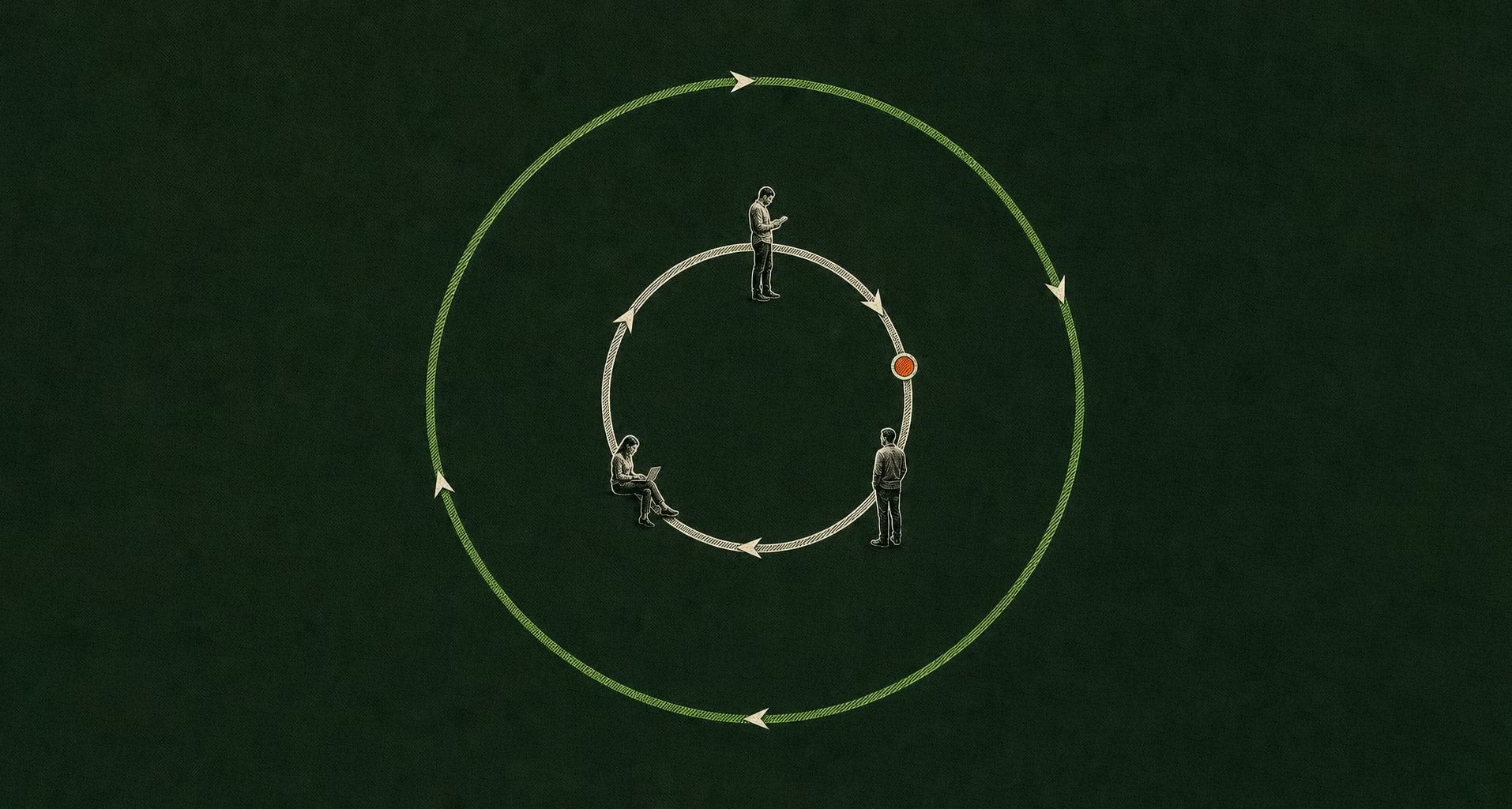
The inner loop and the outer loop are a two-loop system. Human-in-the-loop requires a human to help make decisions as the agent runs. Human-after-the-loop revises the agent as it runs. We refer to this as the inner loop and the outer loop, and it’s where Reindeer pulls ahead architecturally.
The inner loop is case-level review with the SME acting tactically, per-decision, and governing the case as it runs. Most AI agentic products stop here. They gave you a dog, but it isn't house-trained.
The outer loop is revision management, run by an agent manager that watches signals across thousands of cases. Which context entries are stale? Which thresholds are mis-calibrated for a specific customer segment or language? Which policy branches need to be added?
The outer loop governs the agent itself, further tunes and rebuilds it, over time. An inner loop without an outer loop is a help desk that never improves, a dog that never gets trained. An outer loop alone is opaque retraining nobody trusts. Together, they're the governance system regulated industries actually need to put agents into production.
GenAI has given the world two big capabilities: conversational intelligence and code generation. Fusing them together finally makes them work, but until now they've mostly lived in separate products. Reindeer's agents collect feedback through conversations and SME corrections in the inner loop. The hard part is not collecting that feedback. It's deciding which signals justify rewriting the agent and which are noise. That judgment feeds a code-gen layer where the agent modifies its own context, tests, validates, and proposes new policy branches to the agent manager. The conversational layer feeds the code-gen layer, which rebuilds the conversational layer. Humans review the difference.
This is what a self-improving production agent looks like. The operating context for this agent on this bank's process is being authored, in part, by the agent itself, supervised by experts who only review changes.
Why the inner loop and the outer loop matter
Pre-built agents collapse time-to-value from quarters to days.
The brain architecture handles real operational mess.
The two-loop governance model gives regulated buyers a path to trust. The conversational-plus-code-gen flywheel means every case makes the next one easier and creates a real compounding moat, not just a feature list.
All of these have to exist together for any of them to work, and that's the moat.


Ready to see it in production?