
What is Enterprise AI? The Executive's Guide to Practical, ROI-Positive AI Deployments

Enterprise AI is the use of artificial intelligence to run a large organization's core operations. It handles the high-volume, exception-heavy work in areas like finance, supply chain, and compliance that keeps the business moving.
But what truly makes AI enterprise-grade is how well it works within the realistic constraints of the business environment. It's not a bolt-on tool you can deploy on a whim. Enterprise AI must stand up against strict security controls, rigorous compliance requirements, rigid governance mandates, and a litany of approvals, reviews, and executive scrutiny.
So it's no wonder many organizations are struggling to deploy and scale AI.
McKinsey's State of AI survey found that 88% of organizations now use AI in at least one business function. But at the enterprise level, most are still experimenting and piloting, with only about a third beginning to scale.
There's simply a higher bar for enterprise-ready AI systems that many solutions on the market don't meet.
AI assistants vs AI agents vs enterprise AI
Many AI systems and platforms won't work for the enterprise.
It's not because of an issue with any specific model, but because they aren't built to meet the requirements for enterprise-grade AI. They don't provide security and compliance features, they don't handle edge cases that crop up in production, or they don't learn and change as the needs of the business evolve.
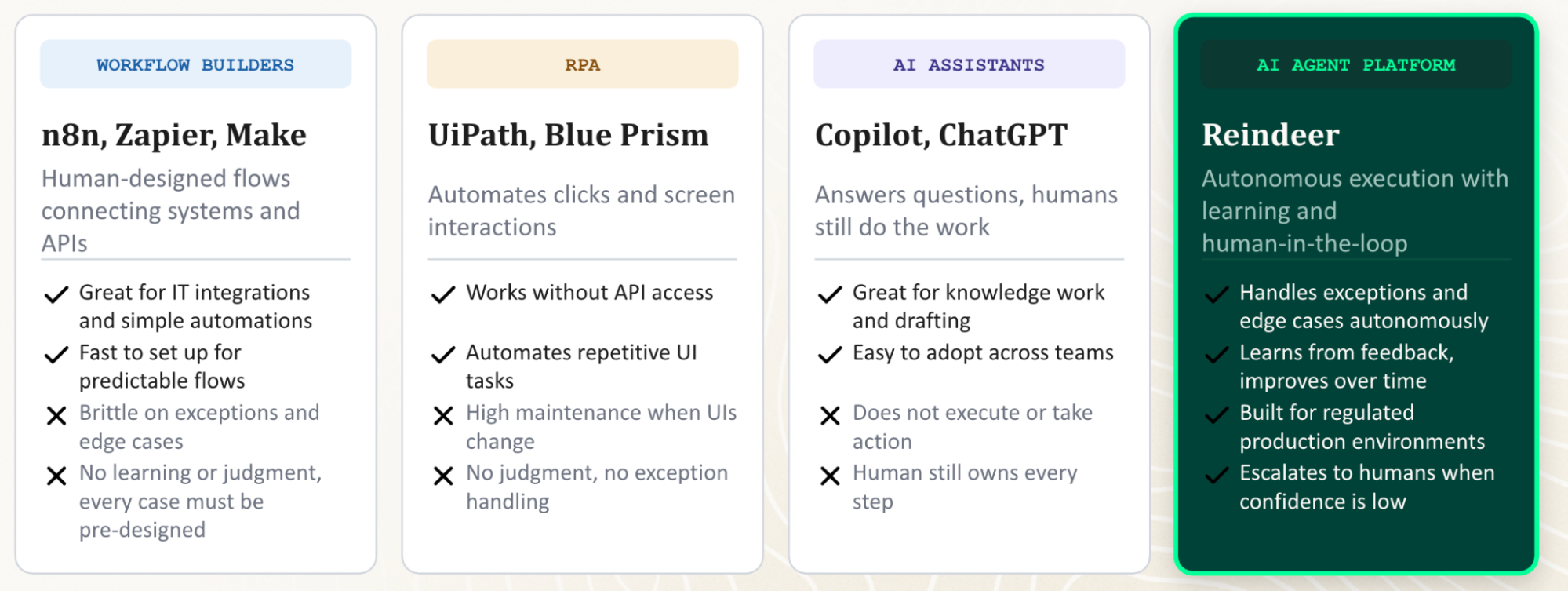
When we think about AI on the market today, it often refers to one of three different things:
- Assistants (generative AI, like Copilot, etc)
- Agents (agentic AI that can execute a workflow)
- Autonomous agents (enterprise grade)
Most marketing language calls all of them "AI agents," which is why understanding which systems will work for your organization and which ones won't can be one of the first major hurdles.
AI assistants: you still do the work
An AI assistant is a generative AI tool like Microsoft Copilot or ChatGPT.
It's like a sidekick that helps you, as an individual, complete tasks.
Imagine you're using ChatGPT to help with onboarding a new vendor. You ask it questions about the onboarding process and it gives answers based on the documentation you've uploaded.
You ask for a draft of the paperwork and it writes the first version. You review, make edits, and iterate. Then you ship it.
It is, most literally, an assistant. But you still do most of the work.
Forrester's commissioned study of Microsoft 365 Copilot reported a 116% three-year return and about nine hours saved per user each month, which is capacity handed back to your team, but the work is still yours. An assistant that saves you an hour is a different thing from a system that runs the process while you're somewhere else.
Most AI agents: you babysit the model
An AI agent completes a task from start to finish using a combination of different types of AI, like generative AI and agentic AI.
This allows it to do things like process an invoice while you do something else.
In theory, this is great. It feels like the promise of enterprise AI finally realized.
But agentic AI is a product of the integrations, policies, and confidence thresholds that are built into the system. It can generally only understand and execute use cases that have already been defined in the training.
When agentic AI meets something its policies don't cover, it may drift.
Imagine the agent set to process your invoices runs up against a new format it doesn't understand or there's a statement of accounts attached to a new invoice, which includes a list of all the previous invoices. The agent has never encountered this before, but it still runs the same instructions and might assume the invoice includes each of those individual line items and add them together.
With most agentic AI, you often have to check its output, catch the mistakes, and correct it by hand every time the process shifts. This means you're working with a system that seems autonomous, but can't be fully trusted to run autonomously.
In other words, agentic AI simply shifts your job description. You went from doing the work to babysitting the thing that does the work, which is not the trade most buyers thought they were making.
Enterprise AI: autonomous AI agents you can trust
Enterprise AI systems are a different class altogether.
They're autonomous AI agents you can trust to execute complex work without babysitting.
Enterprise-grade AI can recognize edge cases, ask for clarification, recognize new patterns, and prompt you to update policies when required.
Imagine, again, a system built to process invoices. While standard agentic AI may struggle to navigate new cases that fall outside of its original training, autonomous agents recognize this as an edge case. They prompt a human to provide direction. And, if these cases keep appearing, they recommend policy updates so the AI agent can evolve to handle them autonomously in the future.
It's a system that does the work, handles the exceptions, and manages its own change over time. People control the decisions that matter, but the system learns and adapts rather than decays and derails.
Critically, the system is also fully secure, compliant, and auditable. There's a clear record of every decision made by the AI and the path it took to complete the task.
This is where enterprises should be investing in 2026.
Assistants and agents are way-stations on the way to autonomous AI. It's important to understand what you're actually buying because it's easy for an agentic system to be sold with a demo that dazzles in a staged environment but will still hand your team a babysitting job at scale.
Why most enterprise AI projects fail after launch
“Adopt or die” is only a slight exaggeration from the message ringing through most orgs today.
Board mandates, marketing rhetoric, and the rise of AI-native startups gunning for your market share are putting immense pressure on executives to deploy AI, perhaps faster than they can realistically assess and put a plan in place.
Unfortunately, that pressure can also drive a series of downstream failures.
The riskiest moment for enterprise AI arrives months after launch.
The agent that demoed beautifully is less accurate than it was on day one, the process has drifted, a document template changed, a senior reviewer left, and nobody is logging the decline. When programs start to fail in this way, they become both a liability and a time sink.
There's system maintenance work nobody expected, planned, or budgeted against.
Accuracy decay is measurable and well documented. In one study of 128 classical ML model-dataset pairs, 91% showed measurable degradation over time.
This is a core reason why AI POCs fail.
AI assistants and basic agentic systems don't have the tools and capabilities to self-evolve, so they slowly (or, sometimes, quickly) drift and fall out of sync with the day-to-day realities of the business.
What makes enterprise AI successful
Plenty of enterprises are still figuring out the right path for AI deployments, and no one can hand you a guaranteed playbook yet, but not all AI initiatives are failing. Many organizations have found success by implementing systems that follow a few key guidelines.
Know when to build and when to buy
Build when AI is native to your product and core to how you make money.
A company putting a customer-facing AI experience inside its own app should build that, because it is a differentiator they should own.
Buy for the back-office workflows like invoice coding and quote handling, where the system is a line-item cost rather than something you sell, and where you don't want to staff a team to keep it alive forever. MIT's research found that AI tools from specialized vendors succeed about 67% of the time, roughly double the rate of internal builds, which is one reason buying tends to be the better call for back-office work.
Independence: data, logic, and model choices stay yours
The strongest programs keep critical business decisions independent from the model itself.
Your data and your business logic stay yours.
The system should be model-agnostic, so a frontier lab's price change, deprecation, or surprise model update can't upend your operations. And you don't need a standing bench of forward-deployed engineers or consultants on retainer to make a change.
If a program leaves you dependent on one model vendor's roadmap, you have traded one kind of lock-in for another.
Enterprise-grade security, governance, and auditability
Security, governance, compliance, and auditability are non-negotiable for enterprise systems.
This means the system runs single-tenant in your own environment, no training on your data, and a record of every decision the system makes.
Change management: keeping the agent accurate as the work shifts
Since drift is what breaks most programs after launch, keeping the agent accurate as the work shifts is a critical capability.
Agents have to be built to develop the way you'd develop a new employee, not installed the way you'd install software. You don't hand a new hire a year of documentation and walk away. You teach a few skills, let them start on real cases, and expect a good employee to ask when something doesn't add up.
Reindeer approaches change management for enterprise AI through two learning loops.
Learning loop #1: the inner loop
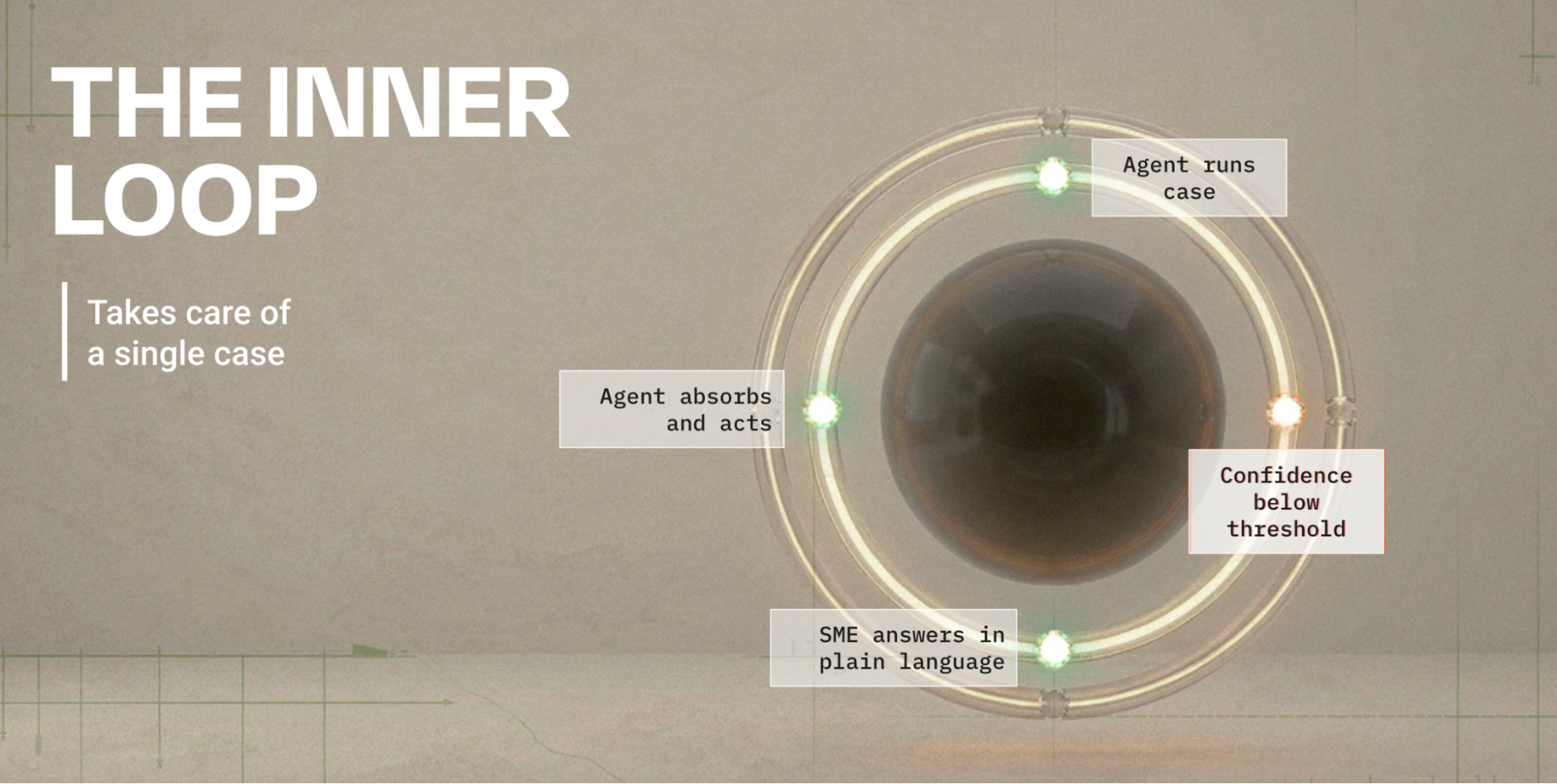
The inner loop handles a single case. The agent runs the work until it hits something it isn't confident about, measured against a threshold your team sets.
Instead of guessing, it stops and asks the right expert for clarification.
The expert answers, the agent learns, and the case completes.
This, again, is a critical differentiator that makes enterprise AI viable where assistants and basic AI agents would often fail. Those systems are generally not designed to recognize when they don't have an answer. They're designed to respond confidently, even when they're wrong.
That behavior is a major liability for enterprise deployments that the first learning loop can help eliminate.
But having an AI system that can recognize its own lack of information creates a much more trustworthy system and unlocks a whole new level of autonomy.
Learning loop #2: the outer loop
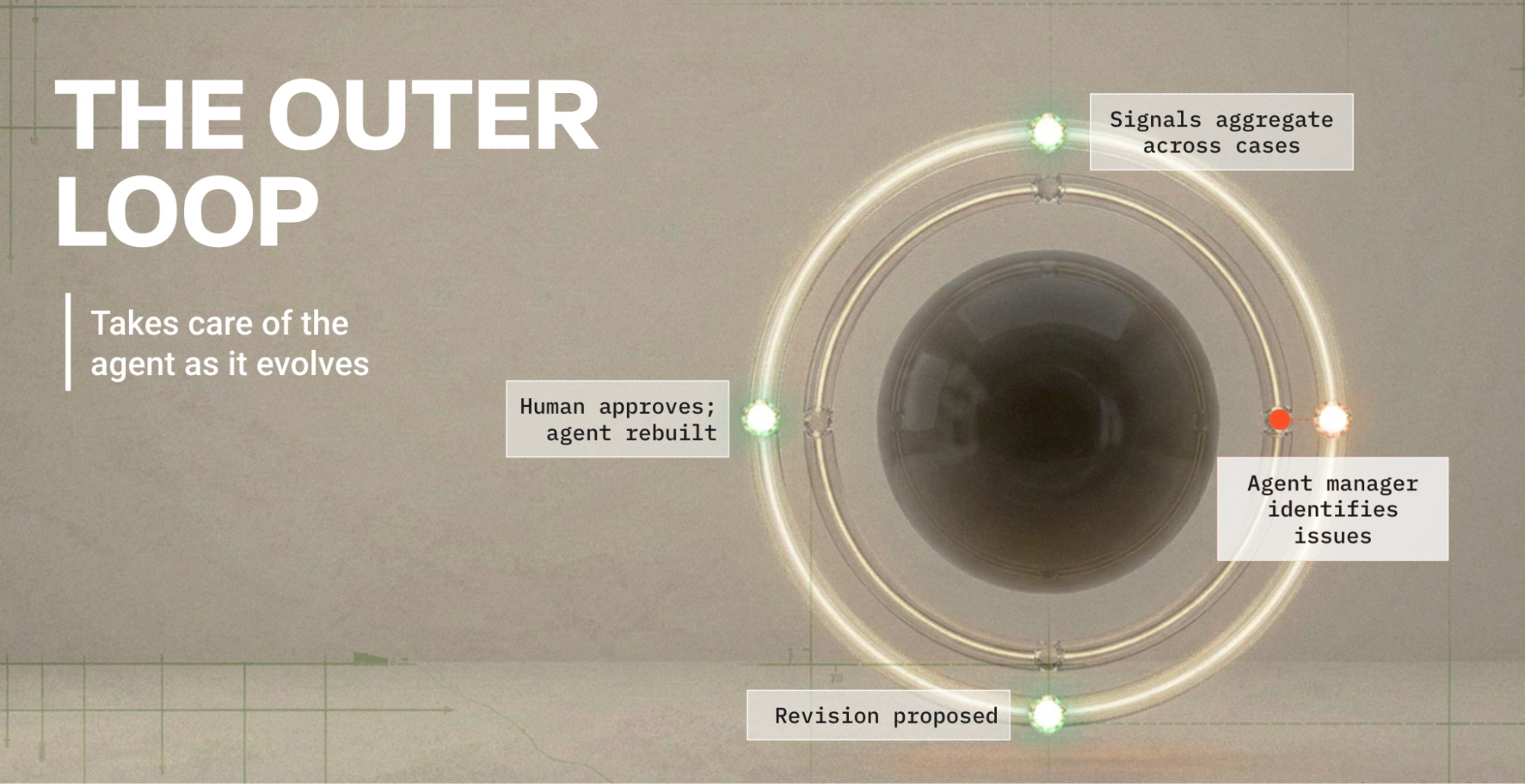
The outer loop improves the agent across many cases by updating its policy with approval from the agent's manager.
When the same kind of exception keeps surfacing, the platform proposes a logic change as one reviewable bundle: what will change, which past cases it affects, and how it performed against regression tests.
A human approves before anything ships, and the agent never rewrites itself in the background.
This is exactly how Reindeer works.
Reindeer's platform works in three stages:
- Build the agent
- Deploy it into the real work
- Manage change over time
The change management phase is perhaps the most important feature of a successful enterprise AI deployment. And it's also the stage that most AI vendors don’t have a good solution for.
The inner and outer loops can turn one-off corrections into a consistent learning loop.
When every expert correction becomes part of the agent's logic, accuracy climbs instead of decaying, and the institutional knowledge that used to leave with a retiring analyst, for example, stays in the system.
The cost of skipping this shows up after launch. Gartner warns that by 2027, 40% of enterprises will demote or decommission their autonomous AI agents, undone by governance gaps that surface only after the agents go live.
One AI platform beats an AI tool for every workflow
A large company has hundreds of exception-heavy workflows, but buying a separate enterprise AI tool for each one can negate the value of deploying AI in the first place.
We've seen this pattern emerge over the last decade with an explosion of specialized SaaS tools.
Many companies have been left managing hundreds of different vendors, creating major problems like integration debt and governance gaps.
For AI systems, the problem can be even worse because the underlying data, context, and training may not transfer across platforms. That can severely limit the abilities of each individual AI tool and slow down progress toward the AI-powered future most companies are investing in.
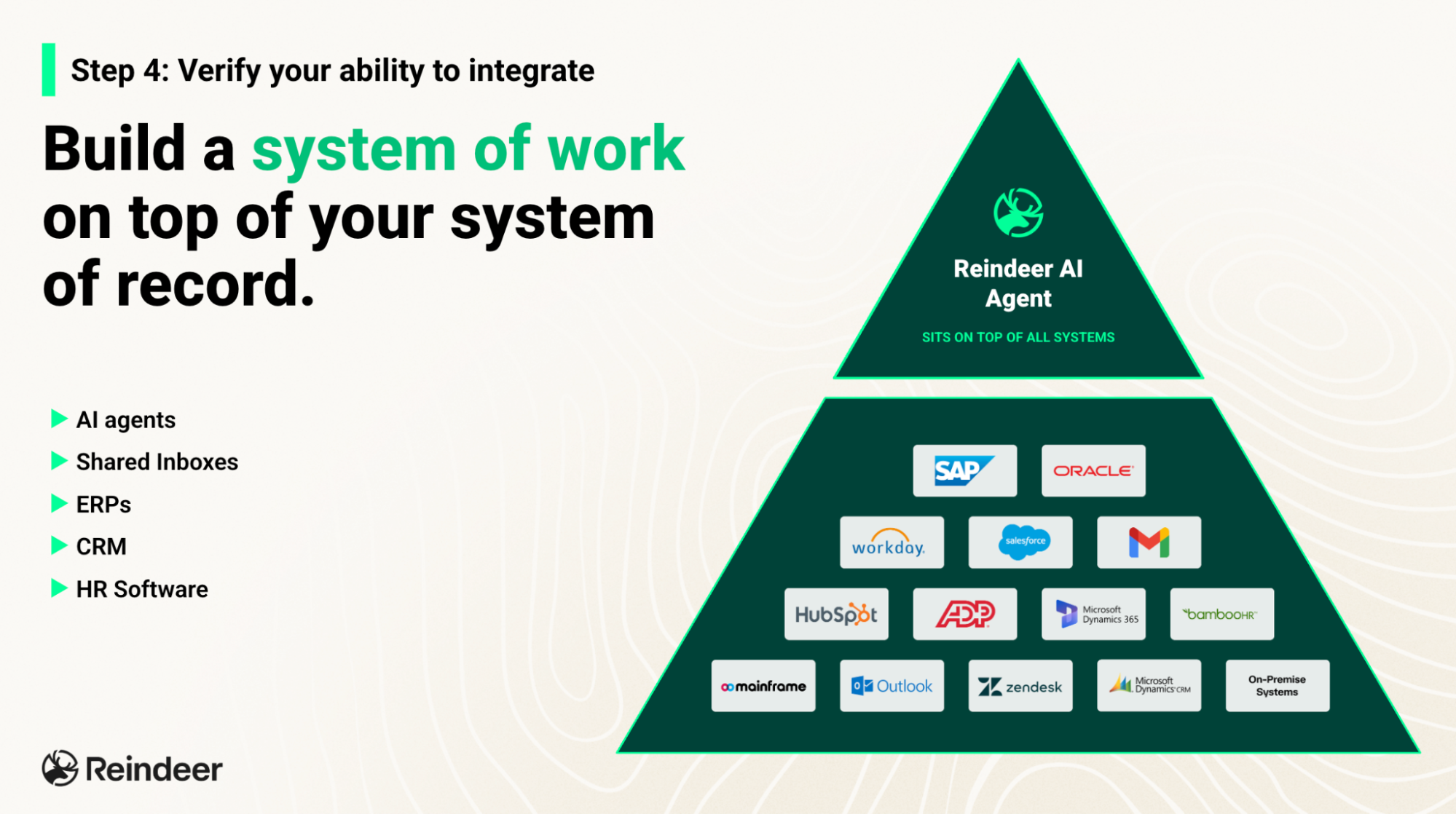
Picture a large enterprise that starts with a quoting agent on inbound freight requests, then adds an invoice-coding agent in finance and a payslip-mapping agent in payroll.
Bought as three separate tools, that's multiple vendors, integrations, and governance reviews, with each agent learning in its own silo.
Adding the tenth point tool is harder than the first, because each one drags its own integration and governance load. Adding the tenth agent to one platform is easier than the first, because it inherits the connections, the controls, and the corrections the other nine already made.
One horizontal enterprise AI platform that grows with you is usually a more rational choice.
How to start with enterprise AI
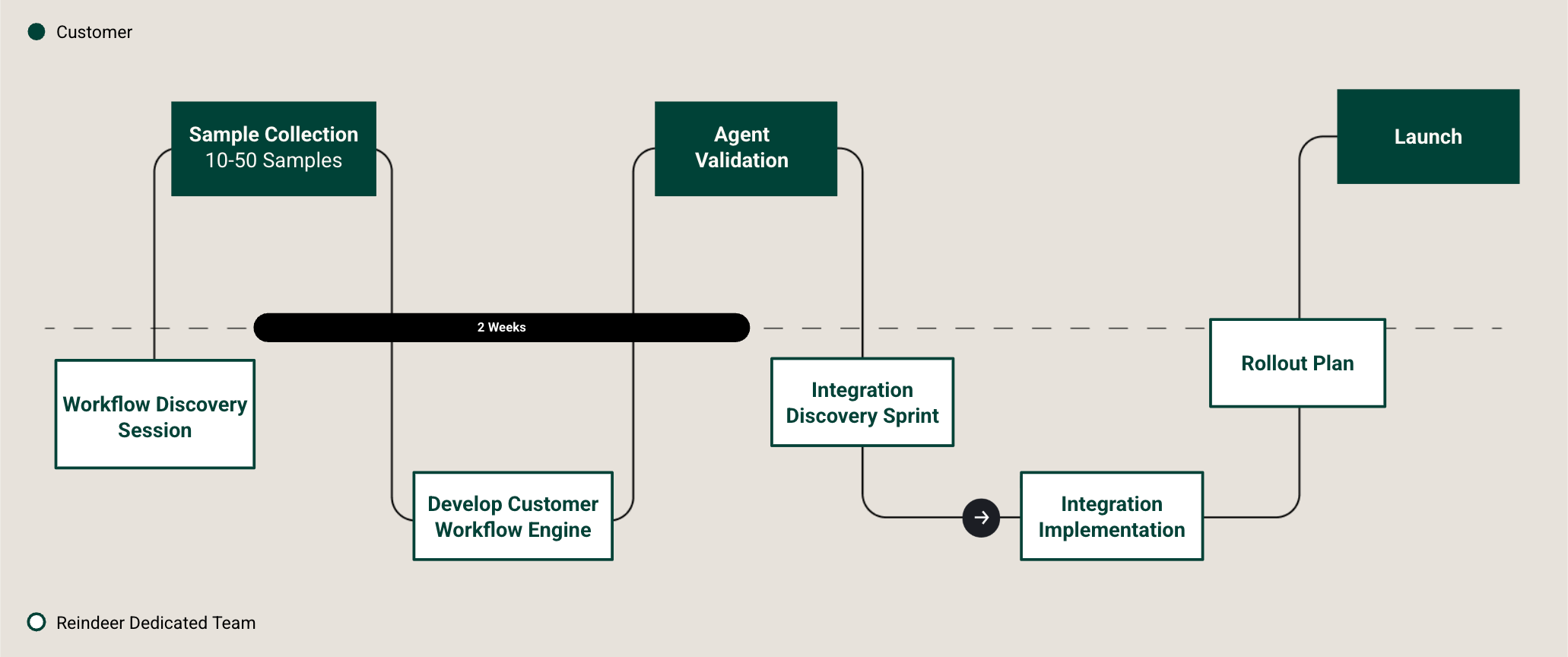
One of the most common paths to successful enterprise AI deployments starts by picking one painful, high-volume, exception-heavy workflow the business cares about and getting it into production.
Don't let concerns over data quality be a blocker, either.
Start with a small set of real samples
The market still sells enterprise AI as a clean-data prerequisite. (“Fix your data. Then you can deploy!” or “The reason the AI isn't working as advertised is because of your data!”)
But, in reality, you probably don't need to start by hiring an expensive consultant to clean up your data.
Many successful enterprise AI deployments take the opposite approach because waiting for perfect data is the reason so many programs never move forward.
Beginning with a small set of real, messy cases can be a faster path to success.
Hellmann Worldwide Logistics trained its quoting agent on about 20 sample requests and had it live in under four weeks. Reindeer's published Hellmann results show a 70% cut in processing cycle time and 85% of exceptions resolved without escalation.
Escalate the cases the agent isn't sure about
The next phase is training. Here, we identify the exceptions, outliers, and blockers, feeding additional context to the AI system so it can expand the surface area it's able to handle autonomously.
Routine cases run automatically, and the people who used to process them move up to the exceptions, the judgment calls, and the customer conversations where their experience matters.
"It feels like we added experienced hands overnight," said Alexander Terglane, pricing and tender lead at Hellmann Worldwide Logistics. "Routine requests move through automatically, more complex ones are handled in a copilot mode, and my team focuses on escalations, edge cases, and customer conversations where experience and human touch actually matter."
A regulated trading platform put its source-of-funds review into production in two weeks on fewer than 50 sample cases, reaching 95% extraction accuracy while routing the uncertain cases to its human reviewers.
Expand the deployment
Once one workflow runs in production, the next one is faster, because the platform and the governance pattern are already in place.
Papaya Global started with payslip mapping, cut manual review from 50% to under 10%, then automated 97% of its invoice coding in NetSuite while processing more than 10,000 payslips a month.
"We can take a messy process, hand Reindeer a short description, and have it running in a couple of weeks," said Yael Hoze, vice president of product management at Papaya Global. "It's a repeatable process that's already changing how we're thinking about other workflows."
That repeatability, applied across AI for finance operations and supply chain, is what turns one win into an operating model.
Talk to Reindeer about your first workflow
The fastest way to understand enterprise AI is to put it on a workflow that's costing you.
Pick one that's high-volume, exception-heavy, and eating overtime.
Reindeer deploys autonomous AI agents on your hardest back-office operations, inside your own environment, and gets them to production in weeks.
Talk to Reindeer to scope your first workflow.
Frequently asked questions about enterprise AI
What is the best enterprise AI?
There's no single best enterprise AI for every company. The right one handles your toughest high-volume, exception-heavy workflows and stays accurate as that work changes. But it also operates within the complex realities of the business. That means strict security controls, compliance with the regulations you operate under, and auditability that fits your governance strategy. Finally, the system must align with the needs of individual stakeholders and decision makers.
What is the difference between generative AI and enterprise AI?
Generative AI is a capability, a class of models that create content such as text, images, or code. Enterprise AI is the system that runs an operation, and it draws on several capabilities at once. Generative AI is most often used to describe an AI assistant capable of performing specific, human-directed tasks such as drafting an email about an invoice. There are also AI agents capable of processing that invoice but need a person to catch what its policy doesn't cover. Enterprise AI is an autonomous system that can perform a complete workflow like processing an invoice, coding it, matching it against the purchase order, routing any exceptions, and becoming more accurate the next time (all while meeting security, compliance, and governance requirements for an enterprise-grade system).
How expensive is enterprise AI?
Enterprise AI is priced differently by different vendors. Usage-, token-, or consumption-based pricing is a common model, and some vendors add platform or implementation fees on top. For example, they may charge a fixed fee for access to the platform and then charge additional fees per 1 million tokens used or for each execution completed by the system.
What is an example of enterprise AI?
Reindeer is an example of an enterprise AI system. Enterprise AI is the system built on top of models, like OpenAI's GPT, Anthropic's Claude, or Google's Gemini, that runs a business workflow.
Is enterprise AI the same as agentic AI?
Enterprise AI and agentic AI are not the same and not all agentic AI is enterprise AI. Agentic AI is the part that acts, taking actions and completing multi-step tasks rather than only answering questions. Enterprise AI is a broader class of platforms that include enterprise-grade integrations, governance, security, escalation, and learning loops that let an agent run live operations safely. Most enterprise AI is agentic, which is why the two terms get used together, but an agent becomes enterprise AI only when it can run inside the controls a large organization requires.
Your next read



Ready to see it in production?

Most "AI agents" still need a person to babysit them when something falls outside their training. Enterprise AI is different: it escalates what it's unsure about, turns corrections into policy updates through two learning loops, and gets more accurate over time instead of drifting.