
Unlocking institutional knowledge is the key to successful AI transformation
Without consistently capturing and feeding new knowledge into your AI systems, your AI transformation will not succeed.

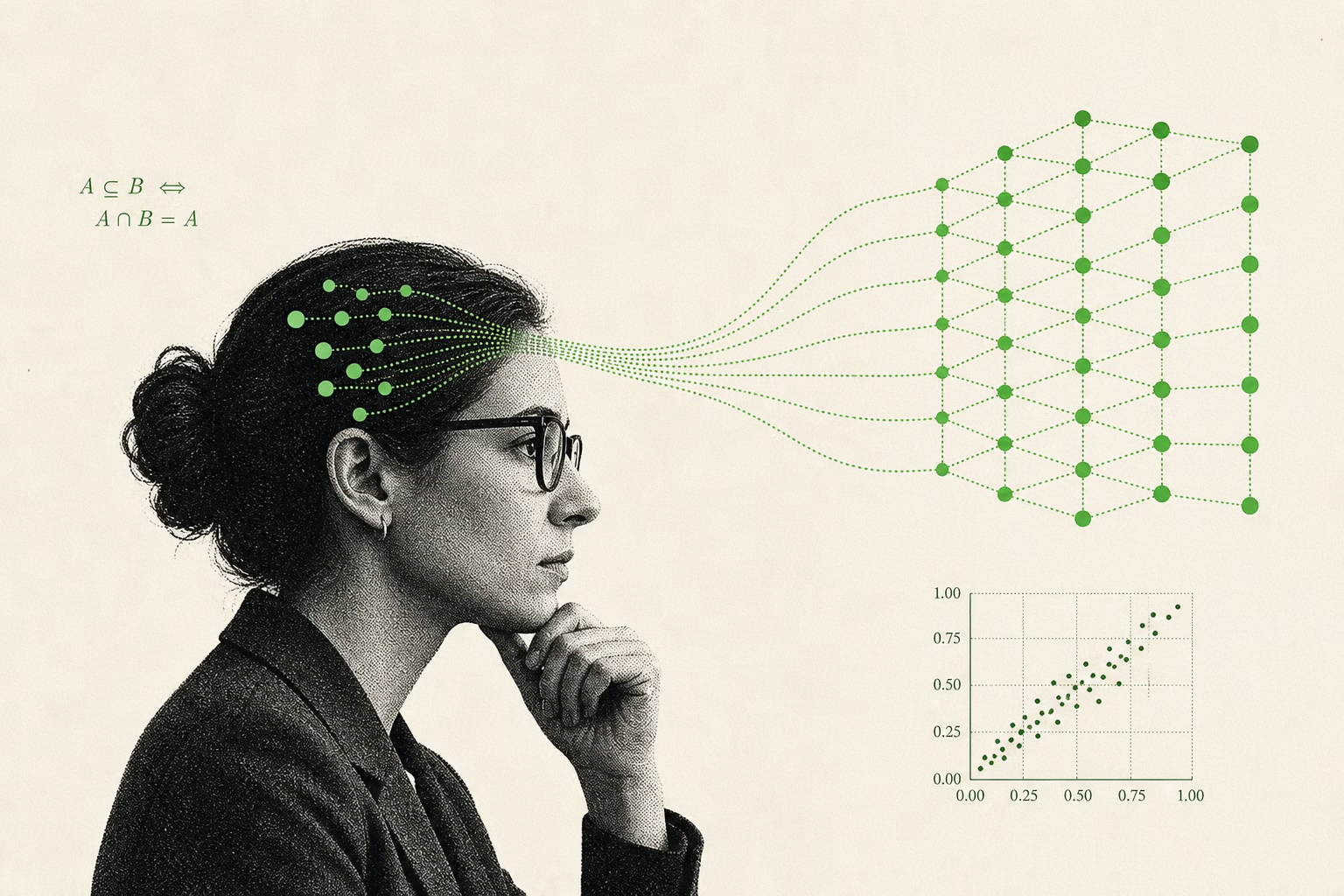
Most enterprises will move to adopt AI by gathering some data, feeding it to a model, and assuming the work is finished. They’ll train the AI against documented processes that could include SOPs, workflows, or playbooks they’ve invested years in codifying. On paper, it all looks airtight.
But in reality, your written processes rarely reflect the way your business actually runs. Your documentation describes the “happy flow,” which assumes nothing goes wrong. In practice, work is messy, and what really keeps things running is the tacit judgment your people use every day; the institutional knowledge that never makes it into the documentation.
This is the gap that breaks most AI projects. When you only train AI on the best case scenario, it stumbles the moment it meets real-world complexity. It fails at launch, and even if it doesn’t, it degrades over time as processes shift and institutional knowledge evolves. But the solution isn't to achieve perfect documentation; it's building AI that can detect exceptions to its current training and ask to be taught again with new information. Without consistently capturing and feeding new knowledge into your AI systems, your transformation will not succeed.
The cost of ignoring institutional knowledge
When institutional knowledge stays locked in people’s heads, the financial impact is enormous. A Panopto study found employees waste more than five hours every week searching for, or recreating, information that already exists, which adds up to more than $47 million lost each year in a large enterprise.
Turnover magnifies the problem. Two-thirds of the costs tied to employee departures are related to intangible productivity losses and institutional knowledge, which can take one to two years for a new hire to make up. Just like a new hire, AI also needs institutional knowledge to reach its maximum potential, and if it doesn’t have it, it will initially fail for the same reason a new initial hire fails.
Take a refund process, for example. Your policy states that you should automatically approve the refund if the amount is under $500. Otherwise, the request gets escalated. In reality, you have agents on your team that work this process using years of unwritten judgment. Maybe someone knows that an old receipt format from a certain vendor is still legitimate, even if it looks “wrong.” Or, they remember that a specific SKU is often mispriced by the system and needs to be corrected before approval. Or maybe they understand that a decade-long VIP customer always qualifies for an exception, even if the amount is slightly over the threshold.
AI would only be able to transform a process like this one if it was trained on the same institutional knowledge your people need to run it, so it can handle the exceptions as confidently as the rules.
Keeping humans-in-the-loop is the key to training AI
It’s tempting to believe you can solve an institutional knowledge gap by throwing one huge dataset at the problem. Feed the model thousands of past cases upfront, the thinking goes, and it will learn how to handle every scenario. But that assumption overlooks two issues. First, generating comprehensive datasets requires significant IT work to pull and scrub data, which slows implementation. Second, returns diminish quickly. Twenty samples may be enough to get started, a hundred may be better, but ten thousand won't be ten times better than one thousand. Large datasets also systematically filter out the context-dependent details that often determine how a process really works. Plus, even if you could capture every edge case in a dataset, tomorrow’s exceptions will look different.
The goal is to ground AI in reality and then give it a way to keep learning and you don’t need a ton of data to do that. In our refund example, that might mean ten approved receipts and two rejections, and then from there,the model would need consistent feedback from human experts when something doesn’t fit the pattern.
Every time a human corrects a mistake, that correction becomes new training data. Over time, the system captures the same unwritten rules that never make it into SOPs. And when this feedback loop continues after deployment, AI evolves as your processes and institutional knowledge evolve.
How Hellman Worldwide Logistics unlocked institutional knowledge to speed up their quoting process
Hellmann Worldwide Logistics handles millions of shipments a year. They have a quoting process where they take in customer requests for shipments, check the details, confirm carrier rates, and send back a quote. Requests arrive in every messy format you can imagine, from half-filled spreadsheets, to PDFs in multiple languages, and even photos of handwritten notes. Their pricing team makes a lot of judgment calls to keep this process running smoothly, like recognizing a customer who always bundled requests or filling in missing shipment data from memory.
Hellmann wanted to speed up this process with AI, and when they did, they didn’t try to code every one of those judgement calls. Instead, they worked with Reindeer AI to build a model that sits on top of Outlook and their quote management system (QMS). These tools are where their pricing team was already working, which made it easy for them to train the model as they went about their day.
Today, AI pulls details from incoming requests in Outlook and passes it over to the QMS automatically. A portion of those quotes are reviewed by a human expert, who provides corrections that continuously train the model. When the AI knows it’s missing information, it asks a human for help, and that assistance also trains the model. As a result, Hellmann was able to dramatically improve their win rate, which likely wouldn’t have occurred at the same scale if their model had only been trained on the best case scenario in their documentation.
Reindeer AI’s system for enterprise transformation
At Reindeer AI, we don’t treat implementations as one-and-done projects. Our system is built to train AI much like you would a new hire: start with a few examples, teach how to handle exceptions to those examples as they come up, and keep reinforcing the model as the work evolves.
Reindeer AI sits on top of your existing systems to work in the same place your people already do. When it doesn’t know something, it asks for help. When a human corrects it, that knowledge becomes new training data. Over time, the unwritten rules that once lived only in people’s heads become part of the system itself.
Turn institutional knowledge into a lasting asset
The success of your AI transformation will hinge on whether institutional knowledge becomes an enduring asset or disappears every time a process shifts or an employee walks out the door.
Companies embed that knowledge into their AI systems are automating workflows and preserving the expertise that keeps the business running. Do that, and every new resignation or policy change stops being a setback. It becomes part of how your AI gets smarter and that’s how you future-proof your organization.

Ready to see it in production?