
What is Agentic AI? An Explainer and Buyer’s Guide to Understanding AI Capabilities


Agentic AI is software designed to achieve goals without requiring step-by-step human instructions. It can plan necessary actions, interacts with the systems where work occurs, executes tasks directly, and adapts as needed under human oversight.
While this core definition sounds straightforward, identifying which products truly fit it can be difficult.
Almost every enterprise vendor now uses “agentic” terminology, even for basic tools that answer questions and wait for user prompts. What often distinguishes a solution is its awareness of its own knowledge and understanding and its own limitations. Great AI agents understand both what they know and what they don’t know, ask questions to fill in gaps, and take action with clarity and certainty rather than simply following step-by-step instructions.
Confusion about agentic AI
Agentic AI refers to systems that manage multi-step tasks end-to-end and adapt to changing conditions along the way. Stanford HAI defines these solutions as systems that "can set or interpret goals, plan and sequence actions, use tools (like web browsers, code, or APIs), make decisions based on feedback, and adapt over time to complete tasks."
Stanford highlights a key distinction for buyers: "Unlike a purely reactive chatbot that only responds turn-by-turn, agentic AI is oriented around ongoing task execution."
Similarly, McKinsey's State of AI survey describes agentic AI as systems built on foundation models capable of taking real-world actions and executing multi-step processes. Foundation models provide the underlying general intelligence, like what powers ChatGPT, while execution and action define agentic capability. Generally, a tool that merely provides suggestions to a user does not meet this threshold.
While formal definitions align on these principles, commercial terminology often varies. The Cloud Security Alliance notes in its taxonomy framework that "the term ‘AI agent’ has become one of the most widely used and least precisely defined concepts in artificial intelligence," creating "confusion among practitioners, inconsistency in governance frameworks, and gaps in security postures."
Consequently, standard definitions explain the concept well, but evaluating whether a specific software product actually delivers agentic functionality often requires a closer look.
How agentic AI works
A typical agentic execution consists of five core steps:
- An event or update occurs in a core business system
- The agent detects the change and retrieves relevant records across multiple software applications
- AI analyzes the situation using established business policies and historical task outcomes
- AI executes the required actions directly within systems of record or the software serving as your primary source of truth
- AI validates the results
Anthropic captures this feedback mechanism by describing agents as "LLMs using tools based on environmental feedback in a loop." This validation determines whether the task is complete or if an edge case requires human review.
At their core, agents rely on language models augmented with specialized software components. As Anthropic notes in its engineering guidance: "the basic building block of agentic systems is an LLM enhanced with augmentations such as retrieval, tools, and memory."
Anthropic further clarifies that while standard workflows follow rigid, predefined paths, true agents "dynamically direct their own processes and tool usage."
For an agent to operate autonomously, three core elements must be connected:
- Automated system triggers
- Action permissions within target applications
- Live data access
Reindeer uses these three components, triggers, access, and live data, as its benchmark for evaluating autonomy.
Missing any of these elements often prevents fully end-to-end execution.
System connectivity remains a critical operational challenge. Reindeer connects out-of-the-box to over 200 enterprise platforms and can interact with legacy systems lacking modern APIs, including mainframe terminal interfaces like IBM i and AS-400. Because significant back-office processing relies on legacy infrastructure, solutions limited to modern APIs often cannot support complete workflow automation.
Agentic AI vs. generative AI, AI agents, and the tools you already license
Generative AI responds to user prompts, whereas agentic AI can execute complete workflows. While both rely on similar underlying foundation models, agentic functionality stems from the system architecture built around those models.
A primary factor separating agentic solutions is the ability for the tool to work and reason autonomously, which often breaks down into three distinct tiers:
- AI assistants support human workers by increasing task speed
- Standard AI agents perform tasks independently but require ongoing oversight, as they may continue processing cases that exceed their intended scope.
- Autonomous AI agents execute processes end-to-end but can also route complex exceptions to designated human specialists
Automating work such as high-volume back-office processes relies heavily on this autonomous tier to avoid returning unhandled exceptions to operational teams.
Three widely used enterprise tools illustrate how these tiers work in practice.
Claude and ChatGPT operate primarily as foundational AI assistants or chatbots when used directly out of the box. They respond turn-by-turn to manual user prompts, answering questions and generating content, but they lack automated system triggers and independent workflow execution capabilities.
Scripted agents and custom agent scripts represent standard AI agents. While they can perform multi-step tasks independently, they require ongoing human supervision because they often lack adaptive escalation logic and may continue processing edge cases beyond their designed scope.
Reindeer builds autonomous AI agents specifically for high-volume enterprise workflows. Reindeer’s autonomous agents execute end-to-end processes directly inside core systems of record, operating on system triggers, live data access, and automated escalation paths to route complex exceptions to designated human specialists.
Alternative taxonomy frameworks exist across the industry. Gartner categorizes autonomy into four levels it calls Observe, Advise, Act with approval, and Act autonomously, while researchers at the University of Washington classify systems based on the degree of human involvement. Because these frameworks differ, evaluating products by their actual operational capabilities often provides the clearest guidance.
Where agentic AI is working right now
Six primary business functions account for most documented agentic AI deployments, showing significant efficiency gains across varied oversight structures.
The oversight processes that drive the most productivity gains typically follow an escalation approach (where humans provide input on exceptions or edge cases) or an approval approach (where humans review output) and the agents learn from the feedback over time.
The Stanford Digital Economy Lab's Enterprise AI Playbook documents average productivity gains across 51 enterprise production deployments across 41 organizations, along with their primary governance models:
- IT operations: 90% productivity gains, escalation model
- Field service: 80%, approval model
- Customer support: 71%, escalation model
- Clinical documentation: 66%, approval model
- Coding: 54%, collaboration model
- Claims processing: 50%, escalation model
Reindeer's production deployments focus on similar high-volume, operational workflows.
Hellmann Worldwide Logistics, which manages roughly 20 million shipments annually across 61 countries, trained their AI quoting agent on approximately 20 historical sample requests, moving it to production within weeks. Previously, pricing teams manually gathered shipment details and followed up with clients for missing data, often resulting in delayed quotes. With automated quoting, responses are delivered complete and fast enough to improve conversion rates.
"It feels like we added experienced hands overnight," notes Alexander Terglane, pricing and tender lead at Hellmann Worldwide Logistics. "Routine requests move through automatically, more complex ones are handled in a copilot mode, and my team focuses on escalations, edge cases, and customer conversations where experience and human touch actually matter."
Similarly, Papaya Global cut manual payslip review by half while achieving 97% invoice-coding coverage across more than 10,000 monthly payslips.
In freight payment operations, a digital freight marketplace reached a 99% extraction grade on carrier invoices and saw payment disputes fall from 5% to 3% within a week of going live, while keeping a random 2% to 5% of documents under human review. Additionally, a global freight carrier raised customer satisfaction scores from 3.7 to 4.7 while reducing escalation resolution times from five hours to three minutes.
How to tell whether your operation qualifies for agentic AI automation
To identify strong candidates for automation with agentic AI, look for operational task queues that have proven difficult to standardize. Automating these workflows will often demonstrate the clearest ROI and also provide the basic building blocks to automate simpler processes.
These workflows typically feature high case volumes where manual review of every item is impractical, it’s difficult (or impossible) to document, and case processing spans multiple software systems, explicit written policies exist for validation, and completion speed directly impacts customer experience.
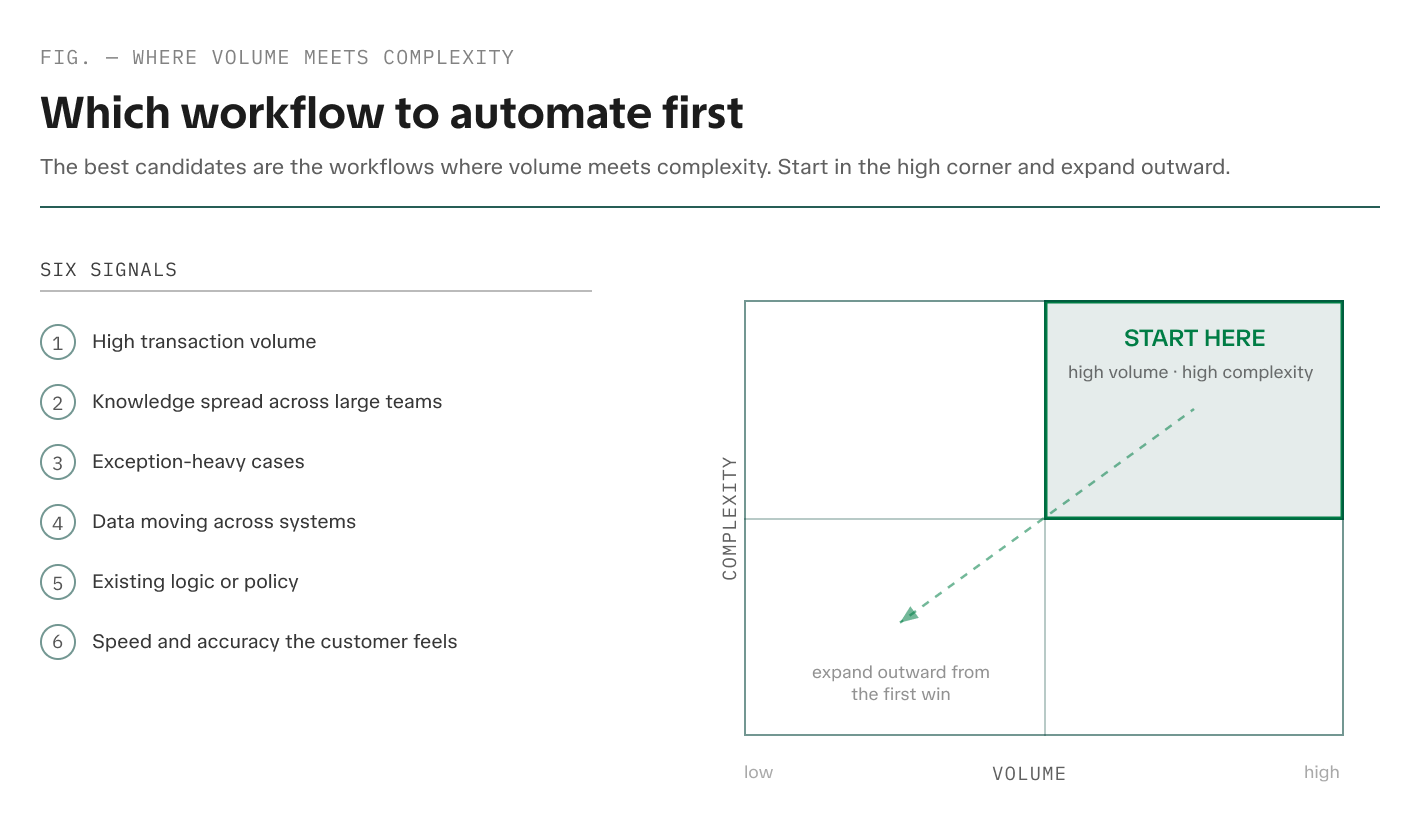
The Papaya Global payslip and invoice example mentioned above illustrates these characteristics. Payroll providers submit thousands of varied payslip formats monthly, relying on coding logic that was historically undocumented. Consulting invoice coding differed between European and US clients based on rules that "lived in people's heads, not in any documentation."
The workflow required cross-system execution, ingesting incoming provider payslips and writing structured, coded invoices directly into NetSuite. Processing delays directly impacted financial reporting schedules.
Although formal rulebooks were initially absent, the deployment began by analyzing a historical batch of processed invoices. This baseline dataset covered roughly 80% of standard case volume, and coverage expanded to 97% as exception patterns were incorporated into the system's logic.
Because exception handling is often the core challenge in complex workflows, the priority for automation with agentic AI is often the opposite of what you might expect to automate. Highly messy, exception-heavy queues are frequently the best candidates for agentic AI because high transaction volume alone can often be handled by traditional automation scripts, while pure exception handling is primarily a staffing challenge.
Back-office operations have become the primary starting point for many enterprise agentic deployments. Finance, logistics, and shared-services workflows are typically high-volume, exception-heavy, and closely measured, aligning well with current agentic capabilities.
Limitations and realities of agentic AI
While interest in agentic AI is surging, bridging the gap between initial evaluation and long-term production success requires navigating two critical operational realities: process evolution and system governance.
First, business processes and operational environments inevitably change. Regulations update, document formats shift, and edge cases emerge over time. An agent cannot be expected to maintain perfect accuracy indefinitely without mechanisms to adapt to changing rules. Systems that rely on static, rigid programming often decay in performance or fail as business workflows evolve.
Second, enterprise adoption depends fundamentally on trust. Deploying agents to execute real-world operations requires stringent governance, comprehensive security controls, and clear human oversight. When organizations grant action permissions without proper safeguards, security risks and operational failures quickly follow.
These challenges explain why current industry stats reflect caution. Industry research shows that while 75% of enterprise leaders claim agentic AI adoption according to Forrester, few have successfully deployed autonomous agents deep into core production. Similarly, MIT's Project NANDA study in The GenAI Divide reveals that while 60% of organizations evaluate agentic tools, only 5% reach full production deployment. Gartner's Hype Cycle for Agentic AI further underscores that failure to establish appropriate governance frameworks remains a major bottleneck.
Technical benchmarks also capture these current limitations. For instance, Stanford's 2026 AI Index reports progress on complex tasks but notes a continuing failure rate of about one in three attempts on unguided computer benchmark tasks. Likewise, METR's March 2025 time-horizon study highlights that model success rates decline on extended, unassisted task sequences, emphasizing the need for structured oversight frameworks.
Security framework organizations like OWASP emphasize this distinction in their Top 10 for Agentic Applications, pointing out that risk management in agentic deployments requires balancing execution capability with strict permission boundaries.
Reindeer solves these core realities through architecture specifically engineered for evolving enterprise workflows. Its inner-loop and outer-loop architecture enables agents to continuously adapt to new process patterns while keeping human specialists in full control of policy updates. Every decision and execution step is logged in a complete audit trail, providing full visibility and accountability.
Combined with enterprise-grade security standards and single-tenant data isolation, Reindeer ensures that autonomous agents operate safely, accurately, and aligned with organizational rules as business requirements change.
What it takes to put an agent into production
Deploying production-grade agents requires addressing two main areas beyond core data science.
Institutional security requirements for agentic AI
Meeting enterprise-grade AI requirements generally involves comprehensive compliance and security reviews prior to production access.
Enterprise security reviews typically involve rigorous architecture verification, strict data isolation, privacy controls, and compliance certifications. For example, Reindeer fulfills these requirements through single-tenant architecture that segregates each customer's environment, cloud infrastructure, and data.
Standard frameworks also incorporate zero-data-retention policies across model providers, assurances against training models on client data, integrated Single Sign-On (SSO) with role-based access management, prompt-injection safeguards, and formal security attestations such as ISO 27001 and SOC 2 Type 2.
Operational workflow design for agentic AI
Managing organizational change is often vital, too. Stanford's Enterprise AI Playbook notes that 77% of reported implementation challenges involve hidden operational costs, such as process redesign, data quality improvement, and change management.
Internal team adoption often presents significant friction, as staff members may resist changing established workflows or learning new systems, accounting for 35% of implementation challenges.
Operationally, three core characteristics almost always determine whether an agent succeeds in production.
1. The agent requests clarification rather than making assumptions
Agents should identify specific missing information rather than returning unhandled tasks to human queues. For example, when Hellmann's quoting agent received a shipping request missing an origin address, it asked the operator for clarification. Upon being directed to use the customer's prior shipment record, the agent retrieved and applied the correct details.
Reindeer's escalation framework ensures that whenever an agent encounters an unclear scenario, it clearly explains the business rules it applied, points out where it needs help, and asks a person for guidance before taking action. Gartner advocates for similar controls at high autonomy levels, emphasizing mandatory guardrails, rapid rollback mechanisms, and automated circuit breakers to halt execution when error thresholds are reached.
2. System logic updates require authorized human approval
Uncontrolled background updates create major compliance risks. In its agent governance report, Gartner predicts that 40% of enterprises will decommission autonomous agents by 2027 due to overly rigid, binary governance models that fail to balance control with flexibility.
3. Agent logic adapts alongside evolving business requirements
Business processes change continuously as regulations, data formats, and policies update. Co-CEO Yoav Naveh cites a banking client that deployed a Reindeer agent to monitor anti-money laundering alerts alongside human analysts. "The rules kept shifting under it, such as new typologies and new sanctions lists," Naveh notes. By identifying new transaction patterns, consulting compliance experts, and incorporating updated guidance, the agent maintained high accuracy over time.
As Naveh highlights in his “built for the wrong moment” article, "The happy path is the first 80 percent and it's all you see up front. The other 20 percent decides whether the agent is worth anything in month six."
What drives the cost of an agentic AI program
Seven primary operational factors determine the cost structure of an agentic AI program:
- How often the work hits exceptions and needs a judgment call
- Number and type of processes in scope
- Number of systems each process touches and the availability of modern APIs
- Build, approval, and rollout effort for the first workflow, including regulatory sign-off
- The organization's starting point with AI
- Size of the team that handles these cases today, including outsourced or contract staff
- Reusability of existing integrations across new workflows, plus ongoing development after go-live
Pricing models vary across the market, ranging from user-based licensing to consumption billing or platform-plus-implementation fees. A DoiT survey of 500 enterprise finance leaders revealed that 79% experienced AI budget overruns, with only 15% able to track AI return on investment without significant administrative friction. Establishing clear metrics to measure operational ROI is critical for long-term project viability.
Use our AI implementation cost calculator to estimate your costs based on your company’s specific needs and requirements.
Should you build agentic AI in-house?
Deciding whether to build or buy agentic AI capabilities typically requires evaluating core engineering requirements. Market trends show a clear shift toward purchasing commercial solutions. Menlo Ventures reports that enterprises now buy commercial software for 76% of AI use cases, up from 53% in 2024.
Building an AI agent internally usually involves far more than basic orchestration. Teams must build connectors for legacy systems, establish enterprise security, conduct extensive testing, design escalation paths, and maintain complete audit logs. Connecting to legacy mainframes like IBM i or AS-400 often requires dedicated, long-term engineering effort.
While most engineering teams can build an initial agent, ongoing maintenance is where costs accumulate. Business processes constantly evolve. Policies update, document formats change, API endpoints are deprecated, and regulatory rules require auditability. Every shift requires continuous updates and testing. Because internal teams bear this maintenance burden permanently, custom builds often fail after launch. Research from MIT's Project NANDA shows that commercial vendor solutions reach full deployment 67% of the time, compared to just 33% for in-house builds.
In-house development makes sense when the core logic provides a direct competitive advantage, such as proprietary underwriting algorithms. Or in cases where the agent is fundamentally part of the revenue-generating work of the business.
For routine back-office workflows, however, the agent is an operational cost rather than a core product. Choosing commercial software allows organizations to retain control over business logic without having to build and maintain the underlying infrastructure for credentials, security, evaluation, and governance.
Most organizations reserve custom software development for proprietary, core-differentiating processes while buying established commercial solutions for standard operational tasks. We’ve found that, for most teams, building internal agents for routine back-office workflows rarely delivers positive ROI compared to commercial options.
Reindeer can manage agents built by your internal team or build and maintain them end-to-end.
Where to start with agentic AI
Understanding the difference between agentic AI and other types of AI is just the first step toward pursuing an AI strategy for your business.
While many products get sold as “agents” or “agentic,” true agentic AI offers capabilities that go way beyond simple AI assistants or scripts, regardless of how vendors market it.
With the definition clear, the next step is to choose the right workflow to automate with agentic AI. Ideal initial workflows are generally high-volume, exception-heavy, reliant on unwritten operational judgment, governed by clear evaluation criteria, and tied to customer-facing response times. When evaluating vendors, ask to see their triggers, system write access, and live data integrations running on your actual systems, and pay close attention to how their agent handles unfamiliar scenarios.
Reindeer builds and manages autonomous AI agents for high-volume back-office processing, directly integrated with your current enterprise software.
Contact us when you are ready to explore deploying agentic AI across your most complex workflows and processes.
Schedule a consultation with our engineering team.
Frequently asked questions about agentic AI
Is Claude an agentic AI?
Claude is primarily a foundational language model rather than a standalone agentic system. Anthropic differentiates the underlying model from full agentic systems, defining agents as broader architectures that direct their own processes and tool usage. Similar principles typically apply to GPT and Gemini. Whether a Claude implementation functions agentically depends on its system integration, specifically whether it incorporates automated triggers, core system write permissions, and live data access.
What is the difference between agentic AI and generative AI?
Generative AI typically creates content in response to manual user prompts, while agentic AI generally executes multi-step workflows independently. Generative tools produce text or summaries and wait for user direction. Agentic systems are often initiated by system triggers, plan multi-step actions, execute tasks inside core applications, validate outcomes, and escalate edge cases automatically. Both often rely on similar underlying models.
What is an agentic AI model?
Agentic capability typically resides in the system architecture built around a model rather than in the model itself. A system often achieves agentic functionality through its integration framework: automated event triggers, application access permissions, live data feeds, and established escalation protocols.
Is agentic AI an LLM?
Agentic AI is generally not synonymous with Large Language Models (LLMs), though LLMs frequently serve as their central reasoning engines. While an LLM produces text responses, an agentic system typically combines language reasoning with operational components including data retrieval, external tool execution, state memory, access security, and continuous execution loops.
What are the different types of AI agents?
Products generally fall into three tiers based on the level of human involvement required: AI assistants (which support human workers to speed up manual tasks), standard scripted AI agents (which execute multi-step workflows independently but require ongoing human oversight), and autonomous AI agents (which handle processes end-to-end and route complex exceptions to human specialists).
What's the best agentic AI platform for the enterprise?
The right platform depends on your operational workflow needs, specifically whether you require basic productivity assistance, supervised multi-step execution, or fully autonomous end-to-end processing with automated exception routing like Reindeer's approach.


Ready to see it in production?

Agentic AI is software that plans and carries out the steps toward a goal inside your systems, under human supervision. Learn how to distinguish true agentic AI from standard assistants and chatbots.