
The 8 Core Types of AI Agents, Explained for Enterprise Buyers


Most lists of AI agent types combine three things: five decision-making types from Russell and Norvig’s AI textbook (the standard AI text taught at more than 1,500 universities), the two common ways of organizing multiple agents, and AI assistants that get marketed as agents.
Together, that makes eight types of AI agents: chatbots and copilots, simple reflex, model-based reflex, goal-based, utility-based, learning, multi-agent systems, and hierarchical agents. These eight categories group agents by how they make decisions.
While this categorization is helpful, buyers also need to know whether a product can run a workflow on its own. That comes down to three things: a trigger, access, and data.
- Triggers start the work when it comes in.
- Access is permission to act inside your systems.
- Data means the agent works from live records.
A product missing any of the three can be helpful, but ultimately not autonomous enough to completely take work off your team’s plate.
The three-tier framework and the eight types of AI agents
To evaluate enterprise software capabilities, systems can be organized into a three-tier framework based on operational autonomy: AI assistants, scripted agents, and autonomous agents.
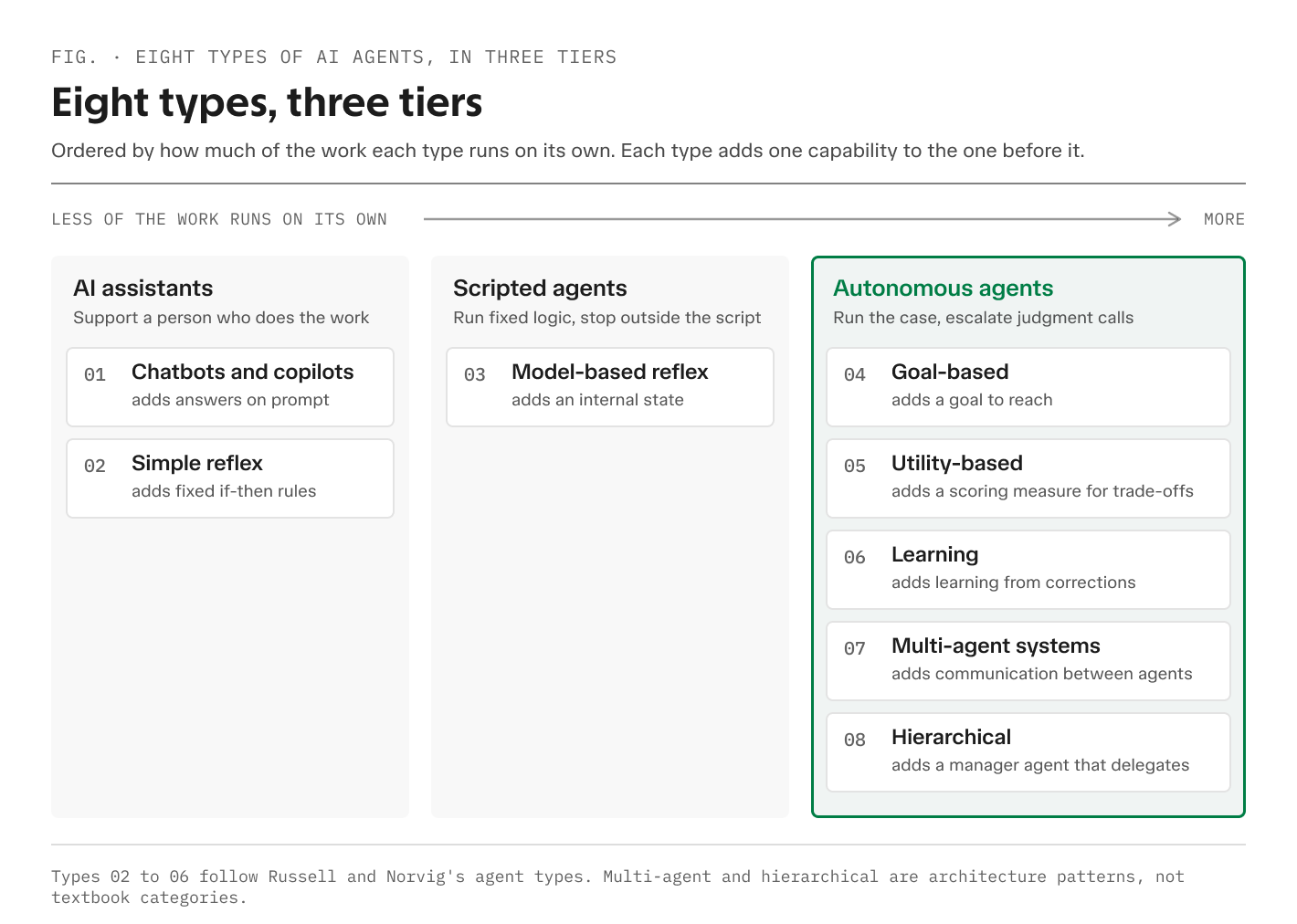
The eight agent types fit into this framework based on how independently they operate, highlighting where high-value platform architectures like Reindeer deliver end-to-end automation.
AI assistants: Support human execution
While often grouped into discussions about AI automation, AI assistants are not technically AI agents. They rely on human prompts and lack autonomous triggers, direct system execution access, and live data integration.
1. Chatbots and copilots
Chatbots and copilots like ChatGPT, Claude, and Gemini for Google Suite assist human users by answering queries, summarizing content, and providing inline recommendations.
Although frequently included in agent discussions, they operate as foundational entry-level assistants that depend entirely on human initiative and lack direct workflow execution permissions.
2. Simple reflex agents
A simple reflex agent evaluates incoming inputs against fixed, predefined rules. It operates entirely on "if-then" logic. Russell and Norvig describe it as an agent that works "by finding a rule whose condition matches the current situation and then doing the action associated with that rule." While academic taxonomies include simple reflex agents as a foundational category, in practice they function more like traditional basic automation, such as a simple email forwarding rule—rather than true AI agents.
Because it retains no memory of past cases and has no context outside the current input, it can only process work covered by explicit instructions.
A common example in back-office operations is basic routing logic in accounts payable that forwards any invoice over a specific dollar amount to a designated manager. This logic works reliably when price threshold is the sole criteria, but fails when processing complex cases, such as an invoice linked to a credit memo from a prior shipment.
Scripted AI agents: Execute tasks with fixed logic
Scripted agents automate specific tasks using direct input-output models or predefined state tracking, but stop when encountering cases outside their pre-scripted parameters.
3. Model-based reflex agents
A model-based reflex agent maintains an internal representation of its environment and updates it as new data arrives. This allows it to make decisions based on information it cannot currently observe directly. In other words it has what’s known as an “internal state” or a memory of past events.
In the first edition of Russell and Norvig's textbook, this category was described as "agents that keep track of the world." Though the terminology evolved, the core concept remains the same: the agent maintains a model of how its environment works and tracks the status of a case over time.
For instance, if a shipment exception agent flagged a delayed container yesterday, its internal state reminds it that a resolution is already underway, preventing duplicate alerts today.
Autonomous AI agents: End-to-end intelligent execution
Autonomous agents handle end-to-end operational workflows independently by evaluating goals, adapting to feedback, and coordinating across systems. Platforms like Reindeer leverage these advanced architectures—goal-based, utility-based, learning, multi-agent, and hierarchical agents—to power high-volume enterprise operations like quote generation and automated invoice processing with minimal human oversight.
4. Goal-based agents
A goal-based agent works toward an explicit objective, evaluating actions based on whether they bring the task closer to completion. The key addition here is a defined target outcome. Rather than simply reacting to rules, the agent determines the necessary steps independently, removing the need to pre-script every action.
Automating price quote generation for freight forwarding is a classic example. Working with Reindeer, Hellmann Worldwide Logistics created a goal-based quoting agent trained on roughly 20 sample requests went into production within weeks to handle quote generation. The objective is to produce a complete, accurately priced quote. The agent dynamically decides which rate lookups, contract verifications, and system calls are needed for each specific request.
5. Utility-based agents
A utility-based agent evaluates multiple potential outcomes using a scoring function to select the optimal path. What it adds is a quantitative trade-off measure. Russell and Norvig define utility as a function that maps states to a numeric scale representing performance quality. This measure resolves scenarios where goals conflict or outcomes are uncertain, requiring a balance between probability and payoff.
Carrier selection is a common business case. Finding the cheapest, fastest, or most reliable carrier creates competing priorities that a basic goal cannot resolve. A utility-based agent uses a scoring model to weigh transit time against shipping costs to select the best option.
6. Learning agents
A learning agent improves its performance over time based on feedback and past outcomes. The key addition is a learning element that incorporates human corrections to update the underlying rules, goals, or scoring models automatically.
Papaya Global uses this approach for payslip mapping using Reindeer. When data fields are ambiguous, the agent flags the case for human review, presents candidate options, and learns from the selection to handle similar issues automatically in the future. As a result, Papaya reduced manual payslip reviews from 50% to under 10%.
Similarly, Reindeer worked with a regulated trading platform to deploy an agent for source-of-funds verification that achieved 95% extraction accuracy, outperforming manual human review while verifying cases 10 times faster.
7. Multi-agent systems
A multi-agent system consists of specialized agents collaborating on distinct parts of a larger workflow. The core innovation is inter-agent communication and task distribution.
Large organizations are increasingly deploying these systems at scale. IBM survey data indicates that most large enterprises plan to deploy over 1,600 AI agents by the end of this year, though 70% of executives acknowledge that current governance frameworks struggle to keep pace. Gartner projects that the average Fortune 500 company will manage over 150,000 agents by 2028, up from fewer than 15 in 2025, creating significant operational management challenges.
Coordination issues can also introduce system vulnerabilities. A UC Berkeley study identified 14 common failure modes in multi-agent systems across 1,600 test runs, citing design flaws, conflicting objectives between agents, and missing verification steps as primary causes.
8. Hierarchical agents
A hierarchical agent establishes a supervisory structure where a manager agent directs subordinate agents. The manager breaks down complex objectives, delegates sub-tasks to specialized agents, and synthesizes the outputs. The added capability is delegation.
Note that hierarchical agents are an architectural pattern rather than a formal academic classification, as standard AI textbooks do not list them as a standalone category. However, their widespread implementation in production systems makes them essential to include.
For example, an end-to-end invoice processing agent might use a hierarchical structure: one specialized sub-agent extracts document data, a second verifies approval rules, and a third confirms vendor authenticity before finalizing the transaction.
How the eight types compare side by side
Each agent type introduces a distinct core capability that differentiates it from the preceding tier, as shown in the comparison below.
Reviewing the added capabilities in order demonstrates how each tier grants progressively greater operational independence to the system. This explains why industry models vary in total count while describing the same fundamental evolution.
What makes something an AI agent at all
An “AI agent” is a system designed to complete tasks independently, rather than simply generating outputs for a human operator to process.
FINRA defines AI agents as "systems or programs that are capable of autonomously performing and completing tasks on behalf of a user," highlighting autonomy, scope, auditability, and data security as key operational considerations. McKinsey similarly describes an agent as "a system based on generative AI foundation models that can act in the real world and execute multistep processes."
While these definitions are clear, vendor marketing often blurs these distinctions. Gartner estimates that out of thousands of vendors selling "agentic AI," only about 130 offer true agentic functionality. Gartner labels the rest as "agent washing," the practice of rebranding traditional chatbots, AI assistants, or RPA tools without adding real autonomous capabilities.
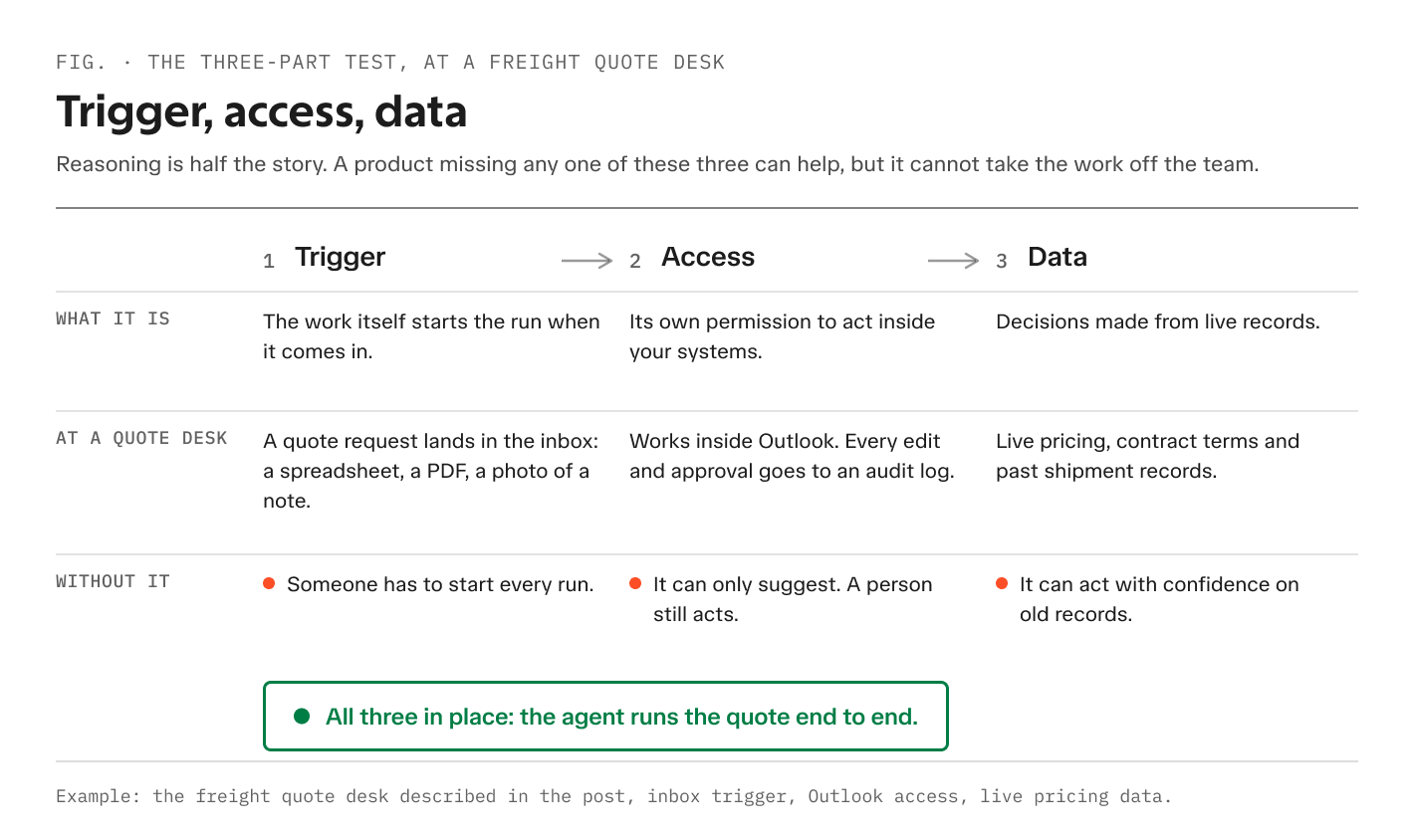
To cut through marketing claims, evaluate an agent based on its permissions and system connectivity. A tool can execute workflows autonomously only when its integrations provide three core elements:
- Trigger: An automated integration that monitors systems and initiates execution when specific conditions occur.
- Access: Dedicated credentials and system permissions that allow the agent to perform actions directly within applications.
- Data: Real-time system connectivity that ensures decisions are made using current, accurate records.
Missing any of these components limits the system's autonomy. Without a trigger, an agent requires manual invocation. Without system access, it can only suggest actions rather than execute them. Without real-time data, it risks acting confidently on outdated information, often leading to costly errors.
Governance research reinforces this principle. Gartner notes that agent failures occur most frequently when organizations confuse reasoning capability with the actual scope of system permissions granted.
Is ChatGPT an AI agent?
ChatGPT is a large language model with a conversational interface that operates primarily as an assistant in standard workplace setups. It responds when prompted, lacks direct user permissions inside enterprise ERPs, and does not monitor systems or access live internal databases automatically.
Under the trigger, access, and data framework, default ChatGPT installations lack all three requirements. However, connecting LLMs to external data connectors and tool execution frameworks allows them to function agentically. Functionality is determined by integration depth rather than product naming.
Copilots occupy a similar assistant role and deliver clear value. A Forrester study on Microsoft 365 Copilot showed a 116% three-year return on investment and saved users roughly nine hours per month. However, these time savings result from assisting human workers who still execute the ultimate tasks.
Assistants are effective tools for individual productivity. Problems arise when an assistant is deployed to manage high-volume queues, as human operators still have to manually process every generated suggestion.
Which type of AI agent fits which job
Select an agent architecture based on the specific structural demands of your workflow.
Answering four basic questions about a process helps determine the appropriate agent type.
Are the rules written down and stable?
If every decision follows clear, static rules, a simple reflex agent or standard automation is sufficient. Advanced architectures add unnecessary complexity. Gartner recommends using plain automation for predictable, routine tasks, AI assistants for standard information lookups, and AI agents only where complex decision-making is required.
Does the work cross systems and time?
Workflows that span multiple applications or rely on historical context require agents with state retention. Systems that evaluate inputs in isolation cannot handle exception queues effectively, as resolving an exception usually depends on understanding the history of the case.
Do good outcomes trade off against each other?
When a workflow involves competing priorities, such as balancing cost, speed, and reliability, the agent requires a scoring function to weight options. Goal-based designs fail in these scenarios because they optimize for a single target while ignoring secondary trade-offs.
Does the judgment live in people's heads?
Workflows relying on unwritten human expertise require adaptive learning agent architectures. If subject matter experts make nuanced decisions based on experience but cannot define explicit rules, simpler rule-based systems will fail. Learning agents capture this implicit knowledge by adapting to human interventions over time.
Designing human oversight models directly impacts operational efficiency. Research from the Stanford Digital Economy Lab indicates that exception-based escalation models, where agents handle standard tasks and route edge cases to humans, achieved a 71% median productivity increase, compared to just 30% for approval models requiring human sign-off on every action. Determining the right balance depends on error tolerance, compliance requirements, and process complexity.
Organizations considering custom solutions should evaluate the build vs. buy trade-offs before committing engineering resources.
When a simpler agent is the better buy
Higher autonomy is not inherently superior for every enterprise application. Simpler designs are often more effective depending on process requirements.
Research on multi-agent systems by Dat Tran and Douwe Kiela demonstrated that when compute resources are held equal, single-agent architectures match or outperform multi-agent setups on complex reasoning tasks. In other words, adding more agents to a single workflow does not automatically increase operational capability.
Similarly, some tasks are better suited to simpler automation solutions altogether. While technical benchmark capabilities are rising rapidly (Stanford HAI's 2026 AI Index notes OSWorld computer task performance jumped from 12% to 66%), agents still fail on roughly one-third of structured benchmark tasks. Gartner predicts that over 40% of agentic AI initiatives will be canceled by 2027 due to rising costs, unclear ROI, or inadequate controls. RAND similarly estimates AI project failure rates at over 80%, which is double the historical rate for standard IT software projects.
Where process rules are fixed and stable, rely on traditional automation. Deploying adaptive learning agents on stable, rule-based processes adds unnecessary monitoring overhead without business benefit.
Autonomous AI agents in practice
Examining a real-world enterprise workflow illustrates how these agent types operate in practice.
High-volume freight quote automation
Consider a freight forwarder's quote desk: incoming email requests must be parsed, rates retrieved across multiple systems, contract terms checked, and final quotes issued.
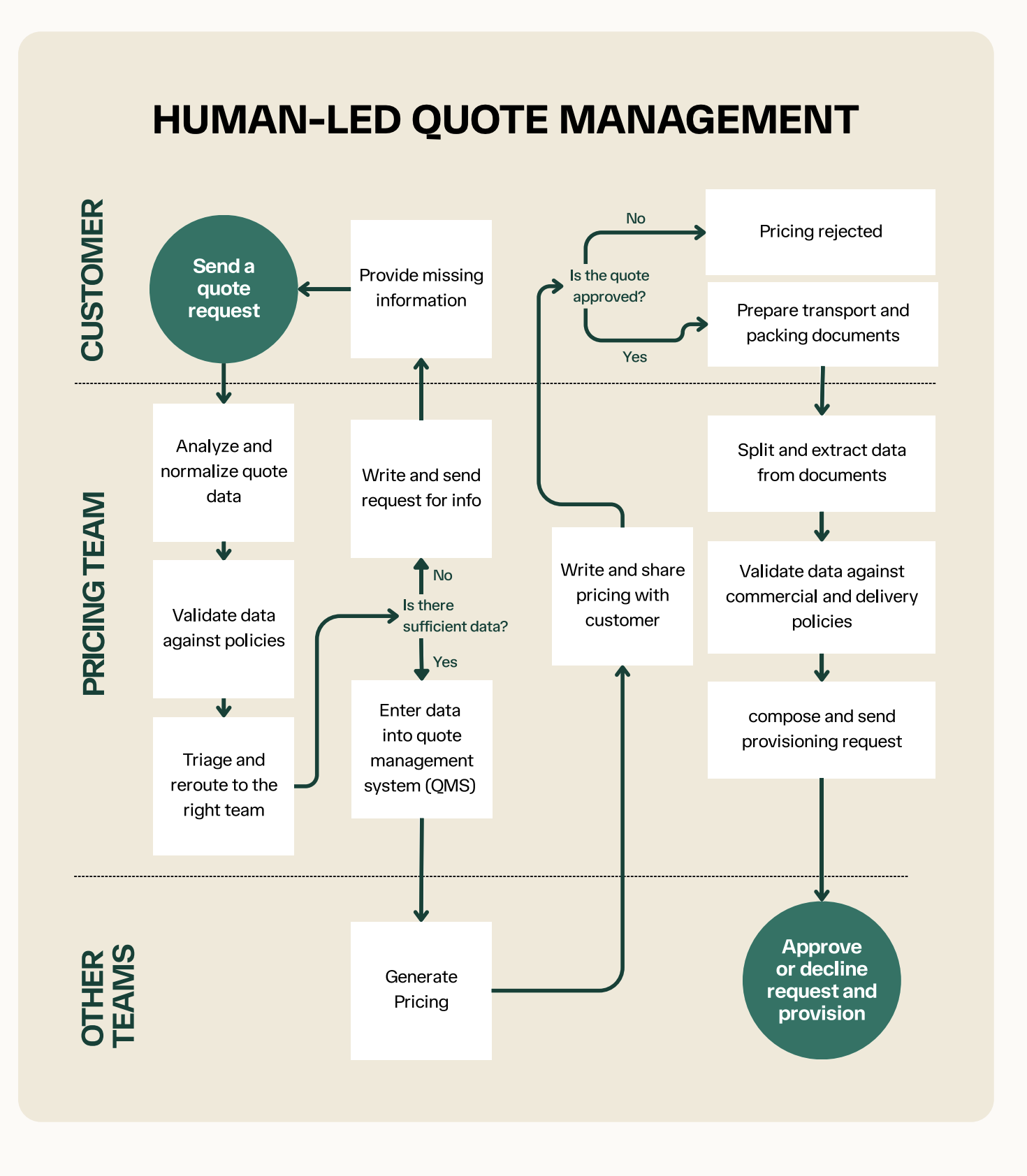
Hellmann Worldwide Logistics, which processes 20 million shipments annually, deployed an agent for this workflow trained on roughly 20 sample requests.
The automated system delivers complete, rapid quotes that help win new business. Its underlying architecture is the escalation behavior: when a request lacks a shipping address, the agent prompts a representative for guidance. If the rep specifies using the address from the customer's prior shipment, the agent locates and applies it. This adaptive memory demonstrates a learning agent in production, supported by a full integration framework across triggers, access, and data.
The trigger is an inbox receiving unstructured quote requests, including spreadsheets, PDFs, and images of handwritten notes. Incoming messages automatically initiate processing runs. Hellmann also established a dedicated feedback inbox where pricing experts corrected output during training, creating a performance monitoring system used in live production.
System access is integrated directly into Outlook, allowing representatives to edit requests, add details, or return items with comments within their existing interface. Every edit and approval is recorded in a detailed audit log. For data connectivity, the agent queries real-time pricing databases, contract repositories, and historical shipment records.
Payroll operations run on the learning element
At Papaya Global, automated invoice coding increased from 80% to 97%. For payslip mapping, processing over 10,000 documents monthly, adaptive learning capabilities handle varying, unannounced regional formatting changes automatically.
Financial crime review turns on what gets looked at first
At a regulated financial platform, a source-of-funds verification agent achieved 95% extraction accuracy, outperforming manual human review, while processing cases 10 times faster.
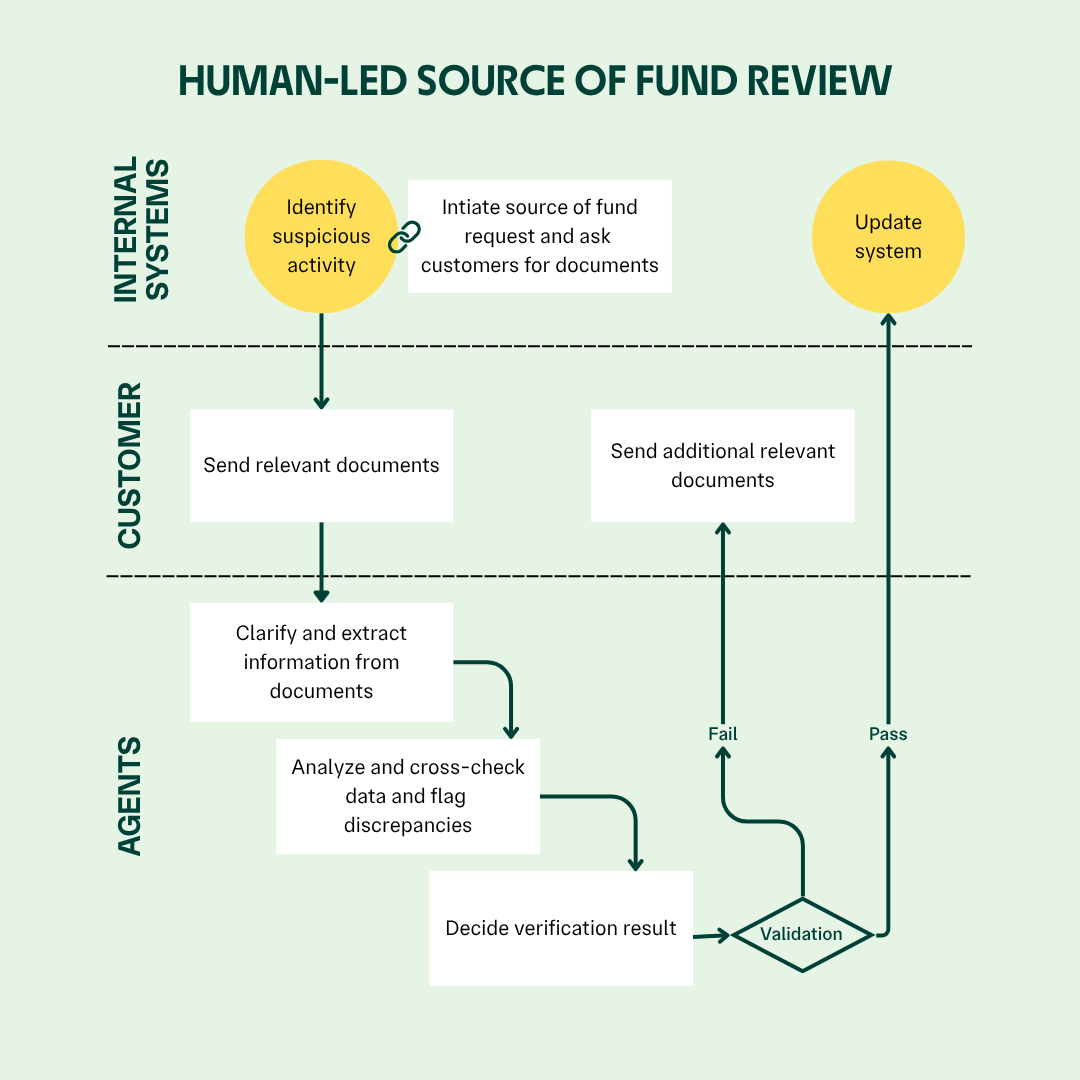
Deployed in two weeks using under 50 sample cases, the agent prioritizes high-risk accounts to maximize reviewer efficiency.
Deployment speed is equally critical during procurement. Reindeer averages under four weeks from kickoff to production by focusing initial implementations on targeted, well-defined workflow scopes.
Start with one workflow
Understanding agent classification frameworks helps evaluate software vendor capabilities. However, high-volume, exception-heavy processes relying on unwritten rules quickly point toward adaptive agent architectures. The primary task is selecting the right initial workflow.
Back-office operations yield strong returns for many AI deployments. MIT's Project NANDA research shows that specialized commercial AI tools achieve a 67% success rate (roughly double that of custom internal builds).
Focus on operational bottlenecks characterized by high volume and complexity. Target workflows that contain six key indicators:
- High transaction volume.
- Knowledge spread across a large team.
- Exceptions as the norm rather than the outlier.
- Data moving between systems to close a case.
- Policy or logic that already exists somewhere.
- Speed and accuracy the customer notices.
Start by deploying AI to automate and single workflow and demonstrate value in production before expanding to additional operational processes.
Set up a call with Reindeer to discuss which workflow is ripe for automation in your org.
Frequently asked questions about types of AI agents
What are the 8 types of AI agents?
The eight types of AI agents are chatbots and copilots, simple reflex, model-based reflex, goal-based, utility-based, learning, multi-agent systems, and hierarchical agents. Chatbots and copilots sit at the assistant level, while simple reflex through learning agents reflect increasing decision-making autonomy. Multi-agent systems and hierarchical agents describe multi-agent coordination frameworks.
Is ChatGPT an AI agent?
ChatGPT is a large language model that functions primarily as an AI assistant out of the box. It requires user prompts, lacks default enterprise system permissions, and does not run workflows autonomously. When integrated with external tools, triggers, and data databases, it can operate agentically depending on the deployment setup.
Which type of AI agent is best for business?
The best agent type depends on process requirements. While predictable tasks with fixed rules suit standard automation, high-volume, exception-heavy back-office workflows benefit most from Reindeer's autonomous AI agents. By combining goal-based reasoning, adaptive learning, and deep system integrations, Reindeer enables end-to-end operational execution with minimal human intervention.
What's the difference between an AI agent and an AI assistant?
An AI assistant helps human users perform tasks, leaving execution to the user. An AI agent completes workflows independently end-to-end. Operationally, agents require automated triggers, scoped system execution permissions, and direct real-time data connectivity.

Ready to see it in production?

AI agents fall into eight types based on how independently they make decisions. For enterprise buyers, choosing the right type of agent is critical for automating high-volume, exception-heavy workflows and processes.