
The State of AI in Logistics: Use Cases, Case Studies, & Trends

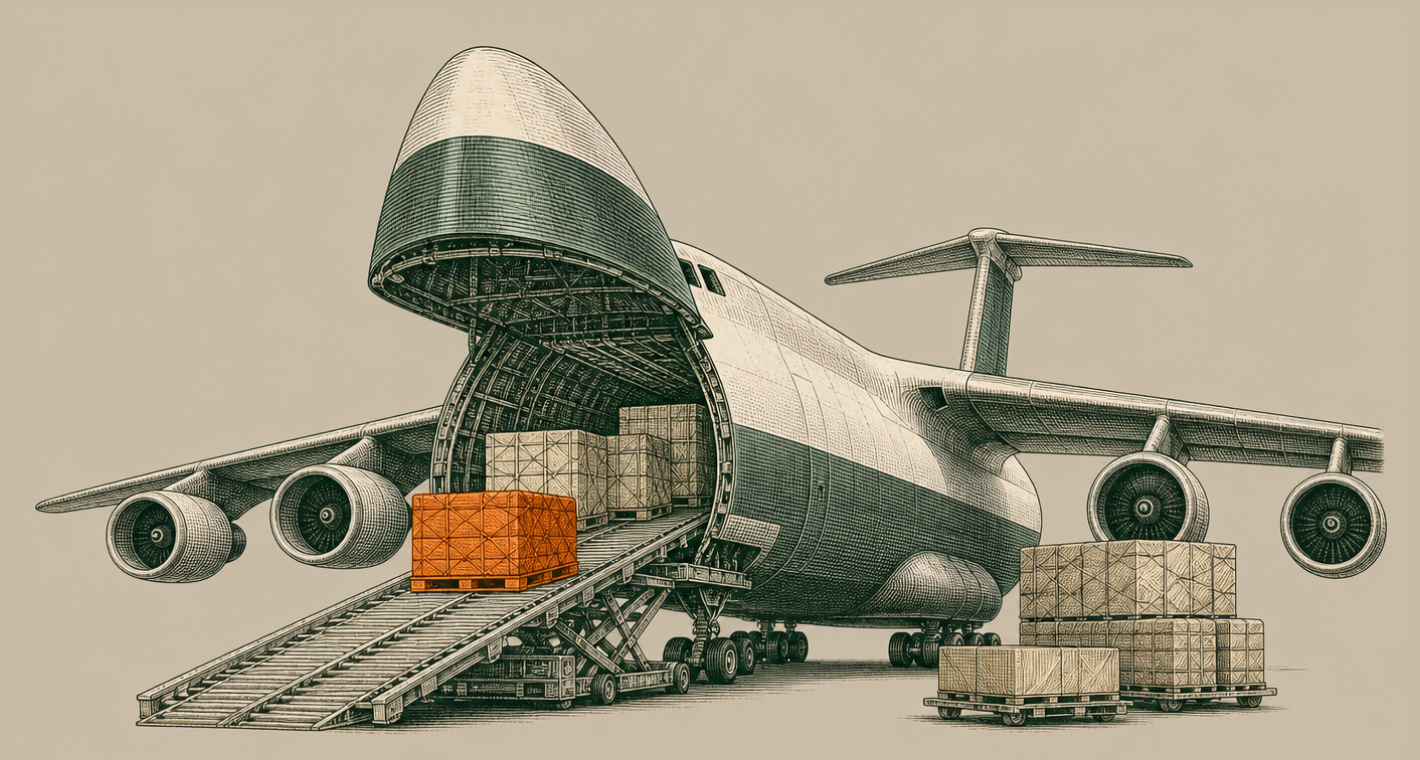
AI in logistics is the use of machine learning and agentic AI to run the work of moving freight, from route and network planning through the quoting, tracking, auditing, and customs paperwork wrapped around every shipment.
The wider supply chain AI story also runs through demand planning, sourcing, and production.
The delays a freight customer feels most are usually clerical.
A quote request waits on a pricing analyst, customs files come back over one missing field, or the carrier invoice sits in a dispute queue long after the shipment it covers was delivered.
That work is high volume, exception-heavy, and already within reach of production AI, which is why it deserves the first look, not the budget left over after the network projects.
What AI in logistics covers
AI in logistics covers two bodies of work that behave nothing alike:
- Physical-network AI: Route optimization, demand forecasting, warehouse automation and robotics, yard and dock scheduling, autonomous trucking.
- Back-office AI: Quote and RFQ intake, track and trace responses, freight audit and payment, transportation procurement and freight matching, customs and clearance filings, and the document processing that feeds a TMS or ERP from bills of lading, proofs of delivery, and rate confirmations.
Gartner treats them as separate stories too, listing agentic AI and physical AI as two distinct trends in its 2026 supply chain technology trends.
The physical-network side acts on transportation and storage themselves:
- Route optimization sequences stops and line-hauls against traffic, capacity, and time windows, so the same fleet covers more ground on less fuel
- Demand forecasting places inventory before the orders arrive
- Warehouse robotics run picking and sorting
- Yard and dock scheduling keeps trailers off the door
- Autonomous trucking aims to drive the long highway legs itself, though it sits furthest from production of the five
Alongside the hardware, driver-facing AI reached the cab in June 2026, when Samsara launched an assistant that answers a driver’s parking, weigh-station, and policy questions mid-route, and last-mile delivery automation is running in production pilots that remain capital-heavy to scale.
The back-office side works the paperwork wrapped around every shipment:
- Quote and RFQ intake reads requests that arrive as emails, PDFs, spreadsheets, and photos, and turns them into priced, trackable quotes
- Track and trace reconciles carrier portals, EDI feeds, and inboxes to answer a customer’s status question without a person assembling it
- Freight audit and payment checks carrier invoices against contracted rates and accessorials before the money leaves
- Transportation procurement and freight matching pairs loads with carriers and rates
- Customs and clearance assembles the filing and checks that classification, valuation, and origin all agree
- Document processing reads bills of lading, proofs of delivery, and rate confirmations into the TMS or ERP
Physical-network AI is capitalized on a multi-year clock, usually decided above the business unit.
Back-office AI runs on the systems already in place, shows up as operating expense, and can be scoped by the leader who owns the workflow. If you've been handed an AI mandate and a fiscal year, only one is yours to start.
Automating back-office work is also where artificial intelligence in logistics has reached production in weeks, making it a key area where operators focus today to unlock immediate returns.
Why the back-office pays back before the physical network
Only 13% of logistics service providers can point to measurable value from AI in their daily operations, according to a January 2026 BCG and Alpega survey of 84 providers and 98 shippers.
About 40% have deployed AI beyond pilots, and where they have, adoption clusters in transport planning and execution at 64% and tracking and visibility at roughly 50%.
The same report says the largest remaining opportunity lives outside both of those areas. "Reducing administrative and back-office workloads, such as booking processing, documentation handling, and internal coordination," the report says, can significantly improve white-collar productivity in branches and service centers.
Freight paperwork is an old problem. McKinsey's trade documentation analysis found the documentation process alone "can take six hours, or more, across all stakeholders," and put the bill of lading at 10% to 30% of total trade documentation costs. Carrier CEOs in the Digital Container Shipping Association even signed a 100% eBL commitment, pledging 50% of bills of lading digital within five years and all by 2030.
The industry considers this worth fixing but hasn't fixed it.
Compare that to the story of physical-network AI deployments. Aurora, one of the furthest-along driverless trucking programs in the United States, said in its Q1 2026 results it anticipates deploying more than 200 driverless trucks by year end. That's a serious engineering milestone, but the scale of the deployment is still small, even after a years-long timeline.
In the document layer, deployments take weeks and scale to cover nearly all production workflows.
All that to say, both categories are worth building, but if you’re looking for opportunities to deploy AI and see results in the coming quarters, it’s worth aiming at the back-office work first.
How to tell which logistics workflow to start with
Conventional wisdom might tell you to start with your highest-volume repetitive task because it's easy to measure and automate.
In a freight operation that usually selects work a script or a TMS rule already handles well, which is why the pilot succeeds but the impact is minimal and there’s no appetite for funding future pilots.
Complex automations are usually the places with bigger payoff and greater impact.
For example, a fulfillment 3PL that ran shipment status for 50 customers across hundreds of carriers, each sending updates in whatever format it preferred, with documented procedures that rarely matched practice. They reported 40% of the 30-person team turning over every year.
Turnover makes a queue like that urgent. The knowledge that makes a freight quote correct is rarely written down and only a handful of senior pricing analysts really know the mechanics.
After deploying an AI agent trained on track-and-trace operations, they were able to improve results and efficiency of their shared services team. CSAT improved by 14% and escalation time dropped from 3 hours to just 2 minutes.
This is just one example, but it points to a pattern across many successful AI deployments we’ve seen. Volume, complexity, distributed knowledge, and constant knowledge loss are underlying factors that point toward the place you should start.
You can think about the convergence of high transaction volume and genuine complexity.
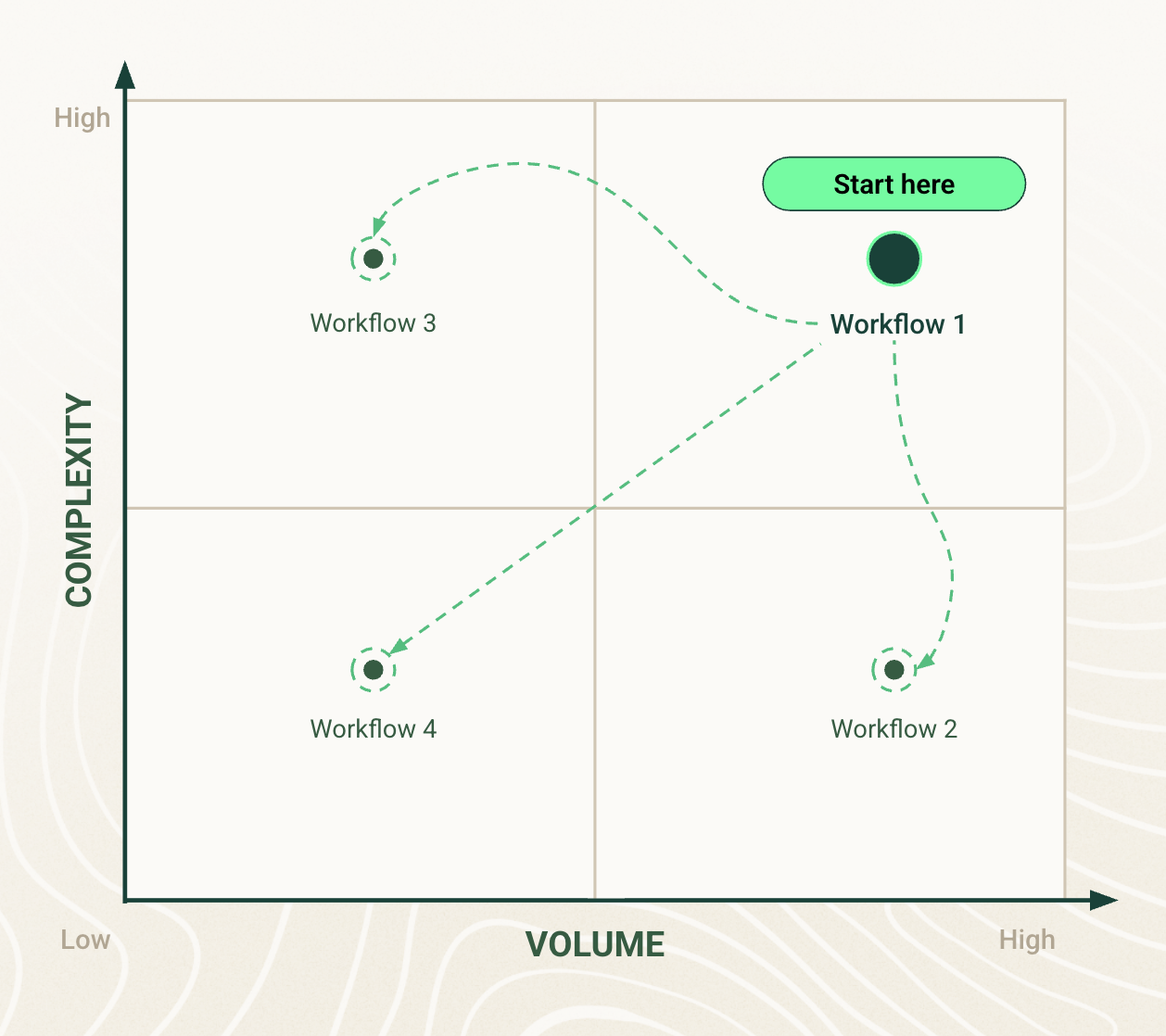
Look for six signals showing up together:
- Heavy transaction volume
- Knowledge spread across a large team
- Exception-heavy cases
- Data that moves between systems
- Existing logic or policy the work already follows
- Speed or accuracy that customers notice
You're not behind for starting narrow.
A Gartner supply chain survey of 140 senior leaders found 17% pursuing immediate transformational redesign, with the other 83% applying AI to specific use cases or scaling gradually. Which workflow wins the test inside your operation is a question only you can answer.
Freight workflows where volume meets complexity
Your company’s operations are unique and the specific workflow that will lend itself best to AI-powered automation may look different from any deployment done by another company. However, looking at examples of what has worked for logistics businesses helps you see patterns in the shape and scale of the automation and identify opportunities for yourself.
Reindeer customers have seen results such as processing cycle time down 70%, 85% of exceptions resolved without escalation, and production in under four weeks.
Across three freight deployments, almost all automation projects start as a narrow and focused deployment:
- Quote intake at a high-volume 3PL: Turnaround from 48 hours to four hours and win rate from roughly 25% to 50% over two months, in its quote turnaround case study.
- Track and trace at a global freight carrier: Escalation resolution in freight from five hours to three minutes, and customer satisfaction from 3.7 to 4.7 in three months.
- Freight audit and payment at a tech-enabled 3PL: Freight payment disputes down from 5% to 3% in a week, and invoice approval from 20 hours to three minutes.
Quote and RFQ intake at a freight forwarder
Hellmann Worldwide Logistics moved their quoting workflow first.
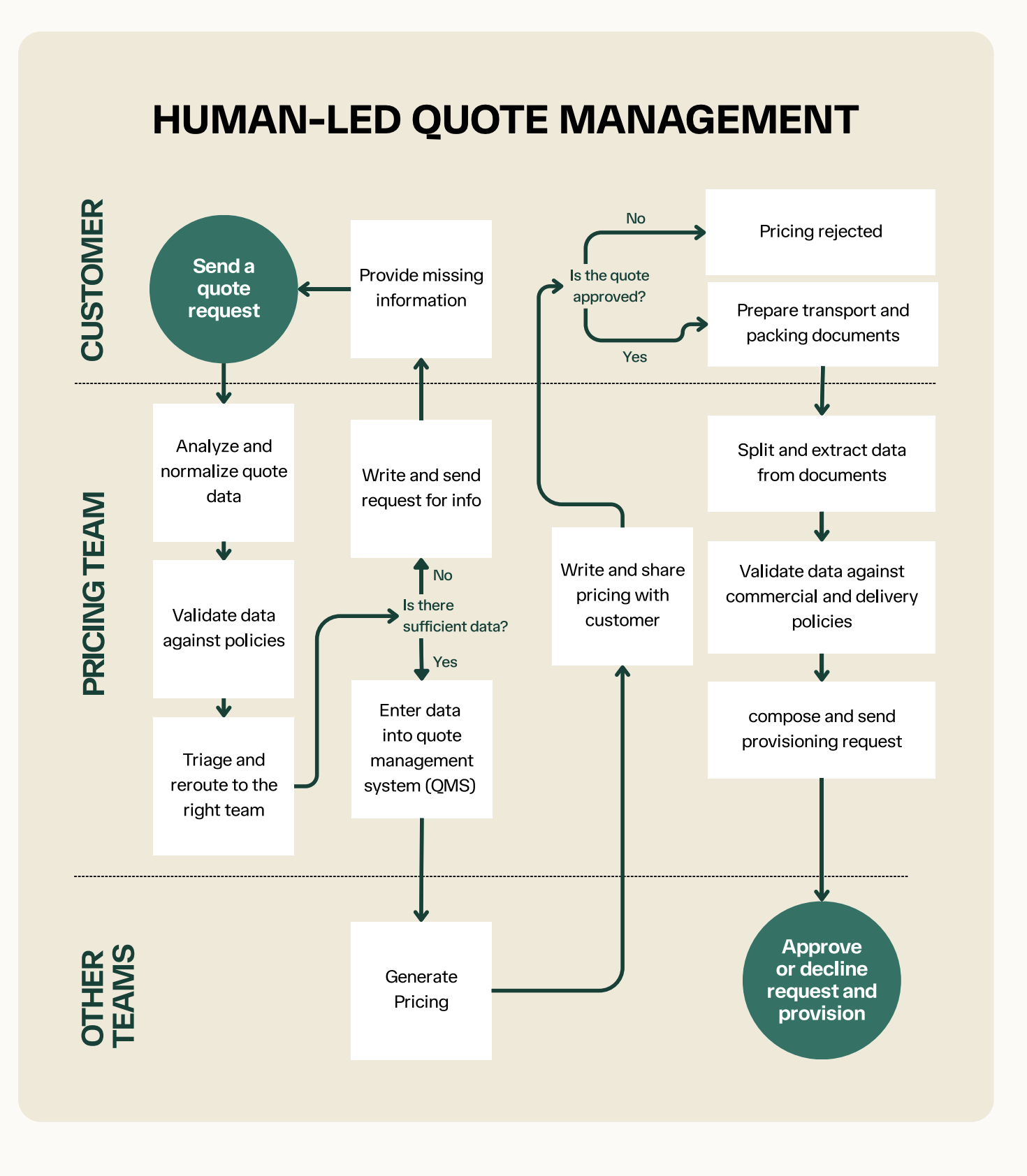
They built an Outlook add-on that pulls shipment details out of emails and attachments, flags what's missing, and tracks each request to completion, trained on about 20 sample requests at a forwarder handling nearly 20 million shipments a year.
Hellmann's pricing team stood up a dedicated training inbox and corrected quotes as they came in, and every correction became training data.
"This project made it clear that AI is already practical," says Dominik Schindler, head of innovation at Hellmann. "It helped us move faster and avoid mistakes, and it showed the team what's possible when you rethink a process like quoting."
Scale changes the texture. One 3PL fields almost 1,000 quote requests a day as emails, spreadsheets, PDFs, and photos of rate requests scribbled on paper, many in different languages, many carrying several scenarios in one message. The agent emails customers in their own language for missing dimensions or insurance details, then hands a clean RFQ to a sales rep.
Track and trace, and the escalation queue behind it
Freight customers form their opinion of an operation during the shipments that go wrong, and those are the shipments where a straight answer is hardest to give. The status of a delayed container lives in several systems at once. The carrier portal says one thing, the terminal system another, the booking in the TMS a third, and none of them match what the customer was promised.
At one global freight carrier, every delayed shipment sent a rep pivoting across all three to rebuild an ETA by hand, while the escalation queue behind them grew.
The carrier put an autonomous agent on that queue, trained on 10 sample cases and went live in 14 days. The agent reads the carrier portal, the terminal feed, and the customer’s request together, reconciles where they disagree, recalculates the ETA, and answers the customer.
Shipments moving on schedule never touch it; the deployment was scoped to exceptions from the start.
Escalation resolution went from five hours to three minutes, and customer satisfaction rose from 3.7 to 4.7 out of 5 within three months.
Freight audit and payment
Carrier invoices are the workflow where accuracy is most measurable. An invoice has to agree with the rate agreement, the accessorial schedule, and the fuel table, and any of the three may have been amended since the shipment was quoted.
When the numbers disagree, someone works the difference line by line. When nobody has time, the overpayment goes out the door and the dispute starts later, from a weaker position.
One tech-enabled 3PL had outsourced that reconciliation to a BPO, but they estimated an error rate around 30%, which is not acceptable (to say the least). Shipping codes sat clearly visible on the paperwork and were missed anyway, invoices defaulted to premium rates, and six months of those miscues produced millions in carrier overpayments.
Bringing the work back in-house with an autonomous agent cut freight payment disputes from 5% of invoices to 3% within a week of go-live and took invoice approval from 20 hours to three minutes.
Customs, clearance, and the documents behind them
Customs is the underserved piece of the market. The BCG and Alpega research found customs and compliance "matters considerably among shippers" but is not yet a top-five concern for logistics service providers, which it calls a clear opportunity. Working with a global logistics leader, BCG found the biggest improvement came from automating complex documentation, including requests for proposal, customs paperwork, and contractual agreements.
The work itself is cross-checking. Classification, valuation, origin, and the commercial invoice all have to agree before a filing goes in, and a mismatch can be hard to spot. It surfaces weeks later as a penalty, a hold, or a post-entry audit, which is why operations keep senior people on work that is mostly reading the same fields across four documents.
Flexport said in February 2026 that AI-powered automation had cut its error rate on U.S. customs filings to 0.2%, a figure its CEO estimated at roughly ten times better than the broker average.
Choosing the right type of AI for logistics back-office automation
Exception-heavy freight work needs a system that can carry a case from intake to completion.
What makes this tricky is that there are a lot of AI products and platforms on the market. They all might seem to be selling ostensibly the same thing in a different wrapper, but the actual capabilities can be wildly different depending on what you buy.
You need an autonomous AI system that owns the end-to-end work, handles cases that it’s been trained, and escalates the edge cases it hasn’t seen.
You won’t be able to get nearly as far with something like an AI assistant, which answers questions and drafts things while a person still does the work. Or a standard AI agent that does the work but still needs supervision from humans.
For a queue where exceptions are the norm, an assistant and a supervised agent both move the bottleneck but don’t eliminate it. These options may be the right fit for certain use cases, but the AI deployments with measurable business outcomes in quoting, escalation handling, and invoice approval, all cleared their queues by deploying autonomous AI agents with enterprise-grade functionality.
Learning to handle edge cases and uncertainty
The decisive question about any agentic system in a freight operation is what it does with the case it can't settle.
Four questions get at it:
- Does the system stop when it's unsure, or does it guess?
- When it stops, who does it ask, and does that person get enough context to answer in seconds?
- Does that correction change what happens next time, or does the same case come back next month?
- Can anything about the system's own logic change without a named person approving it?
The evidence favors designing for escalation over approval. Stanford's Digital Economy Lab found escalation-based operating models, where AI handles 80% or more autonomously and humans review only exceptions or a 20% sample, delivered a 71% median productivity gain against 30% for approval models.
Reindeer's platform runs on two learning loops. Inside a single case, the inner loop gives every decision a confidence score shaped by how unusual the case is, how complex it is, and how far the agent's plan diverges from the norm. Below a threshold, the case routes to a subject matter expert with a precise set of questions.
For example, in one escalation the agent asked whether to use the last shipment's address for a missing field, the rep confirmed, and the captured decision taught it which customers bundle requests from three cities and which odd-looking document formats were legitimate.
The outer loop governs the agent itself. Changes to its logic are proposed as one reviewable bundle, get regression-tested against past cases, and require an agent manager to approve them. Nothing about how the system decides changes in the background, but the agent can learn and expand its capabilities with each new policy update.
Where to start with AI for logistics
Pick one workflow and scope it end to end before you scope anything else.
Run the volume-meets-complexity test against your own queues, figure out which workflows feel like they might be the most difficult to automate, and… start there.
Reindeer's supply chain operations work sits in this layer, from quoting and track and trace through freight audit, customs, and the document processing underneath.
If you can name a queue where volume meets complexity, that's enough to begin.
Scope one workflow with the team and find out what it takes.
Frequently asked questions about AI in logistics
How is AI used in logistics?
AI is used in logistics in two broad ways. Physical-network applications cover route optimization, demand forecasting, warehouse automation and robotics, and autonomous trucking. Back-office applications cover quote and RFQ intake, track and trace responses, freight audit and payment, customs and clearance filings, and logistics document processing that reads bills of lading, proofs of delivery, and rate confirmations into a TMS or ERP. The back-office layer is where most freight forwarders and 3PLs see production results today.
Will logistics be replaced by AI?
No, AI won’t replace logistics work; it will change shape instead of going away. Alexander Terglane, pricing and tender lead at Hellmann Worldwide Logistics, put it this way in the company's case study: "It feels like we added experienced hands overnight. Routine requests move through automatically, more complex ones are handled in a copilot mode, and my team focuses on escalations, edge cases, and customer conversations where experience and human touch actually matter."
What is the difference between generative AI and agentic AI in logistics?
Generative AI produces content, and agentic AI decides and acts inside systems. In freight, generative AI drafts the customer reply or summarizes a long customs document. Agentic AI in logistics reads the rate confirmation, checks it against the contracted rate, routes the mismatch to the person who can settle it, and closes the case. Most production deployments use both, the generative element handling language and the agentic engine handling the workflow.
How long does it take to get an AI workflow into production in a freight operation?
It only takes a few weeks to deploy a new AI workflow when the operating team is available to correct the system while it runs. Hellmann Worldwide Logistics trained on about 20 sample requests and was in production within weeks, and a global freight carrier went live in 14 days on 10 sample cases. Reindeer asks who will be sitting in the training inbox before it quotes a timeline, because that answer sets the schedule more than anything on the vendor's side.
Your next read


Ready to see it in production?

Physical-network AI in logistics (routing, robotics, autonomous trucks) is a multi-year capital bet. Back-office AI, quoting, track and trace, freight audit, and customs, runs on existing systems and reaches production in weeks, which makes it the faster place to start.