
The 9 Elements of AI Enterprise Architecture, Mapped

AI enterprise architecture is the arrangement of systems, data, models, and controls that lets an organization put AI to work inside its live operations, plus the governance and change mechanisms that keep it working after go-live.
It has nine elements, spanning:
- The foundation is the software you already run
- Six layers of new AI capability stack on top of that foundation, each building on the one below it
- And two control planes (governance and monitoring) that apply across both
Data, models, integration, governance, and observability are all part of the equation. But the actual architecture that will work for your enterprise depends, in part, on the nature of the deployments you have planned. An architecture where employees use AI looks different than one where agents do the work autonomously.
What is AI enterprise architecture?
AI enterprise architecture describes how an organization assembles AI into its operations.
It covers four things:
- The layers of technology involved
- How those layers connect to the systems already running the business
- How the whole structure is secured and governed
- How it changes over time without breaking
The output is what architects call a target state architecture, which means a picture of the end state you're building toward. It should be simple enough for a COO or a VP of Finance to draw on one slide, and concrete enough to defend through a security review.
AI architecture is not a single AI application. A Copilot rollout or one document-processing tool is a deployment. The architecture is everything around those deployments, including how they connect to your systems, how they stay secure, who governs them, and how the next one plugs into the same structure. Get the architecture right and the tenth deployment goes faster and safer than the first, because it reuses the connections, controls, and lessons of the nine before it.
Your AI goal shapes the architecture you should build. There is no fixed menu of architectures to choose from. Instead, you assemble one custom to your business, and your goal decides what goes into each layer. For example, if your goal is AI enablement, meaning staff equipped with assistants and search, then the stack should be optimized for breadth of access. That’s because assistants create value by putting answers in front of as many people as possible, so the architecture's main job is connecting them safely to the company's knowledge.
If you want to build for autonomous execution, meaning agents that handle whole workflows from start to finish (coding invoices in finance or quoting shipments in supply chain, for example), you’ll need an architecture that supports it. Agents that act on their own need guardrails that assistants might not. Every action has to be provable to an auditor, every exception needs a defined path to a person, and changes to an agent's logic need human approval.
The difference matters because most organizations start with assistants and eventually want more. An assistant helps a person do the work, but the person still does it. An autonomous agent does the work itself and brings people in only for the unusual cases.
Why the architecture question is different now
The AI systems enterprises are building now take action inside other systems, and that’s a big shift from legacy tools. For example, tools like analytics platforms answered questions and copilots drafted documents, but neither could go into an ERP and change a record on its own authority.
Now, for instance, an AI agent that codes invoices can also write directly to the ERP. But the architecture has to be designed for that.
McKinsey's State of AI survey puts 23% of organizations at the scaling stage with agentic AI in at least one function, while nearly two-thirds remain stuck in experimentation or piloting. Forrester's 2026 assessment finds 75% of enterprise leaders are adopting agentic AI, but few are running production systems beyond chat assistants.
The companies that usually graduate from pilot to production at scale, or move from chatbots to autonomous agents, are the ones that built an integrated architecture before multiplying agents, designed their workflows for autonomous work from the start, and gave every agent its own identity and permissions, the way employees get accounts.
Each is an early decision that's expensive to reverse, which is why the enterprise AI stack is an executive question and not a problem for IT to figure out.
Enterprise AI architecture at a glance
Nine elements make up the complete AI enterprise architecture.
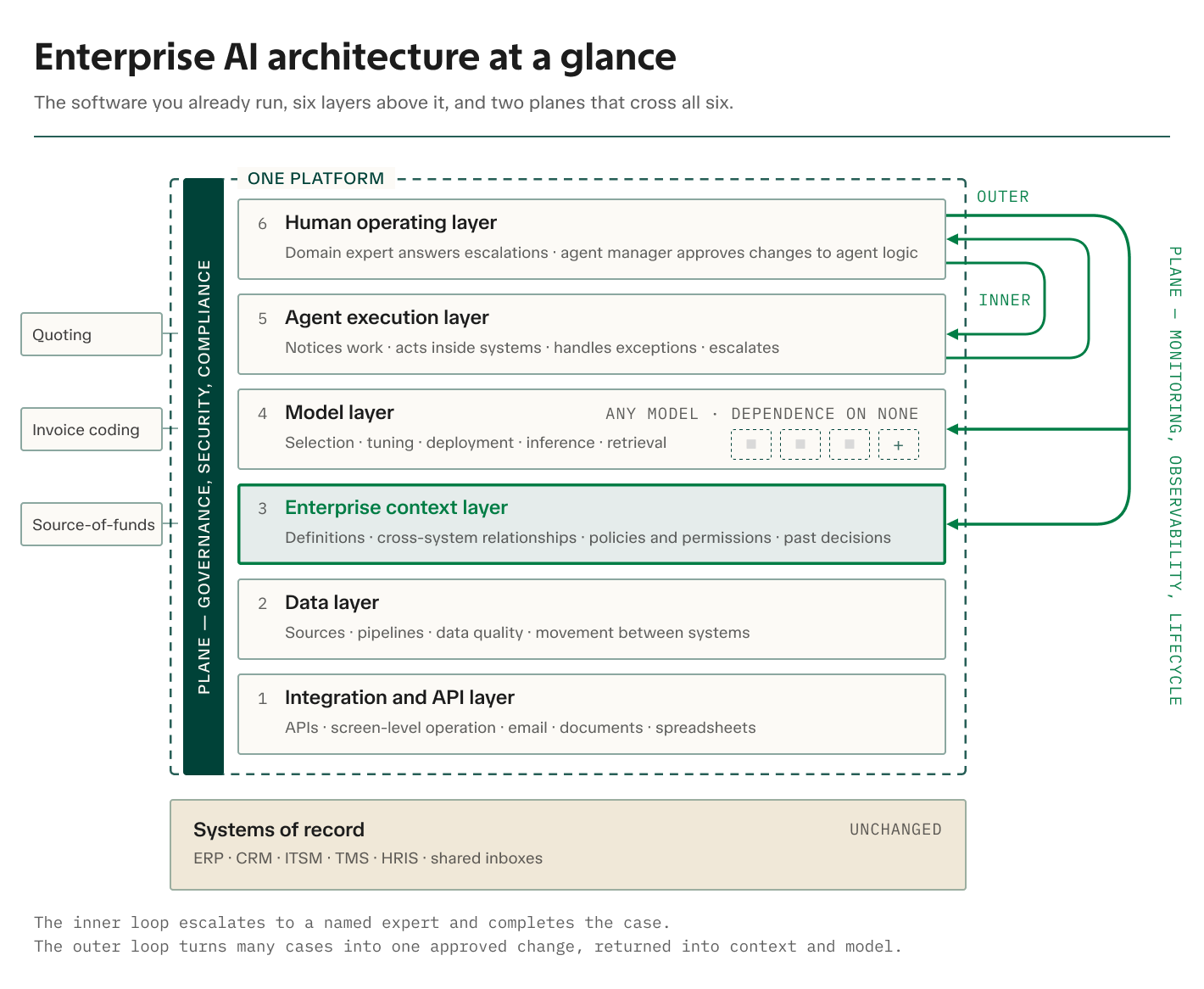
A few key things that make this architecture work for most enterprises:
- Integration sits below data, which means data reaches the stack through live access to the systems of record. You don't have to build a data lake or warehouse first, and agents work from what is true in your systems right now.
- Context sits above data, which means it stores what the data means to your business (definitions, policies, past decisions) rather than more copies of the data itself.
The enterprise context layer, the human operating layer, and change management inside the lifecycle plane are where an architecture built for autonomous agents differs most from one built for assistants. Without those pieces, agents can't safely handle a workflow on their own.
The foundation is your existing systems of record
Start from the estate you already run.
For most organizations, that's some mix of an ERP, a CRM, an ITSM queue, a TMS if you move freight, an HRIS, and the shared inboxes where a surprising share of the work lands. The exact list varies by business, but the pattern doesn't. These systems do what they were built for. They keep the books balanced, the records authoritative, and the auditors satisfied.
What they were never built for is the work that happens around them, the judgment calls, the exceptions, and the decisions made when conditions shift faster than the process map.
This mismatch is why the systems of record are drawn as the ground rather than as a layer.
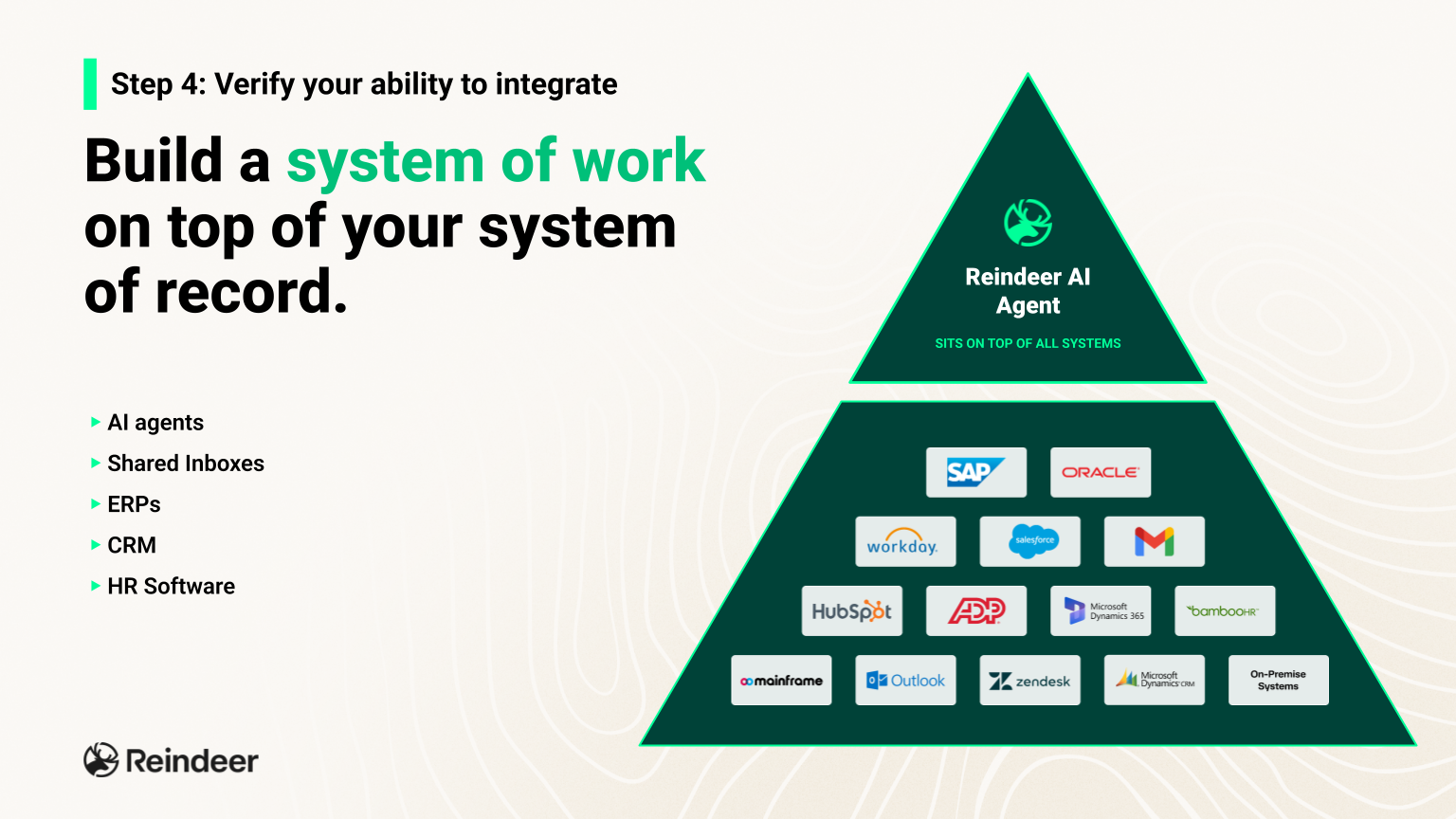
The AI architecture we recommend is additive. Nothing in the layers above requires you to replace, migrate, or re-platform any of these systems. The agents work inside them as they are.
1. The integration and API layer
The integration and API layer connects agents to the systems of record through authenticated, scoped connections where APIs exist, and screen-level operation where they don't.
Reindeer builds this layer around 200+ enterprise integrations, adds new connectors in days, and covers API-less systems with an adaptive operator that works a screen or browser the way a person would.
Reindeer holds the layer to a three-part test. An agent can act on its own only when its integrations include all three of these:
- A trigger that watches a system and starts a run when something happens
- Scoped access that lets the agent read and act while it runs
- Live data pulled from your systems, so it reasons over what's true now
The test matters in vendor evaluations because a tool with only one or two of the three still looks convincing in a demo. A trigger without access can watch and notify, nothing more. Give it access but no live data and it acts on assumptions instead of the current state of the account. Data without the ability to act produces analysis that waits for a person. None of these combinations add up to an agent that can execute a task autonomously.
2. The data layer
The data layer covers where data comes from, how it gets cleaned and processed, and how it moves between systems.
The case for putting data readiness first is serious. Gartner reported in 2025 that 63% of organizations either lack the right data management practices for AI or aren't sure they have them, and it predicts that 60% of AI projects unsupported by AI-ready data will be abandoned through 2026.
Reindeer sees it differently. You don't need a long, expensive data-cleaning program before implementing AI. You need a solution that learns from the work your team is doing live. Reindeer can get started with just a small set of real example cases, start running, and learn as it goes by asking your experts for help when it comes across something it doesn’t understand.
"20 examples are enough to find the edges of a problem. From there, you learn faster by working the exceptions than by waiting for perfect data," co-CEO Yoav Naveh argued in CIO.
Production deployments back this up. Hellmann Worldwide Logistics trained its quoting agent on about 20 sample requests, per its case study, and reached production within weeks. Papaya Global's used Reindeer to automate invoice coding, and was able to cover roughly 80% of volume immediately from fewer than 50 sample invoices.
Starting fast doesn't mean starting alone, though. Successful deployments still include a learning phase where the people who know the work teach the agent by answering its escalation questions, and deployments stall when those experts don't engage. When you plan this layer, map where each workflow's data lives and how clean it is, but don't let a data program gate your first workflow.
3. The enterprise context layer
Every operations team has people who carry knowledge the rest of the team doesn't. Maybe your team knows about a supplier that bills in an odd format, but is fine to pay anyway, or about a SKU that's routinely mispriced at the source. It might be two people or two hundred.
The enterprise context layer is where that knowledge gets captured. Concretely, the layer is a component of the platform itself, a stored and growing body of definitions, rules, and past decisions that agents consult on every case.
The layer holds four kinds of content:
- Definitions and business logic such as what your company means by net revenue, what qualifies a case as an exception, or how a metric gets calculated.
- Relationships across systems like how the same supplier, customer, or employee shows up in records across systems that don't share identifiers.
- Policies and permissions such as what an agent is allowed to reach, enforced by role, with an audit trail behind every access.
- Remembered decisions such as how similar cases were resolved before, which choices the team prefers, and the reasoning behind them.
Data is what the systems hold.
Context is what the business means by it, and how it has decided similar cases before.
The layer's contents can only fully accumulate from running the work.
"I do think there is still a moat around who owns the context and process knowledge… because these are things extracted over time and only from real-life handling of cases," Reindeer co-CEO Yair Weinberger said in a March 2026 interview.
The mechanics are visible in the Papaya Global deployment. When a payslip match is ambiguous, the agent flags the case to Papaya's team with the candidate matches, records which one they pick, and doesn't flag the same issue the following month. An AI context layer fills from two directions, from below by data and from above by corrections. When you evaluate this layer, ask where that accumulated knowledge will live and whether your team keeps it if you ever switch vendors. It becomes the most valuable thing the architecture builds over time.
4. The model layer
The model layer covers which AI models do the thinking, plus how they get selected, tuned, deployed, and run.You don’t want your architecture to be dependent on any single model. If you bind your operations to one foundation model, that vendor's problems become your problems. If they raise prices, you pay. If they retire the model, you migrate on their timeline. If their roadmap drifts away from your needs, you are stuck with it.
Model choice itself matters less than most teams expect. Stanford's Enterprise AI Playbook found model choice fully interchangeable in 42% of the implementations it studied, and located the durable advantage in how the models are orchestrated, meaning how work gets routed to them, checked, and corrected. Picking the single best model today matters less than building an architecture that lets you swap models as better ones ship.
Some vendors run every deployment with a standing bench of their own engineers. That gets the first workflow live, but it means every later change to your process needs their engineers to re-tune the system. Growing an internal AI team for each new use case has the same problem at a higher cost. Both designs put an engineer between the operation and its own agents.
We recommend an architecture that is model-independent by design, and Reindeer builds its platform that way. Agents use whichever model fits the workflow without depending on any specific one. The customer owns the data and the logic, which matters for the same reason model independence does. If you ever leave the platform, the knowledge your team built up leaves with you.
When you plan this layer, press vendors on two questions. What happens when a better model ships next quarter, and what happens to our data and logic if we leave?
5. The agent execution layer
Three tiers of software get sold under the “agent” label. A product falls into one tier, and so does the vendor selling it.
- AI assistants, like ChatGPT or Claude, help humans perform work in response to a prompt or trigger, but don’t actually do the work themselves.
- Agents, the middle tier, do the work while a person watches them and reviews the output.
- Autonomous agents manage cases independently of humans, but involve people at the exceptions to stay accurate.
Automating exception-heavy back-office workflows requires the autonomous tier because autonomous execution means the agent completes the work on its own. If a person still reviews every output, the work hasn’t really become any faster or more efficient.
At this layer, agents notice work as it lands, act inside the systems below, handle the exceptions they can resolve, and escalate the ones they don’t understand. Reindeer's own progression for its agents sets the bar. The agent sees the work, does the task, handles the exceptions with your team, and self-corrects over time with the oversight of an agent manager. One global financial services firm processes 30,000+ invoices a month on Reindeer, with 95% touchless invoice routing.
Gartner grades agent autonomy in four levels, which include: observe, advise, act with approval, and act autonomously. Gartner also finds that governance should match the autonomy level. Regulated work, for example, requires the autonomous tier. A regulated trading platform runs source-of-funds verification on Reindeer at 95% extraction accuracy, above its human reviewers' baseline.
6. The human operating layer
Most published AI architecture diagrams contain no people. But you should reserve your top layer for them, in two defined roles.
- A domain expert answers an AI agent’s specific questions about edge cases in plain language while a case is running.This helps the agents reason through individual cases that may fall outside of the normal workflow.
- The agent manager reviews and approves proposed changes to an agent's logic before they ship. This is how agents evolve to expand their scope of work and stay accurate over time.
Alexander Terglane, pricing and tender lead at Hellmann Worldwide Logistics, describes what the layer feels like from inside:
"It feels like we added experienced hands overnight. Routine requests move through automatically, more complex ones are handled in a copilot mode, and my team focuses on escalations, edge cases, and customer conversations where experience and human touch actually matter."
Where the platform sits organizationally, and who owns it, varies by company and hasn't settled across the market.
Plane: governance, security, and compliance
An agent that can act inside an ERP, for example, carries the full risk of that access, because anything that goes wrong reaches as far as the access does. That's why governance, security, and compliance run the full height of the stack rather than sitting at one layer.
IBM’s Institute for Business Value’s incident data shows what skipping this plane costs. They found AI adoption outpacing governance capabilities in 77% of organizations, which averaged 54 AI agent incidents in the past year, 17% of them high-severity.
Enterprise AI governance, in practice, means having specific answers ready before the security review asks.
- Where the data lives
- Who shares the infrastructure
- What the model vendors keep
- Who can touch what
- What an auditor can rely on
Reindeer built its security page to answer the InfoSec questionnaire point by point, because a lack of governance clarity is one of the main reasons AI deployments struggle to move out of pilot or get funding in the first place.
Plane: monitoring, observability, and lifecycle management
The monitoring, observability, and lifecycle plane decides whether those moments get absorbed or become projects that you have to pick up.
This plane holds performance and cost tracking, evaluation, and the checks that catch an agent drifting off course as conditions change.
The plane also needs a mechanism for changing an agent's logic under human approval. Reindeer's version, and this is Reindeer's specific design rather than a category standard, is two-loop change management.
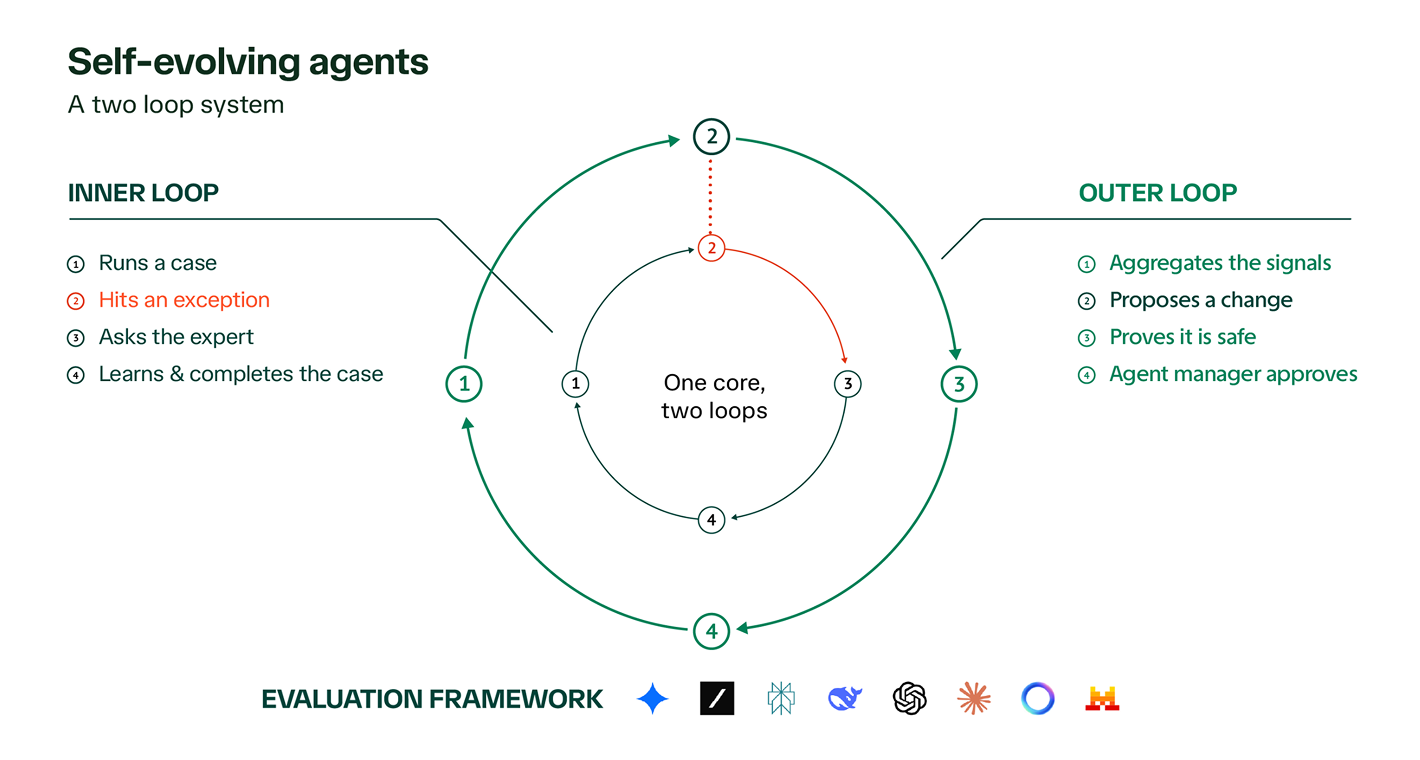
The inner loop operates inside a single edge case. The agent runs, hits the confidence threshold the customer set, asks a named domain expert a specific question in plain language, learns from the answer, and completes the case.
The outer loop operates across many cases. Signals from edge cases aggregate and Reindeer notices the pattern to propose a logic change to the agent manager as one reviewable bundle. The platform regression-tests it against past cases, and it ships only when the agent manager approves. The system never rewrites its own logic in the background.
Those two properties, escalating edge cases and proposing global policy changes to an agent manager for approval, are what make an autonomous system governable.
Putting the architecture together
One architectural decision shapes everything else: Should you choose a horizontal platform or use point solutions for each workflow?
The six layers can run as one horizontal platform spanning many workflows, or get rebuilt inside a separate point solution for each workflow.
Using point solutions will mean that each one carries its own model dependency, its own data exposure, its own governance surface, and its own integration debt. Multiply by the workflow count of a Fortune 500 back office and the estate becomes something nobody can integrate or govern. Gartner calls the result agent sprawl and projects that the average global Fortune 500 enterprise will run more than 150,000 agents by 2028, up from fewer than 15 in 2025, while only 13% of organizations believe they have the right AI agent governance in place.
Vendor consolidation is the obvious argument.
The important distinction between the two approaches is that with a horizontal platform, the work compounds. Each new workflow builds on what the platform already learned, so the second workflow takes less effort than the first, and a correction one team makes carries to the others. Separate tools rarely learn from each other. Papaya Global’s success shows how AI agents can compound. Invoice coding reached 97% automation, and the team pointed the same solution at payslip mapping.
Reindeer builds and runs this architecture for Fortune 500-scale back offices.
If the picture matches what your team needs to get ahead on enterprise AI, bring us a single workflow and we'll show you how the architecture takes shape around it.
Book a working session with us to see how it all comes together.
Frequently asked questions about AI enterprise architecture
What is AI enterprise architecture?
AI enterprise architecture is the arrangement of systems, data, models, and controls that lets an organization put AI to work inside its live operations, plus the governance and change mechanisms that keep it working. It covers how AI connects to existing systems of record, where data and context live, which models run the work, and who approves changes.
What are the layers of an AI enterprise architecture?
An AI enterprise architecture has six layers that operate across your existing systems,, crossed by two planes. The foundation is your existing systems of record. The layers, bottom to top, are integration and API, data, enterprise context, model, agent execution, and the human operating layer. Governance, security, and compliance form one cross-cutting plane. Monitoring, observability, and lifecycle management form the other.
Do we need our data in order before we start?
No. A completed data program isn't a prerequisite for a first workflow. Deployments with Reindeer start from a small set of real example cases and learn from the live work, and production deployments have gone live in weeks on 20 to 50 samples. The team's experts still teach the system by answering its questions as it runs.
Should we buy one platform or a separate tool for each workflow?
At enterprise scale, one horizontal platform is the stronger position, because learning compounds across workflows using the same governance rules. At single-department scope, a point solution can be the right answer. The decision rests on how many exception-heavy workflows the organization runs and on whether corrections made in one queue should carry to the next.
Who owns and governs AI agents inside the organization?
Two roles govern agents day to day. A domain expert answers an agent's case-level questions in plain language, and an agent manager reviews and approves proposed changes to agent logic. In the deployments Reindeer runs, the domain expert is usually someone who already fielded the team's escalations informally. The architecture makes that routing explicit and auditable.
Your next read


Ready to see it in production?

AI enterprise architecture has nine elements: the systems of record you already run, six layers of AI capability stacked on top, and two planes for governance and monitoring that apply to every layer.