
AI In Supply Chain: Use Cases, Case Studies, and Trends

AI is entering supply chain operations everywhere at once, and at very different speeds. Robots pick and pack on warehouse floors. Vision systems inspect welds on production lines. Trucking platforms now ship AI assistants that answer a driver’s parking and weigh-station questions from the cab. Planning engines forecast demand, control towers promise end-to-end visibility, and agents in the back office read quote requests and code invoices.
Amazon deployed its one millionth robot in July 2025 and now coordinates the fleet with DeepFleet, a generative AI model it expects to cut robot travel time by 10% across more than 300 facilities. The same month, plenty of enterprise shippers were still working to get a first invoice-coding pilot into production. Both of those things are true at once, which tells a story about the state of the category.
Set the physical systems aside for a moment, and the software side of this landscape does two kinds of work. Planning systems forecast demand, optimize inventory, and route freight. Operational systems handle the document and exception work between systems, from quoting to customs to freight payment.
In most networks, the records are still produced by people reading quote requests, proofs of delivery, and carrier invoices one document at a time. This can make implementation of the AI-powered planning systems more difficult because no matter how good the prediction gets, the document work can put limitations on everything downstream of it.
What does AI do in a supply chain today?
Planning is usually what people envision when they think about AI in the supply chain.
Demand forecasting, inventory optimization, network design, route optimization, and supplier risk scoring all fit into this category, and they've been improving steadily for a decade. A foundational study from McKinsey reported AI early adopters improved logistics costs by 15%, inventory levels by 35%, and service levels by 65% against slower-moving competitors. These are useful benchmarks, even if they’re a bit dated.
Planning is also just one corner of a much bigger territory. Robotics, planning suites, and telematics are all part of it. Plus, companies like Reindeer build autonomous agents for the document-heavy, exception-heavy back-office work in this landscape, workflows like quoting, freight audit, and customs paperwork.
This is a broad space and AI is being applied in many different ways across all aspects of the end-to-end supply chain.
Plan (demand and inventory)
The forecasting and inventory lane is the most mature on the map. Gartner predicts 70% of large organizations will run AI-based demand forecasting by 2030, and when seven in 10 peers have a capability, it stops being differentiation and becomes the price of entry. Network design still gets AI attention in episodic projects rather than always-on systems.
Source (suppliers and procurement)
Supplier risk monitoring and sourcing intelligence are production-grade inside the large procurement suites, and contract intelligence is spreading fast. Procurement work is document work: supplier onboarding, compliance verification, and contract review are exception-heavy paperwork queues that behave like back-office workflows even when they report to a chief procurement officer.
Make (production)
Predictive maintenance is one of the oldest industrial AI wins. Deloitte’s analysis found it cuts maintenance planning time by 20% to 50%, lifts equipment uptime 10% to 20%, and lowers maintenance cost 5% to 10%. Computer-vision quality inspection is equally proven at manufacturers with the scale to justify it: Audi’s weld-inspection AI checks roughly 1.5 million spot welds per shift. Both are production systems at industrial scale, and both are multi-year capital programs tied to the plant floor.
Move (transportation and logistics)
Route and fleet optimization commoditized into TMS platforms years ago. UPS reports that ORION, its route-optimization system, saves about 100 million miles and 10 million gallons of fuel a year. Driver-facing AI arrived more recently: Samsara launched a driver assistant in June 2026 that answers parking, weigh-station, and policy questions from the cab. Last-mile automation is live in the field but capital- and integration-intensive.
Warehouse and fulfillment
Warehouse robotics is production-grade at the operators with the volume to feed it. DHL runs more than 7,500 robots across its network and is deploying over 1,000 more Boston Dynamics Stretch units, which unload up to 700 cases an hour. For operators without those volumes, the same capability is a long capital cycle rather than a quarter’s project. Returns and reverse logistics run earlier on the curve, and that work is document-heavy and judgment-heavy, which makes it a better fit for agents than for arms.
Visibility and orchestration
Track and trace matured into its own software category, and the visibility platforms are good at answering where a shipment is. The unsolved half is what happens next, when the update contradicts the booking and someone still has to chase the carrier and fix the record. Control towers carry the biggest gap between demo and deployment on this map: Gartner predicts 60% of supply chain disruptions will resolve without human intervention by 2031, which describes both where orchestration is headed and how far it still has to travel.
Compliance and governance
Customs and trade compliance is document-driven, rules-dense, and exception-heavy, and adoption is accelerating from a low base: in the Thomson Reuters 2026 Global Trade Report, 40% of trade departments said they’re exploring AI for trade management, up from 6% a year earlier. Sustainability and emissions tracking is earlier still. BCG’s 2025 survey with CO2 AI found only 7% of companies fully report emissions across all three scopes, and Scope 3 is a supply chain data problem before it’s anything else.
Most networks will eventually run AI in several of these lanes. But the physical lanes are multi-year capital programs, and the planning engines only get as good as the records feeding them. The quickest, most effective place to start for most companies is the back office, the operational layer where an agent deploys on top of the systems already in place and reaches production in weeks.
The operational side of the house is the work that happens between the systems. It’s often messy and unstructured:
- Reading a quote request that arrived as a photograph of a handwritten note
- Chasing a carrier for a status update so a customer email can be answered
- Matching an invoice against a rate agreement with three amendments
- Assembling the customs packet and checks that every document in it agrees with the others
McKinsey's trade documentation research found that a single shipment can require up to 50 sheets of paper exchanged with as many as 30 different stakeholders, and that the documentation process alone can take six hours or more across everyone involved.
The paper bill of lading still applies to roughly 40% of containerized trade transactions.
These complexities likely explain why automation in the operational layer is further behind than you’d expect based on how quickly AI is moving in other contexts. Descartes' 9th annual benchmark study of 616 shippers and logistics service providers, published in September 2025, found 96% report using generative AI somewhere in operations while only 17% have fully automated transportation processes. More than a third remain heavily or mostly manual.
The most common generative AI use case respondents named was simple data entry, at 41%.
So the typical network now has generative AI inside it but still moves documents by hand.
Even so, there are clear use cases and deployments that are succeeding in this area of the business. The key to successfully automating unstructured supply chain work is defining the specific use cases and using the right class of tools for the exception-heavy workload.
Five supply chain workflows where AI is doing the work today
A driver texts that three boxes left Warehouse A at 10:17, and someone retypes it into the TMS.
That handoff between systems that were never designed to talk to each is a nearly-universal trait across supply chain back-office work and it’s both why these workflows are so hard to automate and exactly why it’s so important to do so.
Quote generation across mixed-format requests
A large third-party logistics pricing desk can take 1,000 quote requests a day. They arrive in 20 formats, from PDFs and Word documents to emails and photos of handwritten notes, in several languages, and one request often bundles three or four scenarios.
The rate logic that resolves them sits in the head of whoever has been on the desk longest.
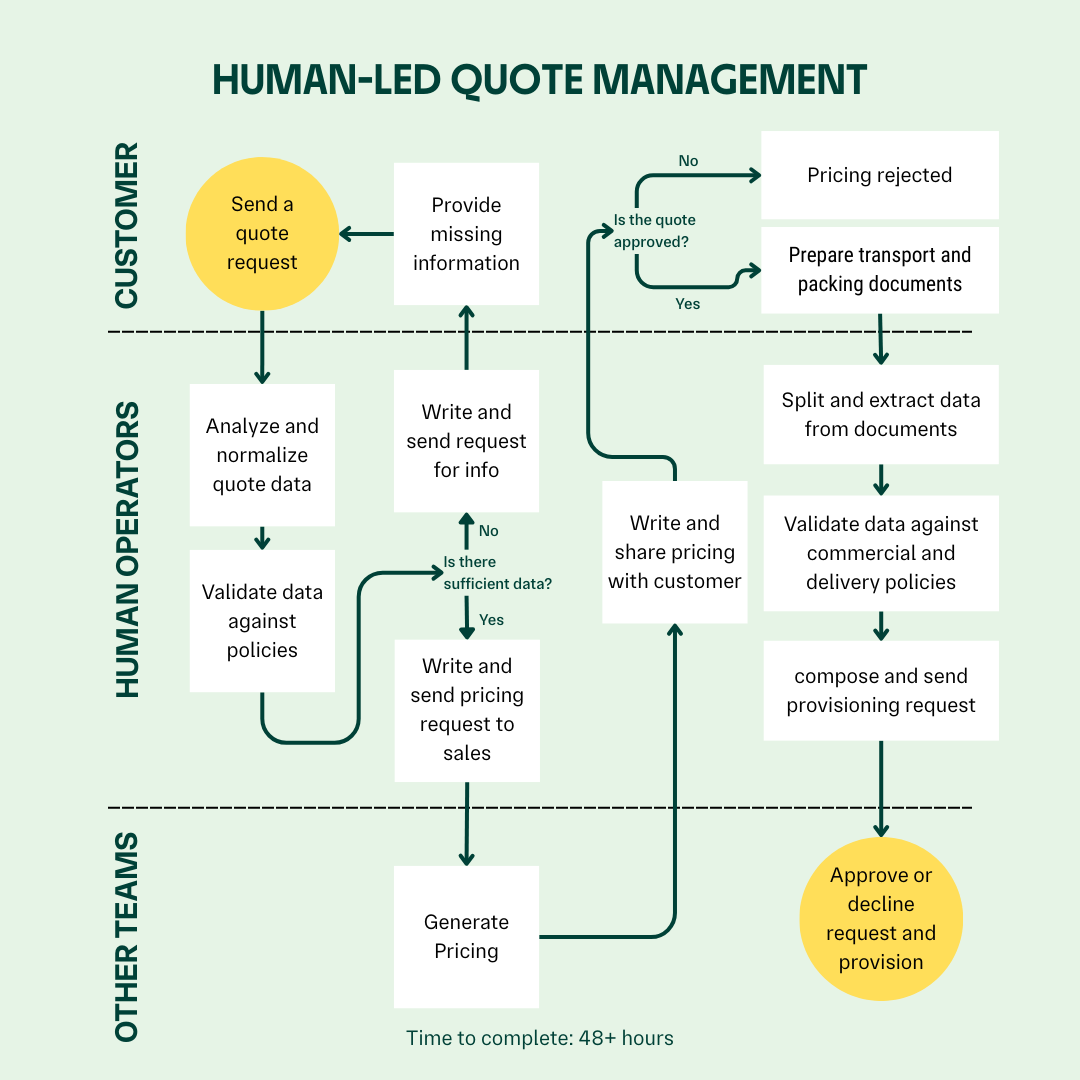
Much of this manual process is possible to automate with the right AI platform.
It’s not just about removing manual work or speeding up the process. Quote speed can be a key driver to winning more deals. Slow quotes are often lost opportunities, which is why companies like Hellmann Worldwide Logistics built agents to handle quotes.
In a published deployment with one such 3PL, Reindeer cut quote turnaround 90%, from 48 hours to four, and the win rate moved from 25% to 50% over two months.
Track and trace and the escalation queue
A Sea-Intelligence study put global container schedule reliability at 64.7% in May 2026, the best month of the year, with late vessels arriving an average of 5.52 days behind schedule. Those delays create a litany of downstream problems and more work to troubleshoot and manage the changes.
Once again, this is a key area that AI is currently capable of facilitating.
At a global freight carrier, the shipment tracking queue was overwhelmed by manual status inquiries. Every delay required an agent to pivot across the carrier portal, terminal system, and the customer’s request to manually calculate an updated ETA.
By deploying an autonomous agent trained on 10 sample cases and live in just 14 days, the carrier automated the status reconciliation process.
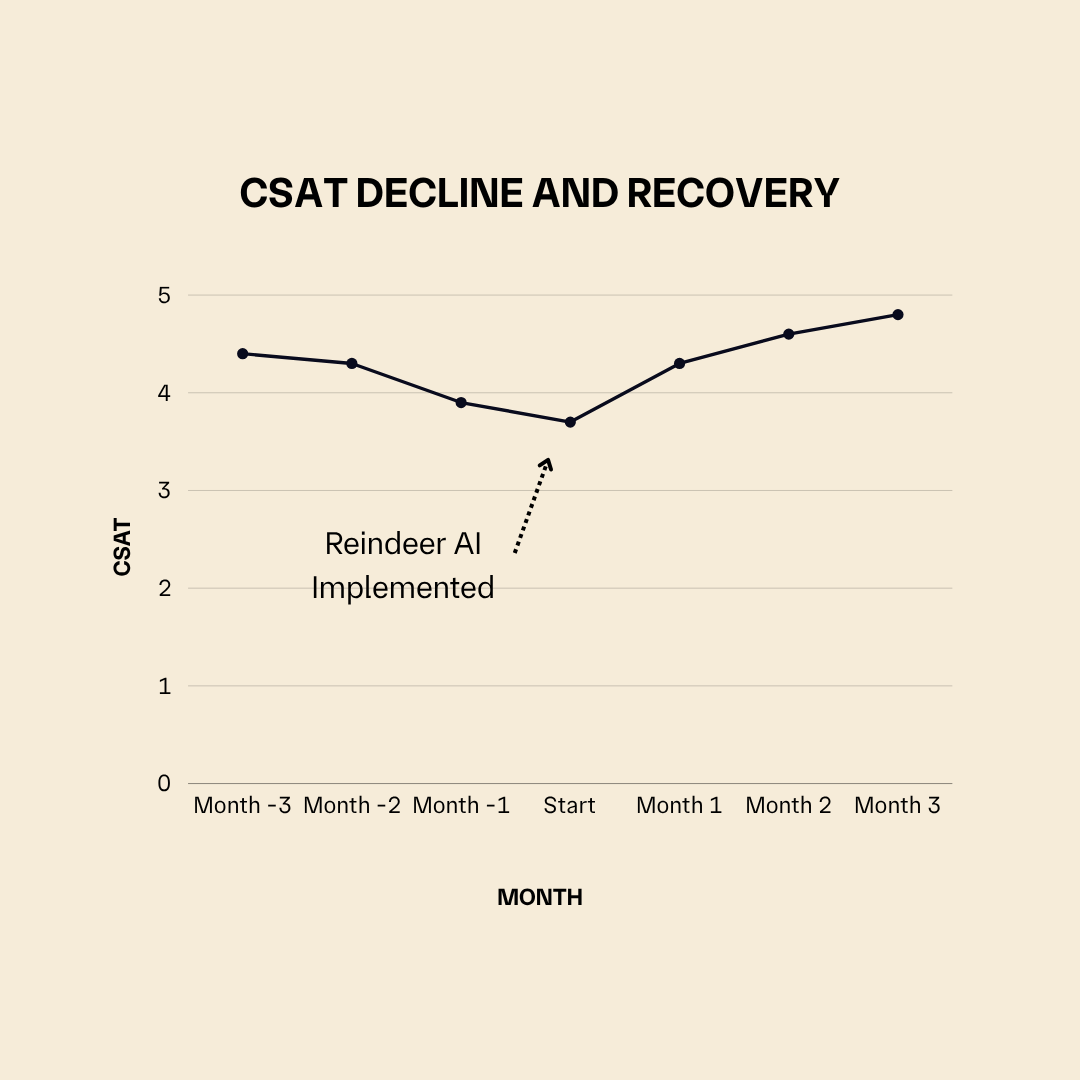
The results were immediate as escalation resolution went from five hours to three minutes and CSAT rose from 3.7 to 4.7 out of 5 in three months, all without manual intervention for shipments moving as scheduled.
Freight audit and payment
Carrier invoices rarely reconcile cleanly against the rate agreement, the accessorials, and the fuel table. Someone works the difference, or the overpayment goes out the door.
This can be a tedious and time-consuming process that creates drag on the entire workflow, plus it introduces a significant opportunity for error.
In one 3PL's outsourced document operation, shipping codes sat clearly visible on the paperwork and were missed anyway. The system defaulted to premium rates, and six months of that produced millions in carrier overpayments.
We helped a tech-enabled 3PL deploy an AI agent for this process and reduced payment disputes 40% (from 5% of invoices disputed down to 3%) within a week of go-live.
Approval time went from 20 hours to three minutes.
Customs and clearance documentation
Because customs and clearance documentation can present such a high cost of error, it’s often a supply chain workflow that’s prime for automation. Usually, humans are in charge of the scattered process of validation and cross-referencing the documents. Classification, valuation, origin, and the commercial invoice all have to line up, and a mismatch surfaces weeks later as a penalty.
Flexport announced in February 2026 that it had used AI-powered automation to reduce error rate on U.S. customs filings to 0.2%, which founder and CEO Ryan Petersen estimated to be a tenfold improvement on other brokers.
Supplier onboarding and document intelligence
Onboarding work is increasingly coming back in-house. Deloitte's 2024 Global Outsourcing Survey found 70% of executives have selectively insourced scope that previously sat with a third party over the last five years, with quality control and rebuilding internal expertise now outranking cost as the primary motive.
One other driver here is the potential for AI and automation to streamline the process.
The work itself is collecting insurance certificates, tax forms, compliance attestations, and banking details from a carrier or supplier, checking each against policy, and chasing whatever is missing.
How do you know which supply chain workflow to start with?
Deploying AI across the supply chain starts with selecting the best first workflow to automate. This is an important decision because it’s, essentially, a proof of concept for the entire automation program. That’s why it’s important to have clear criteria for making this decision.
Reindeer scores a candidate workflow on six signals:
- High transaction volume
- Knowledge distributed across large teams
- Exception-heavy cases
- Data that moves across systems
- Existing logic or policy to follow
- Speed and accuracy that customers feel
We use these signals to map out the supply chain workflows against a 2x2 grid based on their complexity vs volume. From there, we recommend customers aim for the top quadrant, starting with both their more complex and highest volume workflows.
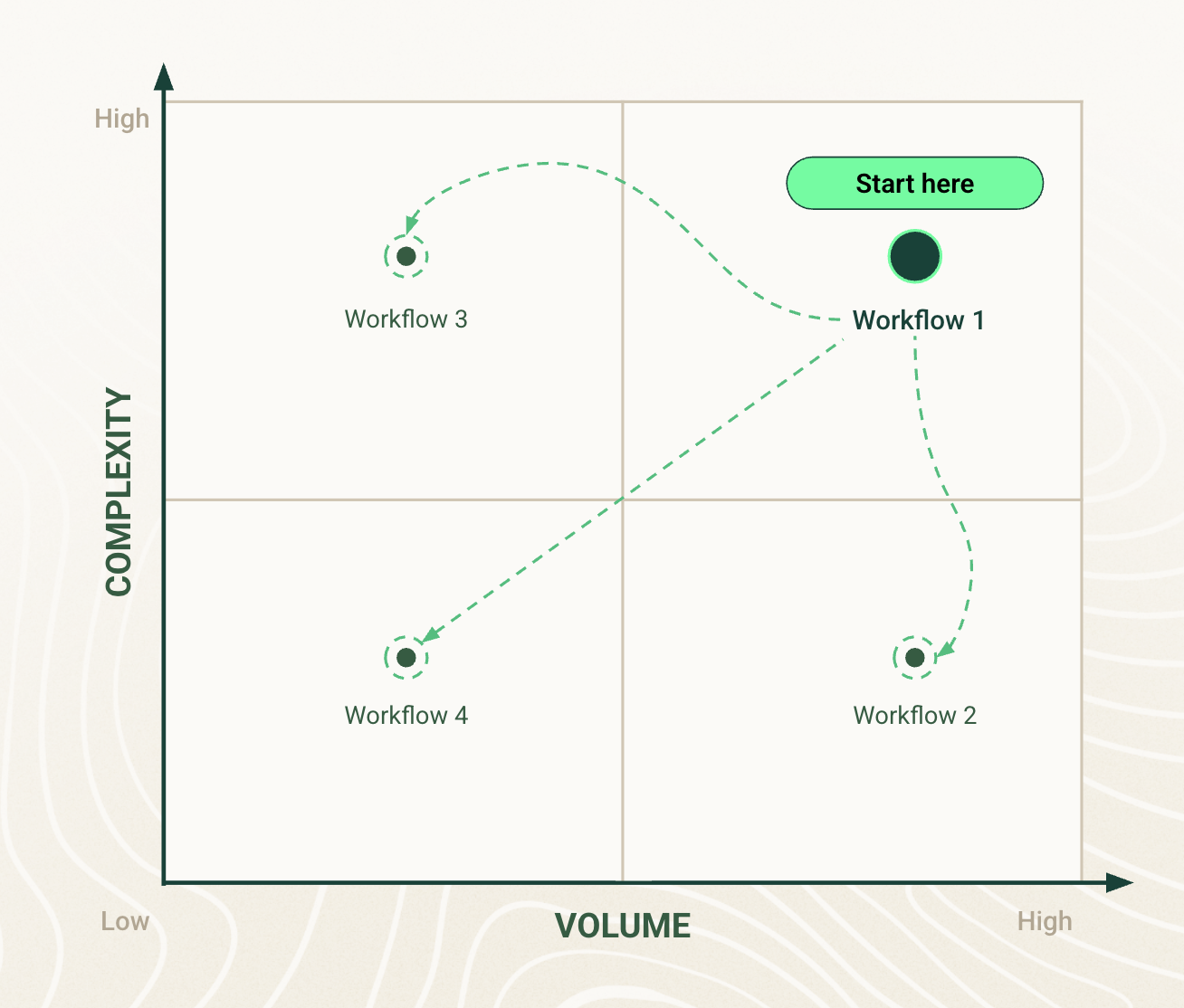
This is where the work pays off most quickly, plus it provides a foundation for future workflows, which should be easier to automate if they’re either less complex or lower volume.
One published Reindeer deployment included a 30-person team with 40% annual turnover, supporting 50 customers across hundreds of carriers, where the documented procedures rarely match the work as it's done.
That's what volume meeting complexity looks like, and it's where the best first candidates sit.
Let’s look at quote automation as an example.
A pricing desk is a quintessential high-complexity, high-volume workflow because of the exact factors we discussed earlier (1,000 requests a day, arriving in 20 formats and several languages). Plus, the rate logic that resolves them is held by a handful of senior reps, and it moves between email and the TMS on the way to an answer. The rate agreement policy is a clear set of instructions an agent can learn and speed and efficiency are major factors in overall success.
This is what makes this a great candidate for a first automation workflow.
Supplier onboarding is another example with a slightly different shape.
This is complex work where the exceptions are constant, the documents cross systems, and the compliance policy is already written down. Volume is lumpy, though, and delays land on a supplier while the customer never sees it.
Those two gaps make onboarding a stronger second workflow than a first.
Your best candidate for automation may not even be on this list, but that doesn’t mean you can’t deploy AI to automate it. To find it, ask which desk would take the longest to recover if its longest-tenured person left next month and that will probably point you in the right direction.
What the published case studies show
The freight deployments with published numbers all started on one narrow workflow and reached production in weeks.
Hellmann Worldwide Logistics, a freight forwarder handling more than 20 million shipments a year, put an Outlook add-on in front of its pricing team, trained on about 20 sample requests.
"It feels like we added experienced hands overnight," says Alexander Terglane, pricing and tender lead at Hellmann Worldwide Logistics, in the published case study. "Routine requests move through automatically, more complex ones are handled in a copilot mode, and my team focuses on escalations, edge cases, and customer conversations where experience and human touch actually matter."
The largest publicly described agent estate in freight belongs to C.H. Robinson. The company said in March 2026 that it runs hundreds of connected AI agents across pricing, orders, freight matching, tracking, documents, invoicing, and freight classification. It reported price quotes in 32 seconds, orders processed in 90 seconds, and an 11% average improvement in speed to market.
It’s notable that across all Reindeer’s published deployments and case studies, there is a fairly low bar for the amount of training data required to deploy the program. Hellman’s agent and the automation for the fulfillment 3PL were each built on 20 sample requests, while the freight carrier case study was built on just 10 samples over a 14 days training period.
None of these programs opened with a data project, instead they required the operators who know the work to sit with the system and correct it as it learned to understand and catch edge cases or exceptions.
Why this class of work needs an agent that runs the case end to end
The type of AI you use to power your automation is just as important as the workflow that you’re choosing to automate. Enterprise-grade AI meets a specific set of criteria that goes above and beyond standard AI assistants and AI agents. This added functionality is critical to your program’s success.
Take a carrier invoice that doesn't reconcile against the rate agreement, and see how each type of AI system might deal with it:
- AI assistants: Summarizes the invoice and flags the mismatch, and the analyst still opens the rate agreement and decides.
- AI agents: Reconciles the invoice against the rate agreement, the accessorials, and the fuel table, proposes the adjustment, and waits for a person to approve every one, including any invoices that reconciled cleanly.
- Autonomous AI agents: Reconciles all of the clean invoices autonomously based on training data, identifies edge cases or exceptions, requests input from a human manager to reconcile the outliers, recommends updates to its internal policies to allow it to handle these cases in the future.
In The Enterprise AI Playbook, Stanford’s Digital Economy Lab found escalation-based operating models, where AI handles 80% or more of cases autonomously and people review only the exceptions, delivered a 71% median productivity gain. Approval models, where a human signs off on every output, delivered 30%.
That doesn't settle the question for every workflow. Plenty of supply chain planning is better served by a model that advises a planner, and enterprise AI isn't one-size-fits-all. But choosing and deploying a fully-capable autonomous AI agent is a common denominator across nearly all successful case studies on AI deployments within the supply chain.
What the adoption data says about programs already in production
Gartner forecasts that 60% of enterprises using supply chain management software will have adopted agentic AI features by 2030, up from just 5% in 2025, and tells supply chain leaders to determine and deploy appropriate levels of human-in-the-loop.
On top of that, Deloitte's Tech Trends 2026 reports pilots built through strategic partnerships reach full deployment at about twice the rate of internal builds.
Build-versus-buy is case-by-case, and a team with the engineering depth and the appetite to own the correction mechanism can build one. What Deloitte's finding adds is that programs reaching production tend to have someone alongside them who has taken a workflow through this before, which is fair to ask a vendor to prove.
Stanford's practitioners attributed 77% of their hardest challenges with AI deployments to invisible costs, change management, data quality, and process redesign. They described the technology as consistently the easiest part but that organizational factors can decide whether a program sinks or swims.
These findings tell us that for a program going into production this year, human-in-the-loop architecture is critical, deploying via strategic partnership can increase the odds of success, and someone has to own which cases the agent settles and which ones it clarifies with the human operator.
What keeps a supply chain AI program running after go-live
What happens the first time the agent gets a case wrong? That question, and the security review the program clears before it ever runs, decides whether a deployment stays in production or stops being used.
Reindeer calls the correction mechanism change management, and builds it in three parts:
- Confidence scoring: Every decision carries a confidence score shaped by case uniqueness, complexity, and how far the agent's plan diverges from what it has seen before.
- Expert routing and plain-language correction: Below a threshold the customer sets, the case routes to a named subject matter expert. The expert gets a precise set of questions instead of a guess, and how the agent learns from that answer is governed.
- Governed logic change: Changes to the agent's own logic arrive as one reviewable bundle, regression-tested against past cases. The approval sits with an agent manager, a customer-side role carrying the authority that already signs off on a workflow rule change.
On a Hellmann quote, for example, imagine a shipping address was missing. Rather than proceeding or stalling, the AI agent would ask a human manager whether to use the address from the last shipment. If the rep confirms, that decision is captured as an immediate learning and later may resurface as a recommended update of the agent’s policy.
We refer to this as the two-loop learning process.
Reindeer's initial process discovery works in a similar way. Instead of asking a 3PL's agents to write down an exhaustive list of their decision rules (that would be impossible), Reindeer runs a zero-shot model past them and collects thumbs-up and thumbs-down reactions. Those 20-second reviews show the decisions people were making underneath the written procedure.
This initial training, quick time to deployment, and multi-phase learning are important for successful deployments that can learn, adapt, and navigate the real-world complexities of enterprise supply chain operations.
Where to start with supply chain AI automation
Starting with AI in the supply chain is simpler than it might seem.
Begin by picking one workflow and score it against the six signals.
If it scores well and meets the high-complexity, high-volume criteria, it's an early candidate for automation. Then it’s time to dig into the specifics, identify the initial policy guidelines, identify a small sample set of cases, and assign a manager to handle the escalated cases.
Bring the process you have in mind and Reindeer will help you scope the workflow against the operation you run.
Set up a time to discuss your needs.
Frequently asked questions about AI in supply chain
What are the benefits of AI in supply chain management?
The benefits of AI in supply chain management show up as cycle time, accuracy, and capacity. Published freight deployments report quote turnaround falling from 48 hours to four, escalation resolution from five hours to three minutes, and payment approval from 20 hours to three minutes. When routine cases clear on their own, experienced operators work escalations and customer conversations instead of retyping documents.
How does AI improve supply chain visibility?
AI improves supply chain visibility by normalizing status information that arrives in incompatible formats. Shipment status sits in carrier portals, terminal systems, EDI feeds, emails, and text messages. An AI-powered supply chain agent reads all of them, reconciles the picture, and answers the customer's question without a person assembling it first. Visibility is a document problem before it's a dashboard problem.
What are the challenges of implementing AI in supply chain and logistics?
The hardest challenges in implementing AI in supply chain and logistics are organizational rather than technical. Stanford's research put 77% of practitioners' hardest problems in invisible costs, change management, data quality, and process redesign, with technology described as the easiest part. That matches what Reindeer sees in its freight deployments. The model handles the documents. The open questions are which cases escalate, to whom, and who has authority to approve a change to the agent's logic.
What is agentic AI in supply chain?
Agentic AI in supply chain refers to systems that carry a case through to completion inside your existing systems rather than answering questions about it. An agentic system is triggered by an event, has scoped permission to act, reads live data, and stops to ask when confidence drops. Gartner expects 60% of enterprises using supply chain management software to have adopted agentic features by 2030, up from 5% in 2025.
Which AI is best for supply chain operations?
While there's no single best AI for supply chain operations, Reindeer AI builds enterprise-grade, autonomous AI supply chain solutions that operate on top of the TMS and ERP already in place. It’s built to automate exception-heavy operational work such as quoting, track and trace, freight audit, customs, and payables.
Your next read


Ready to see it in production?

The physical side of supply chain AI (robotics, forecasting) is capital-intensive and multi-year. The faster win is the back office, quoting, track and trace, freight audit, and customs, where agents reach production in weeks and pay off almost immediately.