
Using AI to Enhance Business Operations: The Executive Framework for Setting Your AI Strategy


Eighty percent of senior executives report their CEOs are mandating AI adoption, according to a survey from IBM's Institute for Business Value.
This puts serious pressure on executives to act first and ask questions later. In many cases, leaders find themselves diving headfirst into AI projects without a clear picture of what success will look like and struggling to justify their decisions later on.
To make things even more complex, the AI market is ripe with noise made by FDEs, consultants, incumbents offering new features, and brand-new upstarts selling shiny solutions.
Making sense of that noise to use AI to enhance business operations starts by defining your AI strategy. Before you choose a tool or build an agent, you need a system and a framework in place for where AI will sit within your organization and how it will be deployed, secured, governed, and managed across teams.
The AI strategy framework: Defining your AI operating model
Setting your AI strategy is about defining the operating model for AI deployments across the org.
AI providers might change but an AI operating model gets staffed, governed, defended to a board, and generally lives on, with its strengths and weaknesses. Defining your overall AI strategy requires answering three critical questions about what, where, and how AI will be deployed:
- Function: What type of AI system will be implemented?
- Form: How will AI be implemented across multiple use cases?
- Focus: Which specific business units, workflows, and tasks will be targeted?
Each of these decisions will lead you toward a better understanding of how AI can be effectively deployed and managed to maximize return on investment and meet the specific and unique needs of your business.
Function: Selecting the correct class of AI
The first decision is about the class of AI that you’re actually buying.
Things can be a little confusing because the marketing language all tends to converge and refer to every class of product as either “AI” or “agents” or some other general term.
Sorting the vendors is genuinely hard. Products sold as business process automation, workflow automation, business orchestration, and agentic AI run on different mechanics and get described in nearly identical language.
Realistically, you’re deciding between three different categories of products, each with their own level of capabilities:
Depending on your business, you may target a different class of AI product built to meet your needs. But it's important to carefully consider your specific needs and the capabilities of any tech you’re considering adding to your stack.
Menlo Ventures found only 16% of enterprise AI deployments qualify as true agents, meaning systems where a model plans, executes, observes feedback, and adapts. (Gartner calls the intentionally-confusing terminology “agentwashing”.)
What we’ve seen working with enterprise customers is that back-office operations require autonomous AI systems. The other product classes tend to fall short because AI assistants can’t execute end-to-end. Plus, standard AI agents overgeneralize their programmed use cases and struggle to understand or identify edge cases that aren’t covered by their initial instructions.
Stanford's Digital Economy Lab studied 51 successful production deployments across 41 organizations and found that escalation-based operating models, where AI handles 80% or more of cases and people review only the exceptions, delivered a 71% median productivity gain. Approval models, where someone signs off on every output, delivered 30%. The researchers note that escalation tends to get applied to high-volume, recoverable work in the first place, which is exactly the exception-heavy back-office work a first agent should target.
On top of that, many products on the market don’t meet the security, compliance, and governance requirements for enterprise deployment.
Gartner expects 40% of enterprises to demote or decommission autonomous agents by 2027 because of governance gaps found only after a production incident.
Form: How AI deploys across your org
The next piece of your operating model is the AI architecture or the shape of tools you’ll ultimately deploy. Point solutions? Specialized tools for each business function? A single horizontal platform that orchestrates AI across the entire business?
An enterprise has hundreds of workflows where volume meets complexity. Buying the best available tool for each one is a defensible instinct, especially for a leader who got burned by a large platform commitment.
But it’s worth pointing out how this instinct mirrors the explosion of SaaS spend over the last decade. Zylo's 2026 SaaS Management Index found large enterprises added 21 applications a month. Plus, across the organizations it measured, 36% of licenses went unused.
IBM's survey data suggests most large enterprises will have deployed more than 1,600 AI agents by the end of this year, and seven in ten executives say their existing AI governance can't keep up with it.
That’s not to say that targeted solutions aren’t sometimes the right answer.
But, in our experience, having a single horizontal platform is the ideal policy decision for most enterprise companies.
The obvious reason for one platform is vendor consolidation. But there are also compounding benefits that come from a horizontal architecture versus a series of disconnected AI platforms that don’t share the same underlying data layer, systems, or learning processes.
On a platform like Reindeer's, each new workflow starts from what the last one taught the system. The integrations are already built, data foundations exist, and continuous learning loops from one team can help inform policies for current or future AI workflows deployed by another.
This means the second agent is easier to deploy than the first and each implementation starts to look more like configuration than a project.
Plus the platform works on top of the systems you already have like your ERP and CRM.
Focus: AI aimed at the right work
The final decision to make as part of your AI strategy is which work to focus on and where to start.
The best candidates to start with are the workflows where high volume meets high complexity.
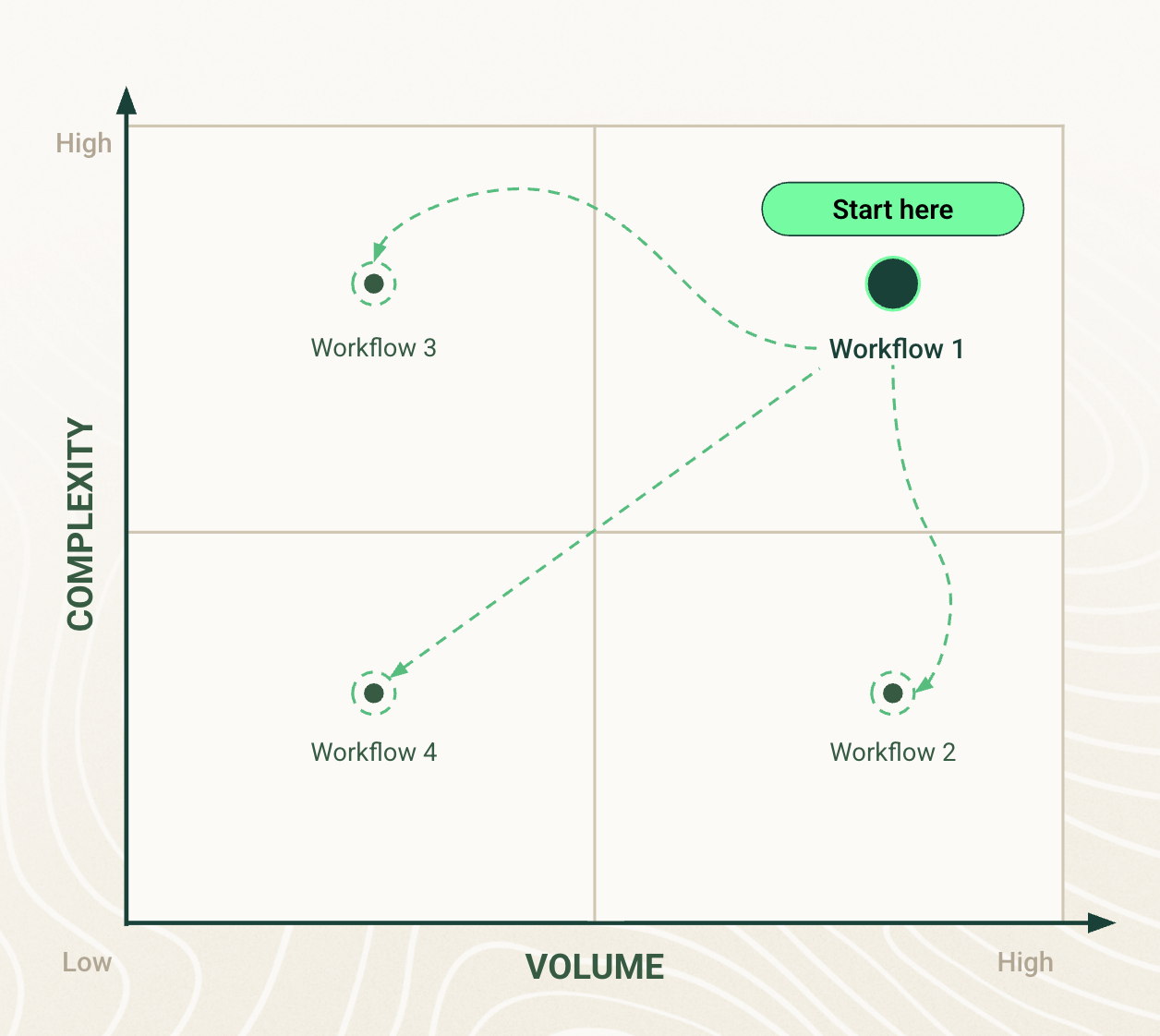
Draw two axes, transaction volume on one and case complexity on the other, plot your candidates, and start in the corner where both run high. Expand outward as the platform absorbs the work around it.
Six signals mark a workflow as a candidate:
- High transaction volume, ideally thousands of cases a month
- Knowledge distributed across a large team instead of written down anywhere
- Exception-heavy cases, where the standard path covers most of the volume
- Data that moves across systems before a case can close
- Policy that has to be applied with judgment
- Speed and accuracy that reach the customer
Together, these factors describe work where judgment is the bottleneck, spread thin across people who each hold a small piece of it.
It’s tempting to take the opposite approach and start by automating the process that’s easiest to hand over. But, in many cases, that produces a clean pilot and a result too small to defend. Plus the infrastructure you’ve created may not support more-complex workflows.
There’s no single right answer here, but often it’s easiest to start with a more complex project, build the systems, and then back into the easier workflows as your programs mature.
Specifically, Project NANDA found the biggest returns in back-office automation. This work tends to concentrate in finance operations, supply chain, procurement, and shared services.
For example, Papaya Global processes more than 10,000 payslips a month, and about half needed manual review because names didn't match the database or the same employee appeared twice with different emails.
Similarly, Hellmann Worldwide Logistics built its first agent on pricing-team quote requests that arrive by email with details scattered across attachments.
What an executive program looks like in the first 90 days
When they first started working with us, Hellmann Worldwide Logistics had a clear AI strategy in mind:
- Function: Autonomous agents capable of handling exception-heavy workflows and meet enterprise-grade requirements
- Form: Horizontal platform that could orchestrate work across multiple workflow types and use cases
- Focus: Back-office automation
Ultimately, we started with roughly 20 sample quote requests, then ran the AI quote-request pilot through a dedicated training inbox, and reached production in under four weeks.
The implementation process followed five steps:
- Pick one workflow: the single candidate that runs at high volume and carries high case complexity.
- Name the owner first: the business-unit leader who runs the process today and can change how it runs.
- Hand over examples and a short description: access to a shared inbox plus a page or two on how the work gets done.
- Measure three things:
- Cycle time: how long a case takes from arrival to close.
- Escalation rate: the share of cases that still need a person.
- Accuracy: how often the closed case is right.
- Define the manager: name who answers the agent's questions and run logic changes as governed releases.
If a quote request reaches Hellmann's agent with no shipping address, the agent might ask the pricing team whether to use the last shipment's address. The rep confirms, and the agent flags when the policy inputs need to be updated to better handle emerging edge cases.
"With an agentic buddy force supporting the team along with their work, it feels like we added experienced hands overnight," said Alexander Terglane, pricing and tender lead at Hellmann Worldwide Logistics. "Routine requests move through automatically, more complex ones are handled in a copilot mode, and my team focuses on escalations, edge cases, and customer conversations where experience and human touch actually matter."
How to start using AI to enhance business operations this quarter
The whole program hinges on three decisions that underpin your company’s AI strategy:
- Function
- Form
- Focus
Deciding these helps you build the AI architecture you need to start quickly and build a scalable and deployable model that works across a variety of operations tasks, workflows, and use cases.
Bring Reindeer your most exception-heavy back-office workflow and see what it looks like in production.
Frequently asked questions about using AI to enhance business operations
What does using AI to enhance business operations mean for a large enterprise?
It means committing to an operating model: which work AI runs (high-volume, exception-heavy back-office workflows), which type of agent runs it (autonomous agents that handle their own exceptions under human control), and whether the program runs on one platform or a tool per workflow.
Where should we start if we have an AI mandate and a history of stalled pilots?
Start with the workflow where volume meets complexity. Plot candidates on transaction volume and case complexity, and begin where both run high. Look for high volume, undocumented knowledge, steady exceptions, data crossing systems, and policy that needs judgment. Work that hits most of those is where the return concentrates.
How is this different from the AI tools we've already piloted?
The difference is which tier of AI you're buying. Assistants advise and leave the work with your team, and agents that need supervision do the work while someone reviews every output. Autonomous agents run the case end to end, escalate what they aren't confident about to a named expert, learn from the correction, and propose changes to their own logic for a human to approve.
Reindeer is an enterprise agentic AI platform built for deploying autonomous, enterprise-grade AI for exception-heavy back-office operations.
Do we need clean, documented data to start?
No, you don’t need a dedicated data project before moving forward with an AI program. Enterprise-grade agents learn from a small set of examples and from expert corrections in the flow of work, which is closer to onboarding a new analyst than to a data migration.
What you do need is expert time. The question is whether the person who knows the exceptions has an hour a week to answer questions.
Will this replace our back-office team?
No, deploying autonomous AI changes the mix of work. Cases that fit the pattern clear on their own, and the exceptions, the judgment calls, and the customer conversations land with the people who are best at them. Those same people teach the agent, so the team that knows the work best ends up shaping how it runs.
Your next read


Ready to see it in production?

Using AI well comes down to three decisions: which class of AI you buy, whether it runs on one platform or many, and which workflow you start with. Get those right and the program scales; skip them and it stalls like most pilots do. Slug: using-ai-to-enhance-business-operations