
AI in Finance: Use Cases, Case Studies, and Where It's Going Next


AI in finance spans trading algorithms, fraud and credit-risk models, forecasting engines, customer-facing chatbots, and autonomous agents that run operational work such as invoice processing, payroll, compliance review, and claims.
One label covers technologies at very different levels of maturity.
That mismatch is the working problem for a finance leader carrying an AI mandate.
Every vendor meeting presents its own corner as the whole market and every use case as equally ready. A defensible point of view starts with knowing which applications enterprises run in production today, which are still mostly pilots, and which one fits your operation first.
What's happening in AI in finance right now
AI adoption numbers no longer separate finance organizations. Eighty-one percent of financial services firms report adopting AI, according to the Cambridge Centre for Alternative Finance's 2026 global report, yet only 40% report increased profitability from it, and 55% say the value is hard to measure.
Across the finance industry, the more scarce thing is production value.
The territory those numbers cover is wide. On the market side, trading algorithms execute in microseconds, fraud models score transactions in milliseconds, and credit-underwriting engines price risk. Chatbots and robo-advisors interact with customers. Forecasting engines sharpen projections inside FP&A.
In the operational core, autonomous agents work the document-heavy back office: invoices, payslips, KYC files, and claims. Under the hood these blend predictive, generative, and agentic AI technologies.
The useful question for a finance leader is which of these an enterprise can put into production now.
The AI use cases in finance that are production-grade today
A use case counts as production-grade only when enterprises run it in live operation. A webinar demo, however polished, doesn't clear that bar. And the best first candidate in your own operation may not sit squarely in any lane.
Accounts payable and receivable
AP and AR are among the most common finance AI use cases.
Invoice coding, three-way matching, and collections combine high volume with rules that vary by entity, contract, and country.
This lane is in production today. The Hackett Group's AP benchmark puts the average touchless invoice-processing rate at leading AP platforms at 60% and finds that crossing 30% touchless correlates with 3.5x higher AP productivity.
Autonomous agents now run coding and matching at global enterprises, escalating the invoices they're uncertain about. Reindeer's three-way matching demo shows the workflow.
In the daily loop, clean matches post without a human touch, and an invoice whose price disagrees with its purchase order reaches the AP analyst as a specific question with the mismatch already isolated. It's a loop Reindeer trusts enough to run its own accounts payable on.
Payroll and payslip operations
Global payroll is a document-format problem as much as a calculation problem. Payslips arrive from dozens of countries in inconsistent formats and languages, and mapping them has historically meant manual review at scale.
This is another area that’s production grade. Papaya Global runs payslip mapping with autonomous agents in live operation. The agent maps the fields it recognizes and hands any payslip it can't read with confidence to a payroll specialist, a question instead of a guess.
Treasury and cash operations
Reconciliation, wire validation, and settlement matching are high-volume and exception-routed by design. Established treasury platforms already handle the standard layer, including connectivity, sweeps, and clean matches.
The area where AI agents show up is the exception queue, the unmatched settlement or flagged wire that lands with an analyst today. Working one of those cases means pulling remittance advice from an inbox, the payment record from a bank portal, and the expected flow from the treasury workstation, then deciding which of the three is wrong and writing down why.
That queue has the same exception-heavy shape as the AP and payroll work agents already run in production.
Financial crime and compliance
KYC review, source-of-funds verification, AML alert triage, and sanctions screening are regulator-facing work on multi-format, multi-language documents, which is why explainability and in-environment deployment decide vendor viability here.
Nasdaq Verafin's 2026 Global Financial Crime Report estimates illicit financial activity reached $4.4 trillion in 2025, and 90% of financial crime professionals surveyed report an increase in AI-driven attacks over the past two years.
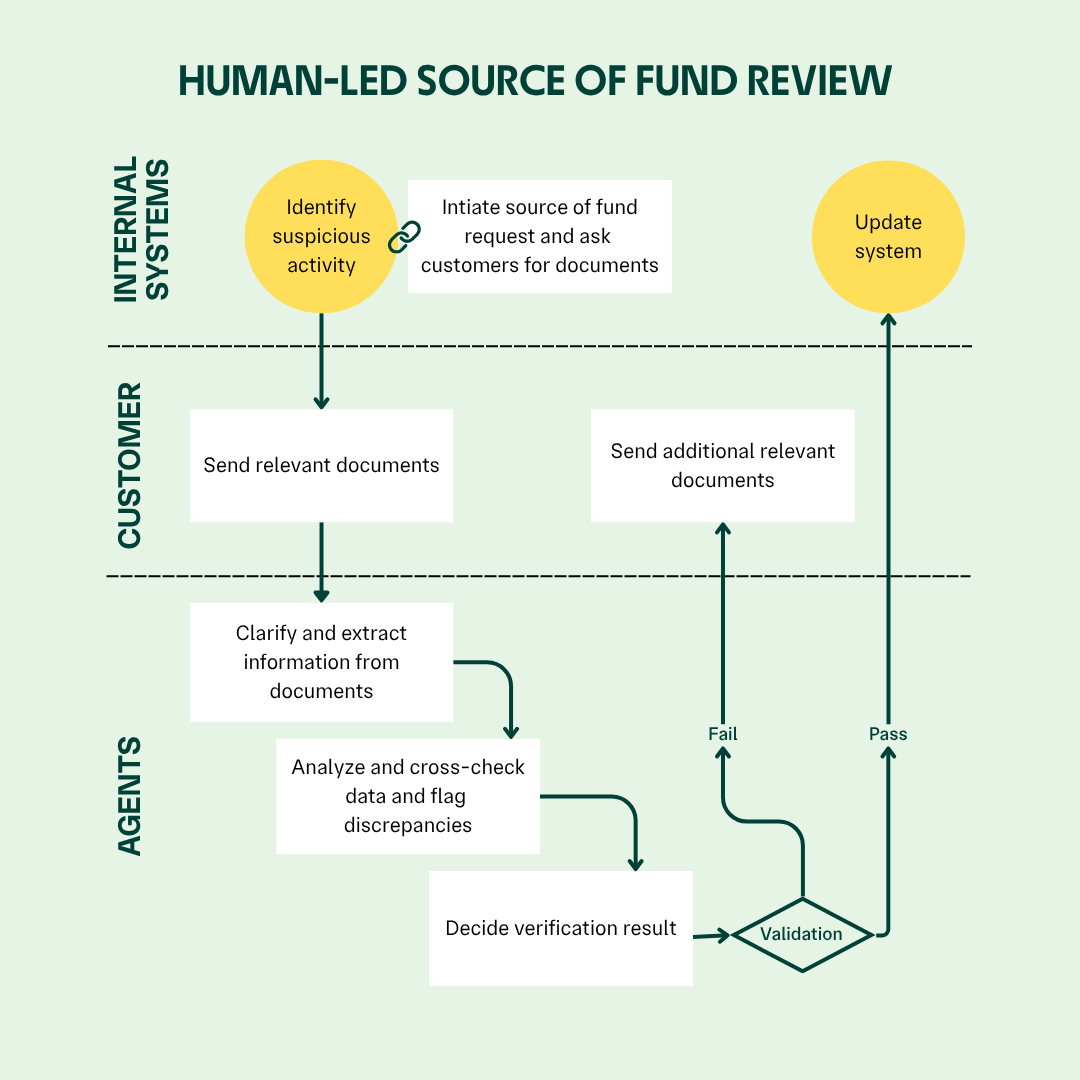
Once again, this is already a proven lane for agentic AI deployments. Reindeer helped a bank with an AML deployment where an agent took over transaction-monitoring alert triage. When sanctions lists and typologies shifted, it reached out to the bank's experts, reconciled the changes, and updated its logic, keeping cases moving without someone standing over it.
Claims and policy operations in insurance
AI in insurance operations concentrates on first-notice-of-loss intake, coverage verification, and exception routing. Handling those exceptions, in particular, is an area where new AI platforms have greatly improved over previous generations.
A single first notice of loss can bundle a phone-call transcript, photos, an adjuster's notes, and a police report, and the work is reading all of it against the policy to verify coverage and route the claim, straight through when it's clean, to an adjuster when it isn't.
WTW's 2026 analytics survey found 14% of P&C insurers process claims straight through today while 36% plan to, and insurers using more sophisticated analytics posted combined ratios six percentage points lower than slower adopters. Intake and operations are production-grade for agents. Underwriting risk models are a separate, longer-established predictive lane.
Fraud detection and credit risk
Fraud scoring and credit-risk models are the most mature AI in banking. Mastercard uses generative AI to double the speed at which it detects potentially compromised cards, and Visa reports blocking $40 billion in attempted fraud on its network in a single year.
For an enterprise buyer this lane is table stakes served primarily by card networks and core banking vendors.
Forecasting and FP&A
Forecasting engines and analytics copilots are broadly deployed and commoditizing quickly.
KPMG's 2026 global finance study of 1,013 senior finance leaders found reported gains led by decision-making speed at 71% and forecast accuracy at 64%. These tools help a person decide faster, drafting variance commentary and flagging outliers in the forecast, and that value is genuine. What they don't move is throughput in the exception queues, where operational cost concentrates.
Customer-facing finance AI
Chatbots, robo-advisory, and personalization engines are deployed across banking and wealth management, but they mature more slowly than any back-office lane because mistakes land directly on customers and regulators watch the interface.
Gartner predicts that by 2028 none of the Fortune 500 will have fully eliminated human customer service, a signal of how much judgment stays in the loop.
This is live deployment on a harder, slower road for most companies.
Capital markets and trading
Algorithmic execution, market surveillance, and trade analytics form a mature specialist domain run at scale by exchanges, market makers, and the largest banks with dedicated quant teams.
AI has operated here longer than anywhere else in finance. It's also not a lane most finance-operations leaders own, so it belongs on the map but not in this evaluation.
What’s making AI work across finance teams
At its operational core, AP and AR, payroll, treasury, financial-crime review, and claims, is document-driven, exception-heavy desk work nearly end to end. That's the work autonomous agents have demonstrated they can run in production.
Budget allocation hasn't caught up with that operational reality. MIT Project NANDA's The GenAI Divide found that enterprise AI budgets favor visible, top-line functions even as the highest measured returns come from back-office automation. Menlo Ventures' 2025 analysis of $7.3 billion in departmental AI spend makes the same point by omission: coding takes 55%, IT 10%, and marketing 9%, while finance and back-office operations don't register as a named category.
A finance leader doesn't have to pick a winning lane. The decision in front of them is which workflow to prove first.
Reindeer's test for picking the first workflow is volume meets complexity: start where the work is heavy and the judgment is dense. Six signals mark the spot.
- High transaction volume
- Knowledge distributed across large teams
- Exception-heavy cases
- Data moving across systems
- Existing logic or policy
- Speed and accuracy that affect customers
Together they describe work where human judgment is the bottleneck, spread thin across many people who each carry a piece of it.
Invoice coding is the classic picture, with its shared inbox, its long tail of small oddities, and the handful of senior analysts who are the only ones able to answer the hard cases.
Why most finance AI dies between demo and production
A vendor demos an invoice agent.
The team runs a proof of concept, and accuracy on the slide deck looks impressive. Six months later the agent is a queue of broken cases nobody trusts.
The picture isn’t pretty. Across enterprise generative AI, The GenAI Divide found 60% of organizations evaluated tools, 20% reached pilot stage, and just 5% reached production, while 95% of organizations report zero return on $30 billion to $40 billion of spend.
Surviving production is mostly a question of what happens after week one, and the evidence points away from the model itself.
But understanding why this happens and how it can be addressed are critical steps in AI transformation.
The key challenge is drift. Finance work moves constantly when coding policies change, supplier formats update, entities get added, regulations move, and thresholds shift. No finance workflow holds still long enough to be automated once and left alone.
Drift is also where understanding the distinctions between tiers of AI matter.
When we look at AI technology across the market, you can break them down into three main buckets. The products might look the same (and even use the same marketing language) but the actual day-to-day functionality gap is one of the reasons many investments fail to reach production or produce ROI.
- AI assistants surface information while the person still does the work
- AI agents execute the work but struggle to reason through edge cases and exceptions
- Autonomous AI systems run the case end to end and escalate by confidence
Exception-heavy finance operations sit, as a class, in territory that calls for the autonomous tier, because in AP, KYC, and claims the exceptions carry most of the cost. Investing in software that can’t learn to handle exceptions or escalate them for human judgement means you’re basically buying a very expensive if-then ruleset.
Reindeer built its platform around that reality, which is why our platform has built-in change management that runs on two learning loops. Every decision an agent makes carries a confidence score, shaped by the case's uniqueness, its complexity, and how far the agent's plan diverges from what it has seen before. Below a threshold the customer sets, the case routes to a subject-matter expert with a precise set of questions, and the answers become part of how the agent handles the next case.
That's the inner learning loop; some regulated customers start the threshold at 100% and tune it downward as trust builds.
The outer learning loop runs across cases. When correction patterns recur, the platform proposes a logic change as one reviewable bundle, regression-tests it against past cases, and waits for an agent manager to approve it. Nothing rewrites itself in the background.
The two loops together are how Reindeer works in production.
When evaluating an AI vendor, ask what happens the first time a coding policy changes after go-live. Demo accuracy measures the happy path, which is the only part visible before deployment. The correction loop decides whether the system is still trusted six months later.
AI in finance case studies
Production proof in finance AI has a consistent shape of one exception-heavy workflow, a small training sample, and going live in weeks.
Papaya Global cut manual payslip review to under 10%
Papaya Global, the global payroll and payments platform, processes payslips arriving from dozens of countries in formats that rarely match. Its case study with Reindeer reports agents mapping more than 10,000 payslips a month, and invoice coding in NetSuite that started from fewer than 50 sample invoices, covered 80% of volume immediately, and now runs 97% automated.
Manual payslip review once consumed roughly half the volume but it’s under 10% today, with uncertain cases flagged to the team. Yael Hoze, Papaya Global's VP of product management, describes handing Reindeer a short description of a messy process and having it "running in a couple of weeks. It's a repeatable process," she said.
A regulated trading platform verifies source of funds 10x faster
Source-of-funds review is the compliance workflow where document chaos peaks. The bank statements, payslips, sale contracts, inheritance documents, and marriage certificates are all floating around, sometimes as phone photos, PDFs, or incomplete submissions.
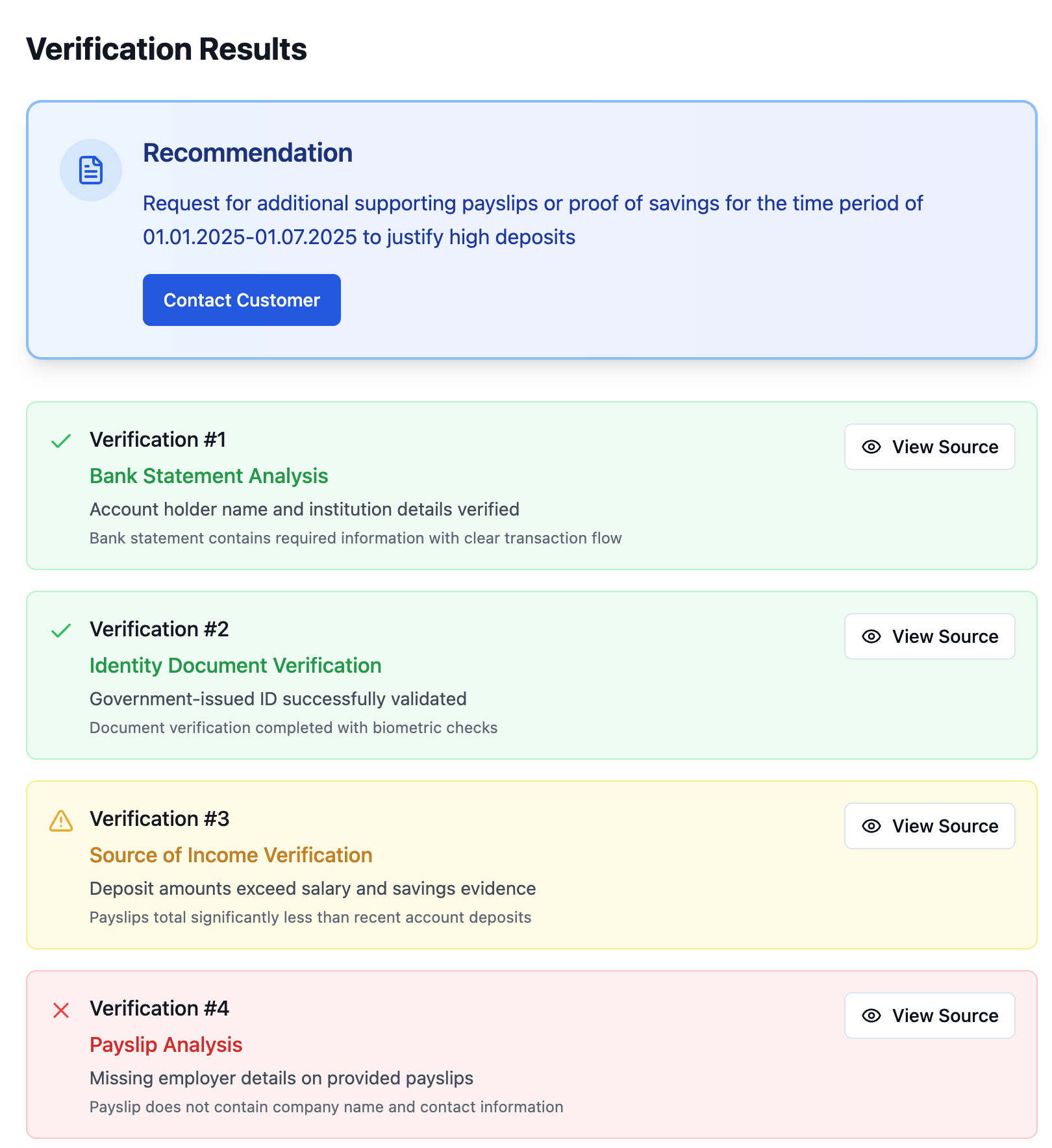
In Reindeer's source-of-funds verification case, a regulated trading platform reached 95% extraction accuracy, above its human reviewers, cut the time to verify cases by 10x, and went live in two weeks on fewer than 50 sample cases.
Outputs are pass-or-fail decisions with written explanations and links back to the source documents, the format a regulator wants to see. The platform's operations lead recalls the old queue flagging a legitimate public figure, temporarily barred from trading because a reviewer didn't recognize the name.
A global financial services firm reached 95% touchless invoice routing
A multinational financial services firm managing complex vendor operations across global entities put Reindeer agents on accounts payable. Reindeer's AI for finance operations page reports an 80% reduction in invoice processing time, 95% touchless invoice routing, and more than 30,000 invoices processed monthly.
The firm's VP of finance operations describes the shift plainly: "Our AP team was spending most of its time on workflow logistics, not finance work. Reindeer's agents took on the routing, coding, and exception handling that used to require constant human attention. Our team is now focused on the judgment calls that actually matter."
The pattern crosses verticals, too. A global CPG company runs three-way invoice matching at global scale, with agents working the matches and escalating the exceptions.
At Hellmann Worldwide Logistics, freight quoting runs on the same division of labor: "Routine requests move through automatically, more complex ones are handled in a copilot mode," says pricing and tender lead Alexander Terglane in the companies' case study, with the team focused on escalations, edge cases, and customer conversations. The approach follows the workflow type rather than any one industry.
Across all of these, the sequence repeats. There one exception-heavy workflow, a sample of cases numbering in the dozens, production in weeks, then expansion after the first workflow earns trust.
How to get started
The territory is wide and the lanes mature at different speeds, but finance's operational core is exception-heavy desk work nearly end to end, so the strategic question is workflow selection. (A multi-quarter data project doesn't have to come first.)
Pick the workflow where volume meets complexity, often the one hiding in a shared inbox, and prove it on a few dozen cases from your own queue, then expand after the first win.
If the workflow you'd prove first is already coming to mind, Reindeer will show you what that workflow looks like running under escalation, trained on your own cases.
Request a demo today to discuss.
Frequently asked questions about AI in finance
How is AI used in finance?
AI in finance runs across four broad areas: market-side models for trading, fraud detection, and credit risk; customer-side chatbots and robo-advisory; analytical forecasting inside FP&A; and operational agents that process invoices, payslips, KYC reviews, and claims. Maturity varies sharply. Fraud models and trading systems are long-established at incumbents, forecasting copilots are widely deployed, customer-facing AI moves slowly because errors land on customers, and autonomous back-office agents now run AP, payroll, and compliance work in enterprise production.
What are examples of AI in finance?
Documented examples of AI in finance include Papaya Global's payslip mapping and invoice coding with Reindeer agents, a regulated trading platform's source-of-funds verification, a multinational financial services firm's touchless AP routing, and Mastercard's generative-AI fraud detection. The strongest examples share one trait: exception-heavy operational workflows run by agents that escalate uncertain cases to a human instead of guessing.
What's the difference between an AI assistant and an AI agent in finance?
An AI assistant surfaces information while a person does the work, an AI agent executes the work but hands exceptions back to the team, and an autonomous system runs the case end to end while escalating by confidence. The difference matters because operations like AP, KYC, and claims concentrate their cost in the exceptions, so a tier that returns every exception to the team returns most of the cost with it. Exception-heavy finance operations, as a class, point to the autonomous tier.
Do you need clean data to start with AI in finance?
No, a data-cleanup program isn't a prerequisite for starting AI in operational finance work. The harder problem in finance operations is that the rules of the work were never in a system: which invoice codes to which GL account under which contract, when a KYC case escalates, how a payslip line maps differently in one country. Those rules live in senior operators' heads and surface one exception at a time. Agents built for this work learn from a few dozen sample cases and from corrections made in the flow of work; Papaya Global's deployment started from fewer than 50 sample invoices. I'd be skeptical of any finance AI proposal that opens with a six-month data-readiness phase.
What's the future of AI in finance?
The future of AI in finance is easiest to read from what production programs already share. Autonomous execution under human escalation, correction loops treated as core infrastructure, and platforms that compound learning across workflows. What's checkable today is that escalation-based operating models measure larger productivity gains than approval-based ones, and that workflow redesign drives the biggest measured impact. Nobody has this market fully figured out, so those are requirements to plan against rather than predictions to bet on.
Your next read



Ready to see it in production?

AI in finance spans very different maturity levels. Fraud detection and trading are already mature, but the operational core, AP, payroll, treasury, compliance, and claims, is where autonomous agents are running in production today, and it's the fastest place for most finance leaders to prove value first.