Reindeer's new COO on the next era of Agentic Enterprise
Dor Haim joins Reindeer as COO as enterprises hit the glass ceiling of traditional process automation, with modern AI Agents surpassing its ability to handle real-world complexity and variability.


The defining question for enterprise AI right now is simple: can it handle the complexity and variability of how real work actually gets done?
For the past decade, enterprise automation has operated within a clear constraint: to automate a process, you first had to standardize it.
- Document all process steps
- Clean the data
- Build rules and hard-code the logic
- Try to account for exceptions
- And pushed the low-exception “happy path” into automation systems
I’ve seen this pattern repeat with every tool in the automation stack- RPA, Workflow, Low-Code/No-Code platforms, integration layers, and BPO models.
These programs delivered real value. They reduced cost, improved cycle times, and freed people from highly repetitive work. The discipline required to do this at scale is significant, and the operators who built these systems deserve credit for the efficiency they created.
But they also exposed a ceiling I’ve seen firsthand across thousands of enterprises, across geographies, industries, and domains all hitting the same limits of traditional automation.
Traditional automation works best when processes are stable, structured, and predictable. Real enterprise work rarely is. It is full of exceptions, judgment calls, changing business rules, regional variations, customer-specific nuances, and institutional knowledge that often lives in the heads of experienced people.
What is changing now is the constraint itself. The latest AI Models and Agents can work with the real shape of enterprise operations, not just the standardized version of them. It can handle the long tail of exceptions, apply context, learn from human input, and adapt as the business changes.
This is exactly why I joined Reindeer as COO. The team is building for enterprise work as it actually exists, not as traditional systems need it to be. That is where the next generation of operational advantage will be created.
What a decade of enterprise automation taught me
I spent most of the past decade inside the enterprise automation space, leading global customer-facing organizations that had to turn the promise of the technology into actual business outcomes.
In those roles, I operated on the side where results matter. Where technology either delivers for the customer or it doesn’t, and where that outcome has to be clearly understood and justified to executives who put large budgets behind the decision.
From that vantage point, patterns become clear quickly. You see which deployments compound into long-term value, and which stall after the initial rollout, often followed by costly operational overhead just to keep them running.
The deployments that drive lasting value are the ones where the technology can absorb the real shape of the customer’s operations, including the parts that couldn’t be fully defined upfront. The ones that stall are the ones that only work when the process stays static, which in enterprise environments, it never does.
Work always changes, but old systems haven’t changed with it
In reality, enterprise work is dynamic by nature. It evolves across customers, regions, products, and time.
Historically, the response has been to prepare work for automation by going deeper on definition, documenting more exceptions, expanding datasets, and encoding more rules to cover every anticipated scenario.
That approach worked within the limits of traditional automation. But it also introduced a scaling problem = you’re trying to model a moving target.
That model breaks down for a few fundamental reasons.
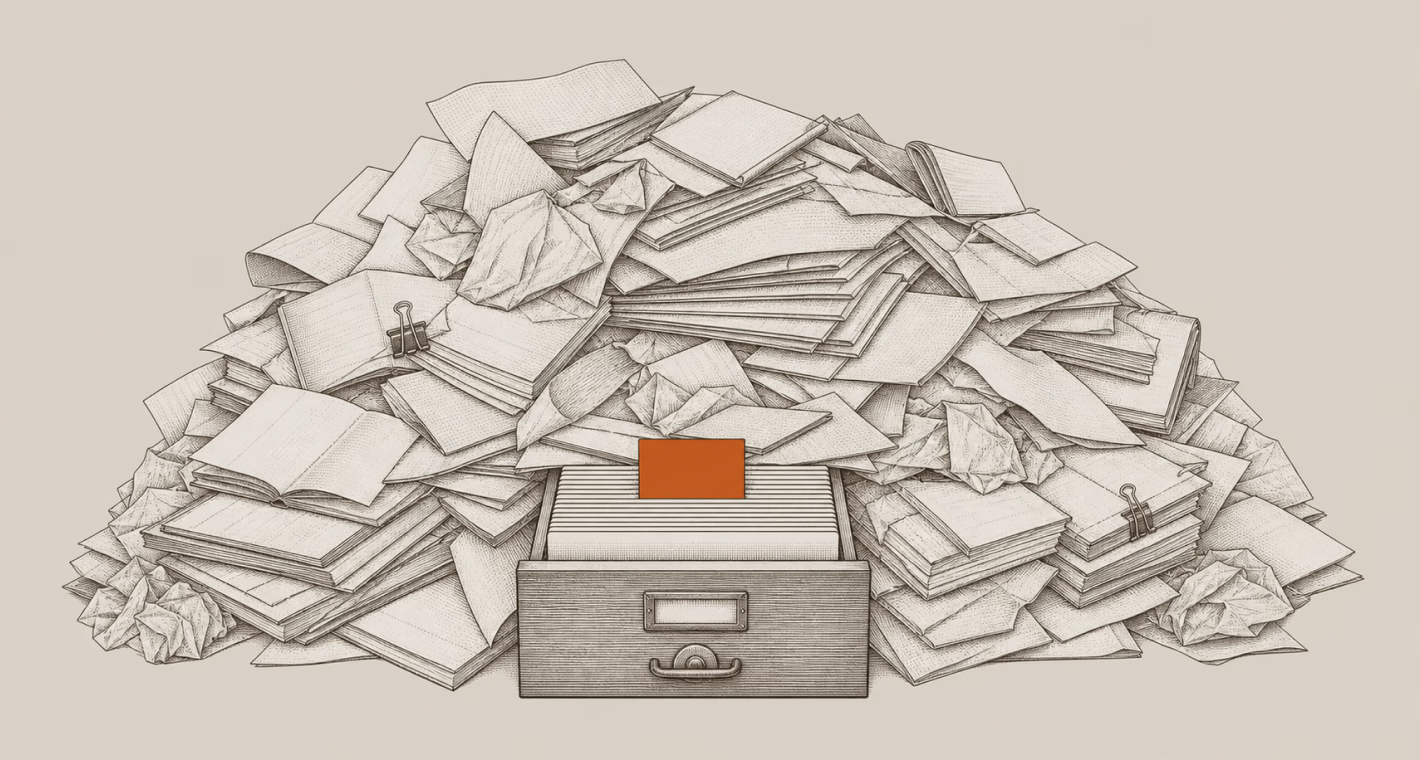
- Enterprise work does not standardize all the way down.
- There is always a tail of variation that resists documentation.
- The tail keeps moving.
- Tomorrow's exceptions will not look like today's.
- Institutional knowledge evolves faster than any historical dataset can capture it.
Over time, the cost of maintaining and updating these systems grows, often eroding the original ROI. No amount of upfront design or historical data can fully anticipate change that hasn’t happened yet.
The answer isn’t more rules or more tools. It’s systems that can operate reliably in real-world conditions, handle variability, learn from new scenarios, and adapt as the business evolves.
What the newest generation of AI enables is a fundamentally different approach to that long tail. Instead of trying to eliminate it, you can operate within it. This is the shift from automation as a one-time project to AI as a system that continuously grows and improves.
Reindeer is building AI that changes for the better as it runs
Reindeer builds AI agents that operate directly within the systems enterprises already use, without forcing teams to redesign processes or change how they work. The fit was clear to me from the first conversation.
Its capabilities map directly to the problems I’ve watched enterprise customers struggle with for years. Reindeer addresses them by:
- Deploying with a small set of real examples, enabling value in weeks without a heavy upfront data effort
- Escalating intelligently when encountering new scenarios, so work continues, and teams stay in control
- Turning every human correction into learning, allowing institutional knowledge to compound inside the system
- Continuously adapting as processes evolve, keeping the system aligned with the business instead of drifting out of date
The result is technology that works with the business as it operates, not one that forces the business to adapt to the tool.
That’s the kind of company I wanted to help build.
The work ahead
Reindeer is built to enable the moment when enterprise AI moves out of pilots and into the core of how businesses operate. This isn't about experimentation; it’s about executing at scale. We help customers and partners turn AI into measurable business impact, driving faster execution, lower operating costs, and more adaptive, resilient operations.
Done right, transformation stops being a slow, one-time initiative that degrades over time. It's an operating model that keeps improving, compounding value, and improving efficiency, decision-making, and performance with each cycle.
Our focus is simple: help enterprises unlock value quickly, scale it across the business, and sustain it over time, turning AI into a core driver of performance, not just another tool in the stack.
I’ll be focused on scaling how we deliver, strengthening our partnerships, and ensuring every agent we deploy translates directly into operational advantage for the business.
If you are leading that kind of work inside your organization, I’d love the conversation.
Connect with me on LinkedIn or reach out to talk to an expert.
Ready to see it in production?